 PledgeBox
A Creator's Guide to Launching Kickstarter Tarot Decks
Discover how to fund and launch successful Kickstarter tarot decks. This guide covers everything from budgeting and audience building to fulfillment.
Discover how to fund and launch successful Kickstarter tarot decks. This guide covers everything from budgeting and audience building to fulfillment.
Launching a tarot deck on Kickstarter is about so much more than just funding an art project. It’s a powerful way for independent creators to connect directly with a passionate, built-in audience, completely sidestepping the traditional publishing gatekeepers. This guide is your roadmap, breaking down the entire journey from that first spark of an idea to getting your finished deck into your backers' hands.
A winning tarot campaign isn't just about beautiful art; it's a journey with three distinct, crucial phases: thoughtful planning, an irresistible live campaign, and finally, smooth fulfillment. Each stage is a building block for the next. Get them right, and you'll turn your creative vision into a real, tangible product that people love.
This guide will walk you through everything, covering the nitty-gritty of niche research, production specs, building an audience before you even launch, and all the post-campaign logistics that can trip up new creators. For a broader look at getting started, you might find our guide on how to start a Kickstarter helpful, too.
The numbers don't lie: the Kickstarter community absolutely loves tarot decks. Since 2009, over 1,200 tarot projects have launched, and they boast an impressive 52% success rate—that’s way higher than the platform's overall average of 38%. This proves there's a huge, eager market for unique, artist-driven decks.
Think of your project in these three main stages.
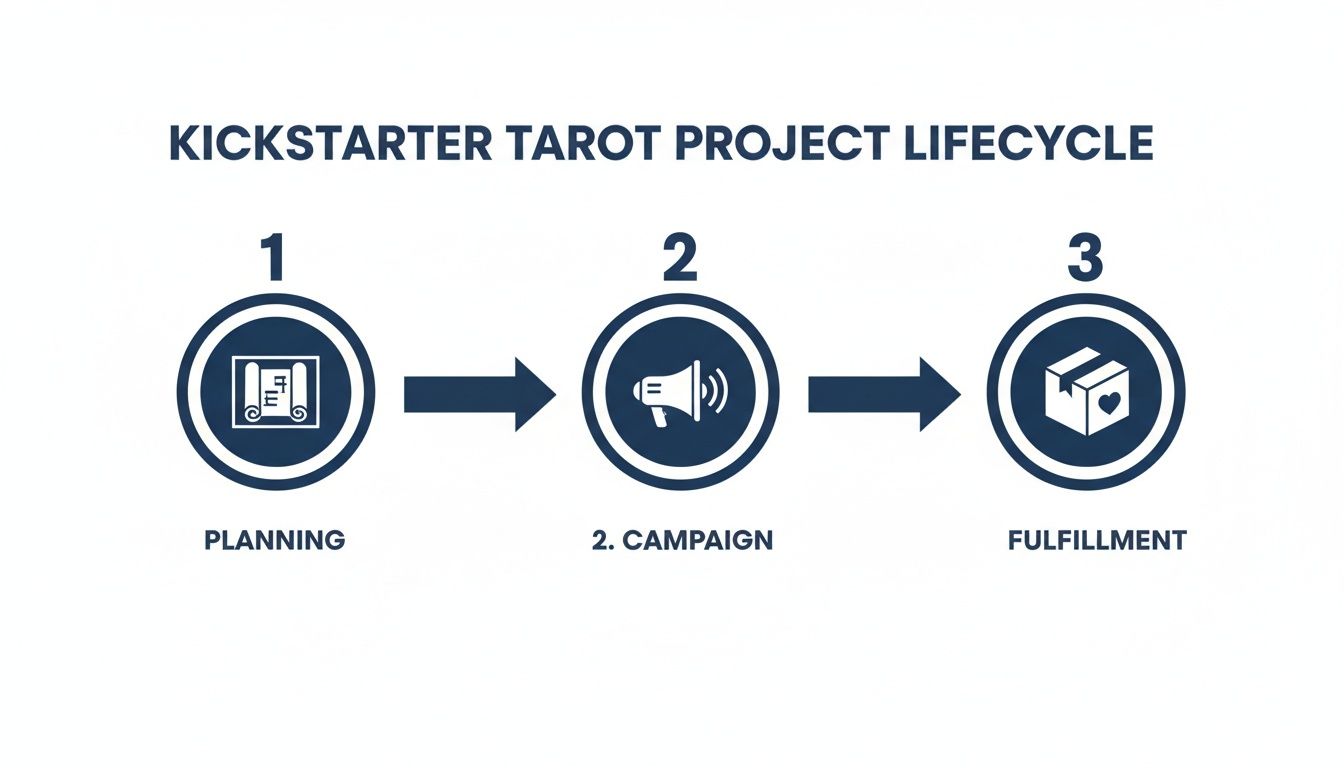
As you can see, the work is far from over when the funding clock runs out. In fact, many creators find that the fulfillment phase is the most challenging part of the whole adventure.
The table below breaks down what each phase is all about.
| Phase | Key Objective | Critical Tasks |
|---|---|---|
| 1. Planning | Validate your deck concept and prepare all campaign assets. | Niche research, budgeting, artist collaboration, prototyping, pre-launch marketing. |
| 2. Campaign | Meet your funding goal and build a community around your project. | Launch promotion, backer communication, stretch goal management, media outreach. |
| 3. Fulfillment | Manufacture the deck and deliver all rewards to your backers. | Pledge management, surveys, production oversight, shipping logistics, customer support. |
Getting a handle on these stages early on is the key to avoiding surprises and keeping your project on track.
Once your campaign is successfully funded, a whole new chapter begins. This is where a powerful pledge manager becomes your best friend, helping you run a smooth, profitable, and low-stress operation. While Kickstarter has a basic survey tool, it’s incredibly limited for a project with physical rewards.
A simple way to think about it is that Kickstarter's pledge manager is like Amazon—a standardized, one-size-fits-all marketplace. A dedicated tool like PledgeBox, however, is like Shopify—it gives you a powerful, customizable storefront to manage your backer relationships and boost your revenue.
A specialized tool lets you handle all the things Kickstarter's system can't, like easily collecting detailed shipping information, letting backers update their addresses, and offering profitable add-ons and upgrades after the campaign ends.
And the best part? It's more affordable than you might think. For example, PledgeBox is free to send the backer survey and only charges 3% on any funds raised through upsells. This makes it a completely risk-free way to seriously improve your post-campaign workflow and profitability.
Before you can even think about launching a hit Kickstarter tarot deck, you need an actual, manufacturable product. This journey starts by finding your unique voice in what's become a surprisingly crowded market. Your art style is more than just a creative decision—it's the marketing engine that will attract your audience and make your campaign pop.
Dive deep into the current landscape. Spend some time on Kickstarter exploring recently funded tarot projects. What themes are pulling backers in? Are they loving the minimalist, nature-inspired vibes of decks like The Wild Unknown, or are they throwing their money at bold, story-rich decks with deep lore? The goal isn't to copy what's trending, but to find the gap where your personal vision can truly stand out.
Once you’ve nailed down your artistic direction, it’s time to get practical and translate that vision into hard production specs. These details will dictate how your deck feels, how long it lasts, and its perceived value. More importantly, they directly control your manufacturing costs. Trust me, tarot enthusiasts are a discerning bunch, and they notice these things.
Here’s what you need to lock down:
Every special feature adds to your per-unit cost. It’s a constant balancing act between your creative dreams and your budget. The best way forward is to get multiple quotes with different combinations of features to find that perfect sweet spot between premium quality and profitability.
You absolutely cannot launch a campaign for a physical product without a physical sample in your hands. A professional prototype is non-negotiable. It's your only way to truly check color accuracy, feel the cardstock, and assess the overall quality. Plus, it's going to be the star of your campaign photos and videos.
Finding a manufacturer can feel daunting, but places like Alibaba are a good starting point, as are crowdfunding communities where creators share recommendations. When you start reaching out, have a detailed spec sheet ready to go. Clearly list your card size, stock, finish, and any special features you want. This level of detail not only gets you accurate quotes but also signals to manufacturers that you’re serious and know what you're doing.
Once your deck concept is locked and you're talking production, knowing how to negotiate effectively with suppliers becomes a crucial skill for keeping costs in check without sacrificing quality.
The sample approval process is your final, critical checkpoint. First, you'll get a digital proof, and then the real deal: a physical prototype. Go over that sample with a fine-tooth comb. Look for printing errors, weird color shifts, or alignment issues. This is your last chance to fix mistakes before you commit to a full production run of 500 or 1,000 units, so don't be shy about being meticulous.
Getting the visuals right is everything, and you can learn more about how art and design can be the key to your Kickstarter success in our other guide. Approving a flawless sample is the only way to ensure the final product you ship will be something your backers absolutely love.
A successful Kickstarter campaign doesn't just happen on launch day. The real magic comes from the meticulous financial planning and dedicated audience-building you do for months leading up to it. Think of your budget as the project's skeleton and your pre-launch audience as the momentum needed to get funded—fast. Get these two right, and you're turning a creative spark into a real, viable business.
But before you can even think about finding your audience, you need to know exactly what your funding goal should be. This means getting brutally honest with a detailed budget that leaves zero room for nasty surprises.
Your funding goal is so much more than just the cost of printing your decks. It’s the all-in number that guarantees you can produce, pack, and ship every single reward without going into the red. I've seen too many promising projects fail after they get funded simply because they underestimated costs. Don't be one of them.
Your budget absolutely must include:
A classic rookie mistake is pricing a pledge based only on the manufacturing cost. You have to factor in everything else—fees, shipping supplies, and that all-important contingency buffer—to land on a pledge price that actually leaves you with a profit.
Once you have these numbers nailed down, you can set a funding goal that truly covers your expenses for a minimum order, which is typically 500 decks. This financial clarity is the foundation of a confident, well-run campaign.
With your budget locked in, it's time to shift gears to marketing. Your number one pre-launch mission is to build an email list of people who are genuinely excited to back your project the second it goes live. A strong start creates a snowball effect, as Kickstarter's algorithm loves to promote projects with early momentum.
A simple landing page is your best friend here. Use a service like Mailchimp or ConvertKit to create a page that shows off a few gorgeous images of your deck, shares a bit of your story, and has a crystal-clear call-to-action to sign up for launch alerts.
Social media is where you'll find your tribe and send them to that landing page. Platforms like Instagram and TikTok are visual goldmines for a project like this. Share behind-the-scenes peeks at your art process, reveal new cards one by one, and run polls to make your followers feel like they're part of the deck's creation.
It's also worth noting that the market for Kickstarter tarot decks is becoming beautifully diverse. There's been a huge shift, with female-led campaigns making up 68% of successful projects since 2016 and raising $9.2 million collectively. This points to a real hunger for inclusive and innovative decks, which is a powerful insight as you position your own project. You can dive deeper into these trends in the Crowdfundr Insights Tarot Report.
Engaging with existing online tarot communities on Reddit or Facebook can also be a game-changer. Just don't show up and spam your link. Genuinely participate in conversations, share your love for tarot, and offer real value. When the time is right, you can introduce your project to an audience that already knows and trusts you.
Do this right, and on launch day, you won't be shouting into an empty room. You'll be speaking directly to a community that's been waiting to hit that "back this project" button.
The heart of that connection is your story. Why this deck? What spark of an idea, artistic vision, or unique perspective drove you to create it? You have to share the "why" behind your project with real honesty. People connect with people, not just products. A compelling, personal video is your best friend here—it puts a face to the project and builds instant trust in a way that text and images alone just can't.
You need to guide visitors through your page without overwhelming them. Think of it as telling a story where each section builds on the last, answering their questions before they even have to ask. You have to start strong, hitting them with your most stunning visuals and a clear, concise hook that immediately explains what makes your deck one-of-a-kind.
Your page absolutely must be a visual feast, loaded with professional mockups and crisp photos of your prototype. When it comes to crowdfunding a tarot deck, the visual presentation is everything. It's worth taking the time to review some essential design tips for visual appeal to make sure your graphics are hitting the mark.
A solid page structure that works time and again usually flows like this:
This logical flow makes it easy for backers to find what they need and feel confident hitting that "Pledge" button.
This is where the magic happens—turning interest into funding. Your pledge tiers need to be simple, clear, and feel like a great deal. The biggest mistake creators make is offering too many options, which just leads to confusion and abandoned pledges. Stick to a few well-thought-out tiers for different kinds of backers.
A classic and highly effective tactic is the early-bird tier. Offering a limited number of decks at a discount for the first 24 or 48 hours is a proven way to ignite that all-important day-one momentum.
Don't be afraid to bundle rewards for higher-tier pledges. For example, a deluxe tier might include the deck, a custom-designed altar cloth, a cool enamel pin, and a signed art print. These bundles don't just increase your average pledge amount; they make backers feel like they're getting a truly special, exclusive package.
Stretch goals are your secret weapon for keeping the energy high long after you’ve hit your initial funding goal. But be warned: they have to be planned with military precision. The wrong stretch goals can add logistical nightmares that can sink an otherwise successful project.
Good stretch goals are upgrades that improve the final product for every single backer. Think upgrading the cardstock from 330gsm to a premium 350gsm, adding a magnetic closure to the box, or upgrading the guidebook from a PDF to a professionally printed booklet. These add value for everyone without creating multiple versions of the product you have to track and ship.
The history of Kickstarter tarot decks is full of incredible success stories. A true standout is The Wild Unknown Tarot, which launched way back in 2012 and raised a jaw-dropping $118,512 from 3,310 backers, blowing past its $15,000 goal. This campaign proved there was a massive hunger for artist-driven, non-traditional tarot decks and really opened the floodgates for the indie tarot scene. You can still see the original Kickstarter project page and see how they did it.
Congratulations, your Kickstarter tarot deck is funded! The confetti has settled, the initial rush has peaked, and now the real work begins. This post-campaign phase is what separates the successful creators from the overwhelmed ones, and it all comes down to mastering logistics.
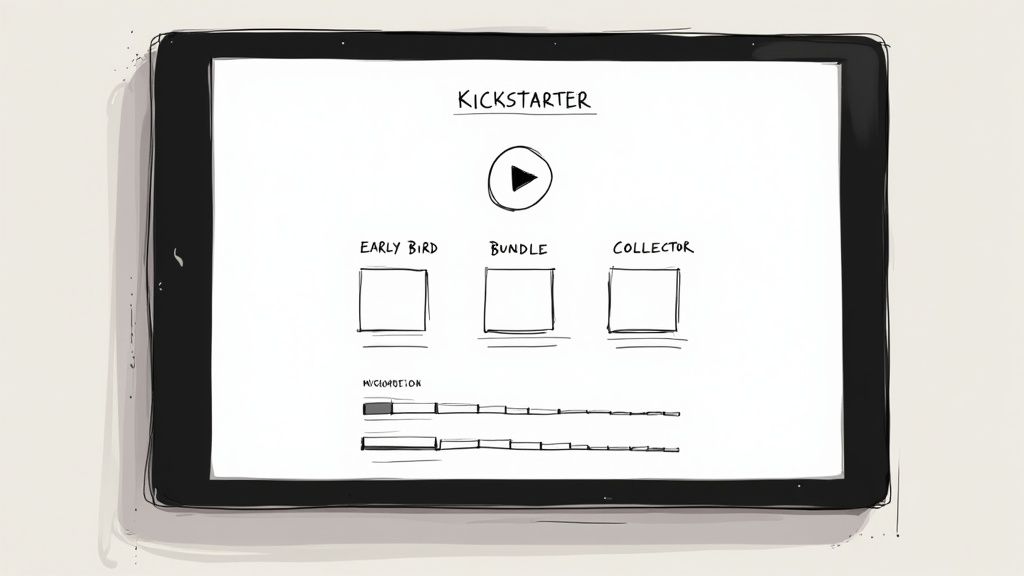
The first, most critical tool you’ll need is a pledge manager. While Kickstarter has its own survey tool, trying to manage a complex physical product like a tarot deck with it is a recipe for disaster. Frankly, it’s a basic, inflexible system designed for the simplest projects imaginable.
Think of it this way: Kickstarter’s pledge manager is like Amazon. You find a product, pay for it, and it's sent to a single address—a standardized, one-size-fits-all marketplace. A dedicated pledge manager like PledgeBox, on the other hand, is like Shopify. It gives you a powerful, customizable storefront to manage your backer relationships, offer upsells, and boost your revenue long after the campaign ends.
Kickstarter’s own surveys are painfully rigid. Once a backer hits "submit," their information is locked. They can't easily change their address, and you can't offer them any cool extras. For a project that will take months to manufacture and ship, this is a massive headache waiting to happen.
This is where a real pledge manager saves the day. It becomes the central command for everything that happens after your campaign, giving you the flexibility you need for a smooth fulfillment process.
The core function of a pledge manager is to bridge the gap between campaign funding and final delivery. It automates the messy, time-consuming tasks of collecting addresses, calculating precise shipping fees, and managing add-ons, saving you countless hours of spreadsheet work.
A robust system lets you handle everything from late pledges (for people who missed the campaign) to complicated orders with tons of add-ons.
One of the biggest wins of using a pledge manager is the ability to offer upsells and add-ons after the campaign ends. This is an incredibly effective way to boost your project's profitability. In a relaxed, shop-like environment, backers can add extra items like altar cloths, prints, or enamel pins to their order.
The business model for these tools is also incredibly creator-friendly. For example, PledgeBox is free to send the backer survey and only charges a 3% fee on funds raised from these upsells. This means you get a professional survey and management tool at no upfront cost, paying only a tiny slice of the extra money you generate.
Let's break down exactly what you get with Kickstarter's basic tool versus a dedicated platform. The difference is night and day.
| Feature | Kickstarter's Pledge Manager | PledgeBox |
|---|---|---|
| Backer Surveys | Basic, one-time submission | Customizable, with automated reminders |
| Address Changes | Not supported; requires manual chaos | Easy self-service portal for backers |
| Add-Ons & Upsells | Not supported post-campaign | Fully supported, a major revenue booster |
| Shipping Fees | Estimated during the campaign | Collected based on actual weight & location |
| Late Pledges | Not supported | Pre-order storefront for new backers |
| Cost | Included in Kickstarter fees | Free for surveys; 3% on upsell funds |
This simple comparison shows why nearly every serious creator of Kickstarter tarot decks uses a third-party solution. It’s not just a convenience—it’s a smart business decision that protects your profits and makes your backers happier. For a much deeper dive, our guide on the Kickstarter post-campaign survey breaks down the entire process.
With a pledge manager ready to go, you can confidently tackle the fulfillment workflow. First up: send out those backer surveys to lock in final shipping addresses and give everyone a last chance to grab add-ons.
While your backers are filling out their surveys, you'll be coordinating with your manufacturer to get production rolling. This means approving the final proofs and giving them the green light for the mass production run. Keep your backers in the loop! Regular, honest updates are the key to keeping everyone excited and trusting.
Once production wraps up and the decks are headed to you or your fulfillment center, it's time to pick a shipping partner. Look into services like Pirate Ship for smaller campaigns or dedicated fulfillment centers like ShipBob or Fulfillrite for larger ones. These partners can handle all the picking, packing, and shipping, which will save you a staggering amount of time.
Finally, you’ll need to navigate the world of international shipping, including customs and VAT. Be crystal clear with your international backers that they are responsible for any import duties. A good pledge manager can help you collect estimated VAT for regions like the UK and EU, preventing delivery nightmares for your backers and legal headaches for you.
Even with the best-laid plans, jumping into the world of Kickstarter tarot decks for the first time is bound to leave you with some lingering questions. I get it. This final section is all about tackling those common "what ifs" and "how do I's" that every creator faces.
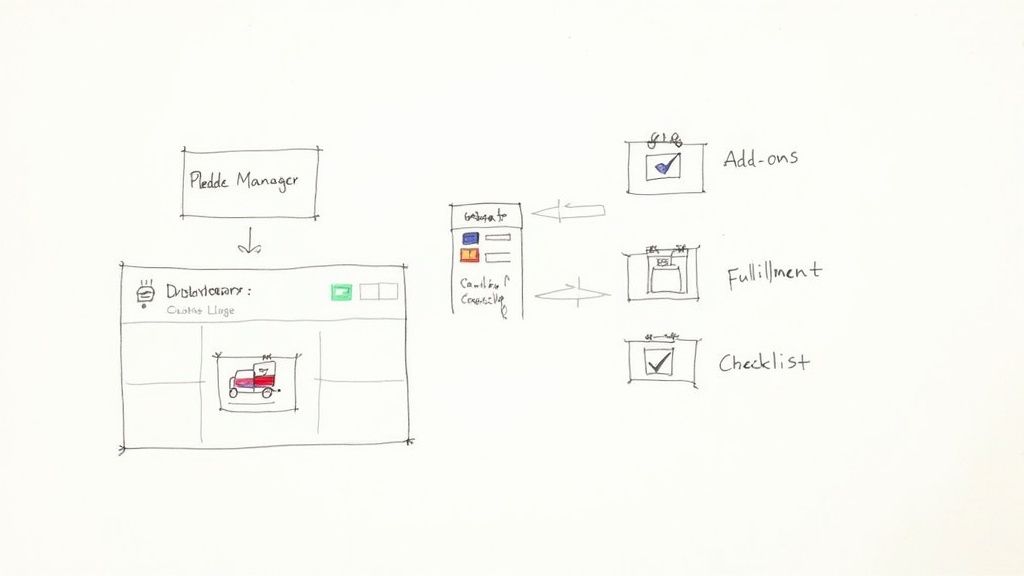
Think of this as a quick-reference guide for those tricky details that can really make a difference. Let's get these last few uncertainties cleared up so you can launch with total confidence.
This is the million-dollar question, isn't it? The upfront, out-of-pocket costs can range from a few hundred dollars to several thousand, especially if you're commissioning artwork. Before you even think about launching, you’ll need cash for a physical prototype (expect $100-$500) and some basic marketing, like good photos or a simple video ($200-$1,000+).
But your Kickstarter funding goal is a different beast entirely. It has to cover everything:
For most first-timers, a realistic funding goal lands somewhere in the $5,000 to $15,000 range.
Hands down, it's underestimating shipping and fulfillment costs. I've seen it happen time and time again. Creators pour their hearts into the art and get a great manufacturing quote, but they completely misjudge the real-world cost of postage, packaging materials, and labor—especially for international orders.
This is exactly why pledge managers are non-negotiable for serious projects. Kickstarter's pledge manager is like Amazon—a one-size-fits-all marketplace. A dedicated platform like PledgeBox is more like your own Shopify store. It lets you charge accurate, real-time shipping fees after the campaign ends, based on each backer's specific location and the final weight of their package. This one move can single-handedly save your project's entire profit margin. PledgeBox is free to send the backer survey and only charges 3% of any upsell funds, if there are any.
Yes, but be smart about it. Add-ons are a brilliant way to bump up your average pledge value and give your community more ways to support you. The trick is to offer items that are lightweight and don't complicate your packing process. Think stickers, enamel pins, altar cloths, or art prints—things you can easily slip into the same mailer as the deck.
Steer clear of bulky or fragile items that demand their own separate, expensive packaging. The best way to handle this is through your pledge manager, where backers can browse and add items after the campaign rush is over. It keeps your Kickstarter page clean and often leads to more sales because backers aren't overwhelmed.
Remember, a service like PledgeBox is free to send the backer survey and only charges 3% of the upsell funds raised from these add-ons. This makes it a risk-free way to significantly boost your post-campaign revenue.
Navigating international taxes feels scary, but your best tool is transparency. Be crystal clear on your campaign page that international backers are responsible for any customs fees or import taxes their country might levy. No surprises!
For regions like the EU and UK, you'll likely need to collect Value Added Tax (VAT) upfront. Many creators work with a fulfillment partner who has warehouses in those regions to handle this. The easier route? A good pledge manager can be set up to automatically calculate and collect the estimated VAT from backers in those specific countries. Proactive communication is everything here—it ensures your backers have a smooth experience and aren't hit with an unexpected bill when their deck arrives.
Ready to streamline your campaign and maximize your success? With PledgeBox, you get a powerful, all-in-one toolkit designed for Kickstarter creators. From building a pre-launch audience to managing post-campaign surveys, add-ons, and fulfillment, we make the entire process easier so you can focus on creating. Learn more and get started for free at PledgeBox.com.
PledgeBox
The All-in-One Toolkit to Launch, Manage & Scale Your Kickstarter / Indiegogo Campaign