 PledgeBox
Kickstarter Stretch Goals That Drive Funding
Unlock campaign momentum with our guide to Kickstarter stretch goals. Learn to plan, announce, and fulfill goals that excite backers and boost funding.
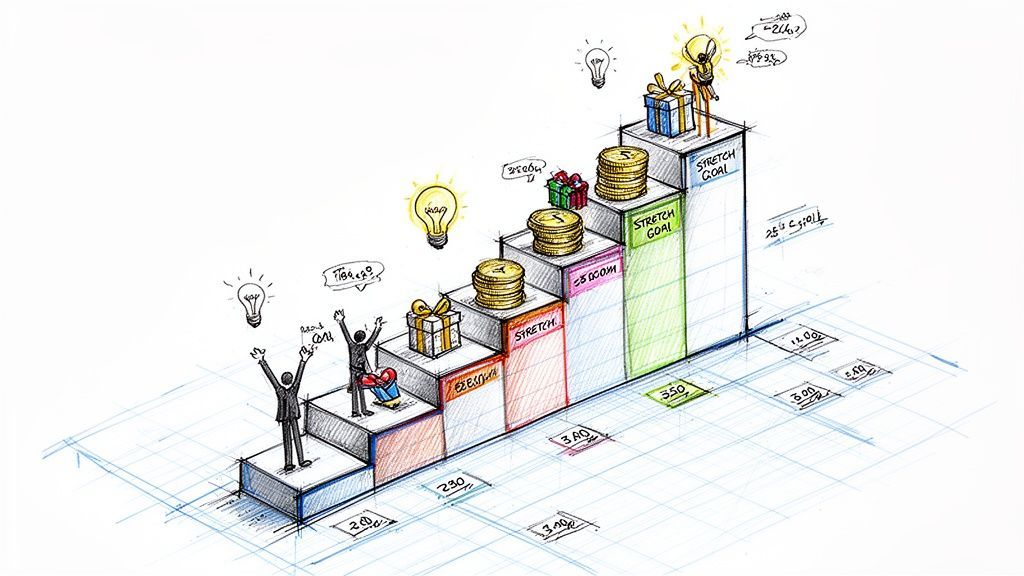
Unlock campaign momentum with our guide to Kickstarter stretch goals. Learn to plan, announce, and fulfill goals that excite backers and boost funding.
If you've ever watched a Kickstarter campaign take off, you know the real magic starts after the initial funding goal is met. That's where Kickstarter stretch goals come in. Think of them as bonus targets that, once hit, unlock exciting new features, better components, or extra goodies for everyone who backed the project.
They’re your secret weapon for keeping the energy high, encouraging backers to raise their pledges, and turning your campaign into a must-watch event.
Stretch goals are what separate a good campaign from a legendary one. They’re the lifeblood that transforms a simple funding drive into a full-blown community celebration. When you announce a stretch goal, you’re not just offering more stuff; you're inviting your backers to become part of the journey.
This gives them a powerful reason to share the project and bring in new people, creating a feedback loop of excitement and growth. Every unlocked goal feels like a win for the whole community, fostering a sense of shared accomplishment. It's less about the transaction and more about being on a team that's creating something amazing together.
While most stretch goals are tied to cold, hard cash (like unlocking a new game character at $50,000), the most successful creators mix things up with community-based goals. These are milestones that don't depend on funding alone.
Some great examples include:
This dual approach keeps the campaign moving, even when funding slows down. It directly rewards engagement, making every backer feel important, whether they pledged $10 or $1,000. We dive deeper into structuring these in our guide on the not-so-secret weapon of stretch goals.
To help you decide what's right for your campaign, here’s a quick breakdown of the common models.
This table gives you a snapshot of different stretch goal types, helping you match an approach to your campaign's unique needs and community vibe.
| Goal Type | Primary Metric | Key Benefit | Best For |
|---|---|---|---|
| Funding-Based | Total Pledged ($) | Drives higher pledge amounts and campaign revenue. | Campaigns with clear production cost tiers (e.g., better materials, new molds). |
| Backer Count | Total Backers (#) | Encourages community growth and attracts new, smaller pledges. | Projects where a larger community adds value (e.g., online games, community forums). |
| Social Shares | Shares, Likes, Follows | Boosts organic marketing reach and visibility at no cost. | Creators looking to build a long-term social media following beyond the campaign. |
| All-in-One | Mix of Metrics | Maintains momentum by offering multiple ways to contribute. | Complex campaigns, especially in tabletop games, that benefit from both funding and engagement. |
Ultimately, a hybrid approach often works best. It gives your community multiple ways to rally and push the project forward, keeping everyone excited from day one to the final countdown.
Let's be clear: well-planned stretch goals are a powerful engine for funding. It’s not uncommon to see campaigns blow past their initial targets. In fact, the average successful campaign raises a stunning 640.1% of its original funding goal. The games category, which has pulled in over $2.63 billion in pledges, is a masterclass in this strategy. You can discover more insights about how top creators use stretch goals to fuel their campaigns.
The key is to see stretch goals not as a pre-order list, but as a bonfire. You are inviting people to join you, and the celebration grows with every person who brings their energy. This mindset is what separates a transactional campaign from a memorable community experience.
Once the confetti settles, you have to manage all those unlocked goals and add-ons. This is where a dedicated pledge manager becomes non-negotiable. Think of it this way: Kickstarter's pledge manager is like Amazon—standardized and rigid. A powerful pledge manager like PledgeBox, on the other hand, is like Shopify; it gives you a branded, customizable storefront to manage your backers like a pro.
Best of all, PledgeBox is free to send the backer survey and only charges 3% of upsell if there's any. This makes it a completely risk-free way to organize complex rewards, collect accurate shipping fees, and offer more add-ons without any upfront cost.
Here’s a hard truth: your stretch goals can make or break your campaign, and the most critical decisions happen long before you ever click "launch." Get the planning right, and you'll build incredible momentum. Get it wrong, and you might accidentally create a logistical nightmare that tanks your entire project.
The secret is to brainstorm goals that genuinely add value without sending your project spiraling into scope creep. Think of natural, exciting extensions of your core product. Upgraded materials, a new colorway, or bonus digital content are fantastic. What you want to avoid are complex new features that demand a total re-engineering of your product. That’s a fast track to delays and costs you never saw coming.
Once you fund, stretch goals are what keep the energy high. They feed into your promotion, which drives more funding, which unlocks more goals. It's a powerful cycle.

Think of stretch goals not just as rewards for your backers, but as fuel for the campaign engine. They create a self-sustaining loop of community excitement and financial growth.
The single biggest mistake I see creators make is massively underestimating the true cost of their stretch goals. A simple-sounding upgrade, like adding custom-molded plastic tokens to a board game, has a domino effect of hidden costs.
You have to dig deeper than the per-unit price and account for everything:
A creator once admitted to me that they got so caught up in the excitement, they almost committed to a stretch goal that would have bankrupted the project if they'd hit it. It was a huge wake-up call. You must budget with a healthy buffer.
This is where you have to be the responsible business owner, not just the excited creator. Always run the numbers for a stretch goal at scale, not just the cost of one unit. For a full breakdown on this, check out our guide on how to craft a Kickstarter project budget.
The timing of your goals is just as important as what they are. Space them too far apart, and you'll hit long, quiet lulls where momentum dies. Put them too close together, and you might blow through all of them on day one, leaving nothing to talk about for the next 29 days.
Here’s a good starting point: set your first stretch goal at around 150% to 200% of your funding target. This gives the community a clear, achievable milestone to rally behind right after the initial "Funded!" celebration. From there, you can space subsequent goals out in slightly larger increments to keep the challenge fresh.
Remember, stretch goals are all about keeping your community engaged and excited to "stretch" beyond the original vision.
As you plan, don't forget the less glamorous side of things. All this extra funding has tax implications. It's always a smart move to have a quick chat with professional Tax Accountants to make sure you're setting aside what you need and keeping your budget clean.
Once the campaign confetti settles, the challenge shifts to managing all the rewards you've unlocked. Using Kickstarter's built-in survey system is functional, but it's a bit like using a one-size-fits-all tool. A dedicated pledge manager, on the other hand, gives you a powerful, customized storefront to manage your backer community properly.
This is exactly where a tool like PledgeBox shines. You can send your backer survey for free—there's no cost to simply gather everyone's information. The platform only earns a small 3% fee on any extra profit you generate from upsells. It’s a completely risk-free way to handle the complexity of unlocked stretch goals, add-ons, and shipping.
Hitting a stretch goal is a huge win, but your work isn't done. The real momentum comes from how you share that news. A smart announcement strategy can take a simple funding update and turn it into a viral moment that builds community and attracts new backers.
The trick is to frame every milestone as a shared victory. Your language is critical here. Instead of a dry "Stretch Goal Unlocked," go for something like, "We did it! Your incredible support just unlocked the next level!" This simple shift turns backers from passive observers into active partners who are genuinely invested in the project's success.

This feeling of shared ownership isn’t just about making people feel good; it drives real results. Campaigns that inspire this kind of audience participation consistently outperform those that don't, sometimes by double-digit percentages. When backers feel like they’re all working together, they get a powerful sense of shared accomplishment. You can see more on how this psychological trigger works to boost campaigns.
Your campaign page is the main stage, so use it to show powerful forward motion. One of the best tools you have is a simple graphic that shows your list of goals, clearly marking some as 'UNLOCKED' and others as 'LOCKED.'
This visual roadmap is incredibly effective for a few reasons:
I once saw a creator brilliantly theme their goals around a "God of Upgrades." Backers started roleplaying in the comments, making the whole thing fun and interactive. It also gave the creator amazing, direct feedback on which upgrades were most popular—a huge leg up over a rigid, pre-planned list.
One creator I know put it perfectly: a crowdfunding campaign is like lighting a bonfire. You’re inviting people to join you, and after the party, they get to take a piece of the fire home. It's a shared experience, not just a pre-order.
This is the mindset you need. It’s what separates a forgettable transaction from an event people will be talking about for years. Your announcements need to carry that same celebratory, community-first spirit.
Don’t just post updates on your Kickstarter page. Shout your success from the rooftops on every channel you have to keep the momentum going. A consistent communication rhythm is vital, especially when you're getting close to smashing a goal.
To get the most out of your updates, follow this cadence:
Building this hype is a massive part of the pre-launch phase. For more on this, check out our guide on planning your Kickstarter pre-launch strategy.
Once the campaign ends, managing all those unlocked rewards is the next puzzle. Kickstarter's built-in survey tool gets the job done, but a dedicated pledge manager gives you so much more power. Think of it this way: the Kickstarter pledge manager is like Amazon—standardized and limited. A tool like the PledgeBox pledge manager is your own Shopify—a powerful, custom storefront for your backer community.
Best of all, PledgeBox is free for sending your backer survey. The platform only takes a 3% fee on the upsell revenue you generate if there's any, making it a completely risk-free choice. This lets you handle complex rewards, collect accurate shipping fees, and offer more add-ons, turning your post-campaign logistics into another way to grow your project.
That feeling when your campaign ends successfully is incredible. But once the confetti settles, the real work begins. Now you have to deliver on every promise you made—including all those amazing Kickstarter stretch goals you and your backers unlocked together.
As your campaign grows, so does its complexity. It’s tempting to think you can manage it all with a simple spreadsheet, but trust me, that's a path paved with headaches. Manually tracking reward tiers, unlocked options, add-ons, and thousands of different shipping addresses is a nightmare waiting to happen. This is the moment a dedicated pledge manager stops being a "nice-to-have" and becomes absolutely essential.

Think of it this way: Kickstarter’s pledge manager is functional, but it's rigid. It's designed for simple, one-size-fits-all campaigns and can't handle the dynamic nature of stretch goals, add-ons, or complex shipping calculations. It’s like Amazon—standardized and limited in its customization.
A real pledge manager, on the other hand, is like getting your own custom storefront built just for your backer community. The PledgeBox pledge manager is more like Shopify; it gives you the control and flexibility you need to manage complex fulfillment without losing your mind.
This approach allows you to:
By putting all this information in one place, you replace chaos and a high risk of errors with a single, reliable source of truth.
A great pledge manager does more than just organize your data—it can actually make you more money. The post-campaign survey is the perfect time to offer upsells and add-ons to your biggest fans. Your backers are already excited about the project, and many will happily add an extra item or two to their order if you make it easy.
This is where a tool like PledgeBox really shines. PledgeBox is completely free for sending your backer surveys, meaning you can get organized without any upfront cost. There are no hidden fees or per-backer charges just to collect the info you need.
The platform only takes a 3% fee on the upsell revenue you generate if there's any. This model makes it a no-risk choice for creators. If you don't sell any extra add-ons, you don't pay a thing.
This turns the chore of fulfillment into a smart business move. You can easily open up late pledges for people who missed the campaign, sell leftover inventory, and give backers a clear, simple way to upgrade their pledge or add more cool stuff.
Let's say you unlocked three stretch goals: an alternate art box, a set of metal coins, and an exclusive miniature. With a spreadsheet, you’d be wrestling with dozens of columns, trying to figure out who gets what.
With a pledge manager like PledgeBox, the whole process is straightforward and mostly automated:
This smooth workflow saves you countless hours of admin work and dramatically cuts down on costly shipping mistakes. It frees you up to focus on what really matters: making a fantastic product and getting it into the hands of your happy backers.
One of the smartest things you can do is learn from the hard-won battles of other campaigns. Even the most experienced creators trip up sometimes, but by understanding where the common traps lie, you can steer clear before they become a post-campaign nightmare.
Think of this as your pre-flight check. Spotting these weak points in your stretch goal plan now will save you from massive headaches, evaporating profits, and a comments section full of disappointed backers later on.
By far, the most dangerous mistake is getting the math wrong on your goals. When a campaign is picking up steam, it's incredibly easy to get swept up in the excitement and promise a cool upgrade without running the numbers. Jamey Stegmaier, the creator of Scythe, has been open about how during his first campaign for Viticulture, he almost added a stretch goal that would have bankrupted the entire project if they had hit it.
Let that sink in. Adding something that seems simple, like a new set of custom tokens, isn't just about the per-unit manufacturing cost. You absolutely have to factor in new molds, extra assembly labor, the increased weight of the final package (which bumps up shipping for every single backer), and the added complexity for your fulfillment partner.
"I got caught up in the excitement...and added a stretch goal that likely would have sunk the campaign if we had reached it. It was a big wake-up call that I needed to budget much more carefully (and with a healthy buffer)." - Jamey Stegmaier, Stonemaier Games
Your backers are smart, and they can spot a low-effort "fluff" goal a mile away. These are the kinds of goals that don't add any real, tangible value to the product they’re excited about.
Don't fall into the trap of offering weak goals like these:
Truly meaningful Kickstarter stretch goals make the product better, enhance the experience, or add exciting new content. A goal that fails to generate real buzz is worse than having no goal at all—it can kill your campaign's momentum flat.
Clarity is everything. If a backer has to squint and spend five minutes figuring out your stretch goal map, you've already lost. I remember one creator who got a little too clever during the Scythe campaign, waiting 24 hours after a goal was hit to reveal the funding target for the next one. It just created confusion and irritated the very people who were trying to support him.
Contrast that with the brilliant approach from the "Almighty" campaign. The creator introduced the "God of Upgrades," a fun character that backers could appeal to in the comments section. This not only created an incredible community vibe but also gave the creator direct, real-time feedback on which upgrades backers wanted most. It swapped a rigid, pre-planned structure for a flexible, community-driven one.
Once the campaign is over, managing all those unlocked choices is the next hurdle. This is where a proper pledge manager isn't a "nice-to-have," it's essential. Kickstarter's built-in surveys are like Amazon—standardized and restrictive. A tool like PledgeBox is your project's Shopify—a powerful, custom storefront just for your backers.
What's more, PledgeBox is free to send your backer survey and only charges 3% of the revenue you generate from upsells if there's any. This risk-free model lets you organize complex rewards, collect shipping, and manage fulfillment without any upfront cost, helping you dodge those costly post-campaign mistakes.
To help you stay on track, we've put together a checklist of these common pitfalls and how to proactively avoid them.
| Common Mistake | Potential Impact | Proactive Solution |
|---|---|---|
| Under-costing Goals | Lost profits, potential project bankruptcy, cutting corners on quality to compensate. | Get firm quotes for manufacturing, molds, and freight. Add a 10-15% buffer to all cost estimates for unforeseen issues. |
| Offering "Fluff" Goals | Backer apathy, slowed funding momentum, perception of a low-value campaign. | Focus on goals that add tangible value: component upgrades, new content, or enhanced artwork. Ask your community what they want! |
| Confusing Structure | Backer confusion and frustration, reduced sharing and excitement for what's next. | Create a clear, visual map of your goals. Reveal goals in a logical sequence that's easy for anyone to understand at a glance. |
| Scope Creep | Overwhelming production complexity, significant delays, increased error rates in fulfillment. | Plan all potential stretch goals before launch. Stick to your plan and resist the urge to add unplanned goals mid-campaign. |
| Poor Post-Campaign Management | Shipping errors, incorrect reward fulfillment, backer frustration, damage to your brand reputation. | Use a dedicated pledge manager like PledgeBox to handle surveys, add-ons, and shipping calculations cleanly. |
By keeping these points in mind, you can turn your stretch goals from a potential liability into one of your campaign's greatest assets, driving excitement and funding from day one all the way to fulfillment.
Even the most buttoned-up stretch goal plan comes with a few lingering "what ifs." This is where we get into the nitty-gritty, moving from strategy to the practical questions that pop up for every creator. Let's clear up some of the most common ones so you're ready for anything.
My rule of thumb? Always plan for more goals than you think you’ll ever need. A campaign can catch fire when you least expect it, and the last thing you want is to be seen scrambling to invent new goals on the fly. It looks unprofessional and, worse, leads to rushed decisions and costly mistakes.
The best way to handle this is to map out a full sequence of potential goals before you launch. But on your campaign page, only reveal one or two at a time. This keeps your backers focused on the immediate target and builds suspense. I also recommend having a "dream goal" tucked away—a truly ambitious unlock for that best-case, went-viral scenario.
First, take a breath. This is a common worry, but let's remember the real mission: getting your project funded. If you hit your main goal, you’ve already won. Stretch goals are the cherry on top, not the whole cake.
If funding stalls before you unlock any extras, your job is to celebrate the core victory. Remind your backers that they are the ones making your project a reality. The key is to position your core product as a complete and fantastic offering on its own. The stretch goals were just exciting possibilities, not essential features. Your goal is to make every backer feel fantastic about getting you across the finish line.
Your project's value should never depend on hitting stretch goals. The core product must stand on its own as an amazing reward. The extras are just that—extras.
Technically, yes. Should you? Almost never. Adding unplanned Kickstarter stretch goals mid-campaign is a massive red flag for backers. It signals that you didn't do your homework and can throw your project into chaos. The pre-launch phase is precisely for figuring this stuff out.
Here’s why improvising is so risky:
Stick to the plan you carefully crafted before you hit "launch." Your future, less-stressed self will thank you for it.
Once the confetti settles, the real work begins. You're no longer a fundraiser; you're a project manager. Trying to track all the unlocked stretch goal choices, add-ons, and shipping addresses in a spreadsheet is a recipe for disaster.
This is where a pledge manager stops being a "nice to have" and becomes an absolute necessity. While Kickstarter’s built-in survey tool is a starting point, it's a one-size-fits-all solution that can’t handle real complexity.
Here's an easy way to think about it: Kickstarter's pledge manager is like Amazon—it’s standardized and gets the basic job done. A dedicated tool like the PledgeBox pledge manager is more like Shopify; it gives you a powerful, fully customizable storefront to manage your backers, their choices, and even your post-campaign sales.
The best part is how it's priced. PledgeBox is free to send your backer survey and only charges 3% on any new funds you raise through add-ons or upgrades if there's any. This means you can organize all your backers, collect shipping info, and let them finalize their rewards with zero upfront cost. You only pay a small fee on the extra money you make, making it a no-brainer for protecting both your profits and your sanity.
With a solid plan and the right tools, stretch goals transform from a source of stress into your campaign's most powerful growth engine. To see how you can make your post-campaign life infinitely easier, check out PledgeBox and discover a smarter way to manage your backers.
PledgeBox
The All-in-One Toolkit to Launch, Manage & Scale Your Kickstarter / Indiegogo Campaign