 PledgeBox
Kickstarter's Four Windows
Every Kickstarter campaign is really four campaigns stacked end to end. The catch is that each one's window opens well before the stage it belongs to — and most creators find that out one stage too late.
Most creators shop for tools one at a time. A landing page builder for prelaunch. A spreadsheet once the campaign is live. A pledge manager after it ends, usually chosen in a hurry the week funding closes.
It works, roughly. You end up with four logins, three sets of numbers that don't reconcile, and a recurring discovery: the thing you needed should have been set up two weeks ago.
That last part is the real problem, and it isn't a tooling problem. It's a timing one. Every window on Kickstarter closes before the stage it belongs to. Your prelaunch list is decided before your page goes live. Your mid-campaign traffic is booked before the slump arrives. Your add-on revenue is determined by choices you made while the campaign was still running.
Here are the four windows, what each one actually decides, and when it shuts.
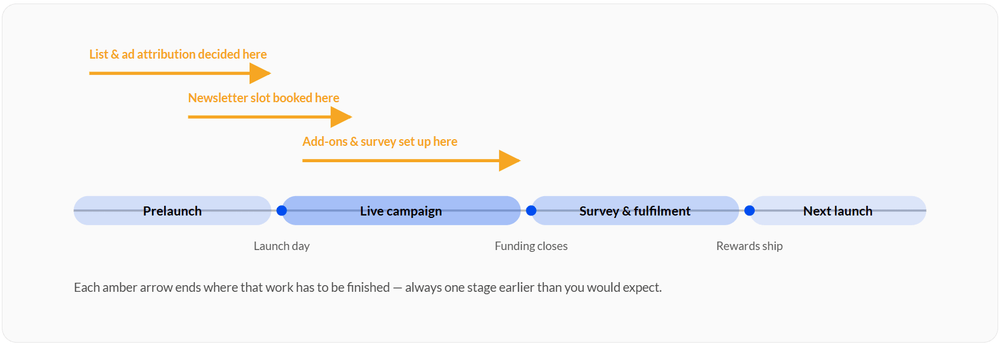
Every window opens early and shuts early. The work that decides a stage happens during the stage before it, which is why "we'll sort that out after the campaign" is the most expensive sentence a Kickstarter creator can say.
The list is built before anyone can see your page
By the time a Kickstarter page flips to Coming Soon, the decisions that matter are already behind you. You've submitted for review. Your landing page has been collecting emails for weeks. The ad spend that filled it has already been spent, well or badly.
Which means the prelaunch window doesn't open when you go Coming Soon. It opens months earlier, and it's the one creators most often start too late.
Two things determine whether launch day converts:
How big the list is. Drag-and-drop prelaunch pages get you collecting in an afternoon instead of waiting on a developer. One creator told us they had theirs live in under an hour.
How well you can tell who will actually pledge. Smart tracking and filtering separate genuine intent from people who'll take any free thing. A list of 5,000 tourists converts worse than 800 people who've clicked three times.
Where the good ones came from. Native Meta, Google Ads and Mailchimp integration means you can see which spend produced which subscriber — and stop funding the channel that only delivers volume.
There's a second, quieter prelaunch job most creators skip: finding out whether the product survives contact with real users. Backer Tester puts your product in the hands of vetted backers before launch and brings back structured feedback. Testers carry a star rating earned by actually filing useful reports, so you're not shipping units to people who'll never respond.
Thirty days you cannot get back
Every campaign has the same shape: a spike, a long flat middle, a smaller spike at the end. The middle is where campaigns are lost, and by the time you feel it, your options have narrowed to whatever you set up in advance.
Running a live campaign on the Kickstarter dashboard alone is flying with one instrument. Campaign Manager puts rank, traffic sources, pledge velocity and backer trends on one screen, so you can tell the difference between "the algorithm cooled off" and "our best-performing ad set stopped delivering" — two problems with completely different fixes.
Urgency controls, reward limits and early-bird tiers give you something to pull mid-campaign instead of watching and hoping.
A backer referral program turns people who already pledged into a distribution channel. Automated ambassador rewards, no manual tracking.
Newsletter Boosting is the outside traffic. Our newsletter reaches700,000+ Kickstarter backers(plus 100,000+ on Indiegogo) — an audience that has already backed something, which is a very different thing from an audience that merely clicks.
The day funding closes is a revenue event
Funding closing is not the end of the campaign. It's the beginning of the only stage where you can still increase what each backer spends — and the stage where the most money quietly leaks away.
Three leaks, all of them fixable:
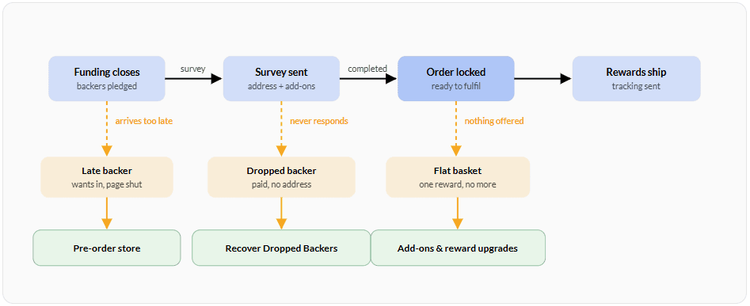
Three leaks between funding and fulfilment. Dashed amber is money already pledged that walks away; solid amber is what brings it back. All three are configured before the survey goes out, not after.
Around those recoveries sits the survey itself, and the difference between a good one and a bad one is mostly friction. A branded survey on your own domain reads as your company rather than a third-party form. An AI setup wizard imports your campaign data and proposes the settings instead of making you build them. Tax and VAT calculate and collect automatically by backer location, which is the single most tedious part of international fulfilment. Address verification catches the typos before they become reshipments.
Then it connects onward: Shopify, shipping vendors, shipping notifications, digital download delivery, invoices generated on their own.
What it costs you to get it wrong
Post-campaign fulfilment is one of the largest hidden costs of running a Kickstarter campaign. Between platform fees, payment processing and setup charges, a meaningful slice of what you raised can disappear before a single reward ships.
Most pledge managers charge a campaign fee — a percentage of the money you already raised on Kickstarter, taken for work that happens after. PledgeBox doesn't. There is no fee on your original funds. The only platform fee is 3% of what the survey itself generates: add-ons, shipping, tax. If your survey only collects addresses, it costs nothing at all.
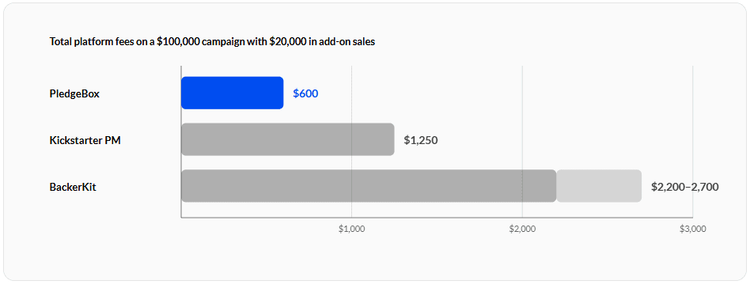
The gap is the campaign fee. BackerKit's charge lands on the $100,000 you already raised; Kickstarter's own pledge manager takes 5% and counts shipping and tax inside the fee base. PledgeBox charges 3% of add-on revenue and nothing else. Figures from published rates.
| Platform | Campaign fee | Add-on fee | Notes |
|---|---|---|---|
| PledgeBox | $0 | 3% | Instant payouts via Stripe / PayPal |
| BackerKit | ~1.5–2% | 3.5% | Plus a setup fee |
| Kickstarter PM | None | 5% | Shipping & tax inside the fee base |
| Gamefound | None | 5% | Plus $0.20 per transaction |
Stripe and PayPal processing is billed separately at their own standard rates and goes directly to them. Because payouts are instant, backer payments land in your connected account with no holding period and no intermediary.
One more line item worth checking: your email tool. InBox is built for Kickstarter campaigns rather than adapted from a generic marketing tool — drag-and-drop campaign builder, click and conversion analytics, and a connection to your own Amazon SES account. Which means no per-email fees and no sending limits imposed by a middleman.
One workflow instead of four
None of the four windows is technically hard on its own. What makes Kickstarter campaigns expensive is that the four stages are usually run by four different tools that don't know about each other — so the prelaunch list never reaches the survey, the campaign data never informs the add-ons, and every handoff is a spreadsheet export.
Everything above lives in one place, natively connected, free to start.
That $227.8M is money creators earned after their campaigns closed — add-ons, upgrades and late pledges that would otherwise never have been sold. Anker, EcoFlow and Bambu Lab run on it, Kickstarter lists PledgeBox as a Trusted Expert, and Stripe has verified the payment path.
Start at whichever window is open
You don't have to begin at prelaunch. Connect a campaign at any stage and use the parts that apply — there's no campaign fee either way.