 PledgeBox
kickstarter crowd funding: Launch & Grow Your Campaign
kickstarter crowd funding: Plan, launch, and manage your campaign with backer insights, timelines, and proven post-campaign success strategies.
kickstarter crowd funding: Plan, launch, and manage your campaign with backer insights, timelines, and proven post-campaign success strategies.
Think of Kickstarter as a way for a community to collectively commission a project they really believe in. At its heart, it’s a platform where creators pitch their cool ideas and backers pledge money to help bring them to life. The whole system is built on an all-or-nothing model, meaning if a project doesn’t reach its funding goal, nobody pays a dime.
The Kickstarter process is a collaborative journey that boils down to three key players. Each one has a specific job to do, and understanding these roles is the first step to really getting how the platform works.
First up, you have the Creator—the person with the big idea. This could be anyone from an inventor with a new gadget to an author with a novel or a designer with a new board game. The creator is the one who builds the campaign page, sets the funding goal, and is ultimately on the hook to deliver what they promised if the campaign succeeds.
Next, you have the Backers. These are the folks who browse through projects and pledge money to support the ones that catch their eye. Backers aren't just buying something; they're early adopters and patrons who provide the financial fuel to get a project off the ground. In return, they usually get rewards, like early access to the product or special editions.
Finally, there’s Kickstarter itself. The platform acts as the bridge connecting creators with a global community of potential backers. Kickstarter provides the entire framework for hosting campaigns, processing payments, and keeping everyone in communication, which builds a trusted space for this unique kind of commerce.
To make things crystal clear, here’s a quick breakdown of the core concepts and the people involved.
These pieces all fit together to create a dynamic and exciting funding environment where ideas can get the support they need to become a reality.
The whole thing kicks off when a creator submits their project for review. Once it's approved, they launch their campaign, which typically runs for a set time—usually 30 to 60 days. During this live window, the creator is hustling to promote their project and attract backers.
The core mechanic is simple but powerful: if the funding goal is met by the deadline, the project is successful. If it falls short, no funds are collected from backers, and the project doesn't move forward. This all-or-nothing approach keeps the risk low for everyone.
The impact of this model has been massive. Since its launch, Kickstarter has helped fund over 651,000 projects, with backers pledging more than $8.5 billion to bring creative ideas to life. It just goes to show the incredible power of community support. To see how a campaign works from start to finish, check out our detailed look at everything Kickstarter.
What many first-timers don't realize is that post-campaign management is a huge—and critical—phase. This is where pledge managers come in. While Kickstarter gives you a basic survey tool, think of the Kickstarter pledge manager like Amazon. A dedicated pledge manager like PledgeBox, on the other hand, is like Shopify, giving you way more control and flexibility.
With PledgeBox, it's free to send the backer survey and they only charge 3% of upsell if there's any, making it a powerful, risk-free way to manage your project after the funding clock runs out. You can learn more about the scale of crowdfunding and its success rates over on Statista.
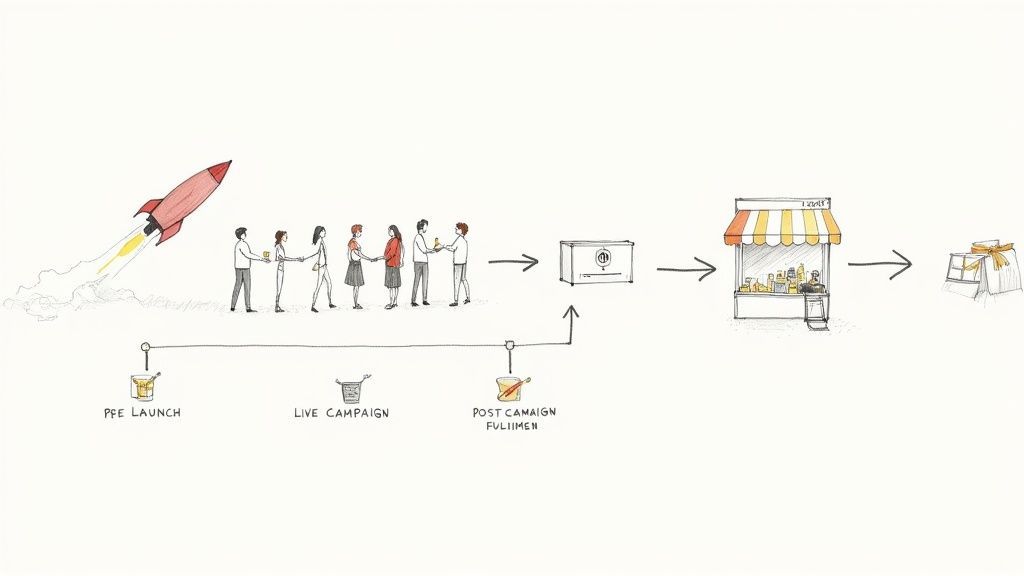
A successful Kickstarter campaign isn't just a 30-day sprint—it's more like a well-planned marathon broken down into four key stages. Each phase comes with its own set of challenges and opportunities. Nailing each one is what turns a cool idea into something real that you can hold in your hands.
To make sure every stage runs smoothly, it's a good idea to develop a robust go-to-market strategy long before you even think about hitting "launch."
This visual guide neatly sums up the simple, yet powerful, flow of a Kickstarter campaign. It shows exactly how a creator's idea finds its audience and gets the funding it needs.
As you can see, it's a partnership: the creator supplies the vision, Kickstarter provides the stage, and backers bring the support that makes it all possible.
The campaigns that look like an overnight success almost never are. The real magic happens months before the launch button is ever pressed. This pre-launch phase is all about building an audience before you need them. Your main goal here is to whip up excitement and collect a list of eager backers who are ready to pledge the second you go live.
Here’s what you should be focused on:
Once you launch, you're in the most intense phase of the whole journey. For the next 30-60 days, your job is to keep the energy high, engage with your growing community, and drive those pledges. That initial flood of support from your pre-launch email list is crucial—a strong start often creates a snowball effect that pulls in new backers who see your project trending.
Constant communication is everything during this time. Regular updates keep your backers in the loop and emotionally invested in the project's success. This is also the perfect time to roll out stretch goals—extra goodies or features unlocked at higher funding levels—to keep the momentum going and encourage more pledges.
You did it—you're funded! But don't pop the champagne just yet. This next part is where you manage backer expectations and gather all the info you need to actually send them their stuff. And this is exactly where a dedicated pledge manager becomes a lifesaver.
Kickstarter's built-in survey tool is fine, but it’s pretty basic. Think of the Kickstarter pledge manager like Amazon; it gets the job done, but you don't have much flexibility.
A powerful pledge manager like PledgeBox, on the other hand, is like Shopify. It gives you total control to manage your backers, collect all the details you need, and even bring in some extra cash.
With PledgeBox, it’s completely free to send the backer survey. You can easily collect shipping addresses, let backers pick their reward options, and sort out even the most complicated orders. The platform only takes a small 3% fee on upsell revenue if you decide to offer add-ons, which makes it a no-risk way to boost your total funding after the campaign has officially ended.
The final stretch is all about making good on your promises. This means coordinating with manufacturers, wrangling logistics, and shipping rewards to backers across the globe. Honesty and transparency are your best friends here. Delays happen, but keeping your backers informed with straightforward updates will maintain their trust and goodwill.
Nailing this stage is what turns one-time backers into loyal fans who will be first in line for your next project. It's the last step in your Kickstarter journey and the one that cements your reputation as a creator who delivers.
Think of your Kickstarter campaign page as your project's digital storefront. It’s your sales pitch, your project portfolio, and your personal story all wrapped into one powerful package. In the world of kickstarter crowd funding, this page is your single most important asset. A great page doesn't just list facts; it tells a compelling story, builds trust, and turns a curious browser into a committed backer.
The first thing anyone sees is your video. You absolutely need one. Campaigns with a killer video have a much, much higher success rate, and for good reason. Keep it short and sweet—the sweet spot is 2-3 minutes long—and focus on the why. Share your personal journey, explain the problem you’re solving, and most importantly, show your product in action. Don’t just tell people it’s great; prove it.
Once the video grabs their attention, the project description is where you seal the deal. You need to make this section incredibly easy to read. Use headings, short paragraphs, and plenty of high-quality visuals to break up the text and guide the reader's eye down the page. Start with a hook—a powerful opening sentence that makes them want to know more.

Speaking of visuals, amazing product photos are non-negotiable. If a professional photoshoot is out of budget, consider leveraging AI product photography to create stunning, professional-grade images that make your product look irresistible without breaking the bank.
A truly great description anticipates and answers questions before a backer even thinks to ask them. Make sure you clearly cover:
Being transparent with your budget is a huge trust-builder. When you show backers exactly where their money is going, it signals that you're professional, organized, and have a solid plan.
Your reward tiers are where the magic happens—it's the direct call to action. Getting them right is both an art and a science. The biggest mistake creators make is offering too many choices. It leads to analysis paralysis. Stick to a sweet spot of 5 to 8 tiers.
The idea is to create a clear value ladder that gently nudges backers to pledge a little more. Here are a few battle-tested strategies that just work:
Think of your campaign page as a conversation with a potential backer. Every element—from the video to the timeline—should work together to build a strong case for your project, making it easy for them to say "yes" and click that 'Back this project' button.
At the end of the day, a page that converts is authentic, transparent, and visually engaging. You're not just selling a product; you're selling a vision and a promise. When backers connect with your passion and feel confident you can deliver, they won’t just give you their money—they’ll become your biggest cheerleaders.
Launching a Kickstarter campaign with zero backers feels like opening a store to an empty street. It's a ghost town. Those first few pledges are always the toughest to land, but they're also the most critical for getting your kickstarter crowd funding effort off the ground.
Securing your first 100 backers is the secret sauce. It builds momentum, signals to Kickstarter's algorithm that your project is worth watching, and creates the social proof you need to pull in a much larger audience. A strong start isn't just a nice-to-have; it often begins long before you hit the launch button.
This initial wave of support is what gives your project velocity. A campaign that funds quickly is far more likely to get featured by Kickstarter, attracting the kind of organic traffic that can make a project go viral.
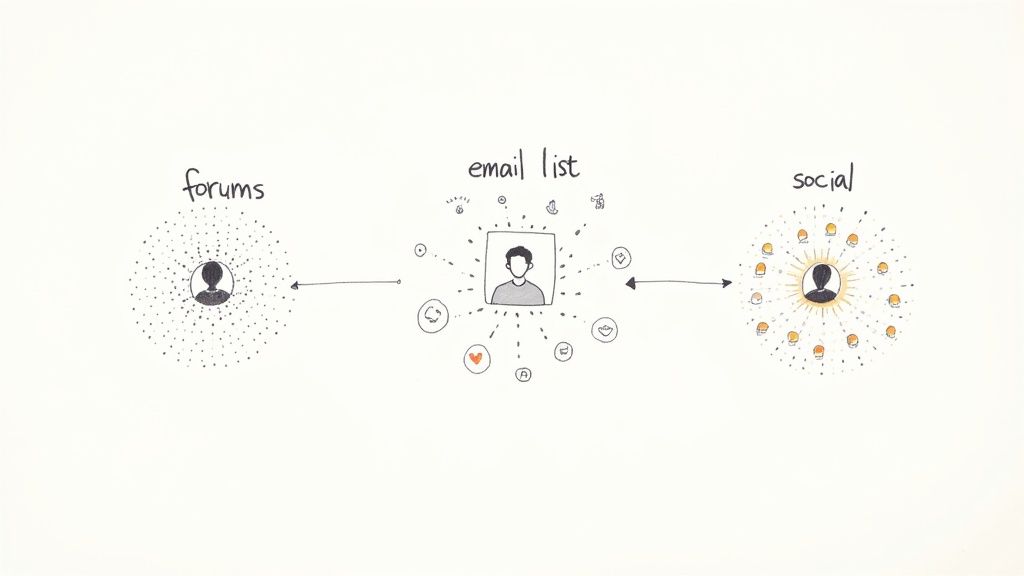
Before you can rally your troops, you need to know who you're looking for. Don't fall into the trap of targeting "everyone." Instead, get specific and create a detailed backer persona—a fictional profile of the person who is going to absolutely love your project.
This isn't just about demographics. You need to dig deeper into their world.
Ask yourself these kinds of questions:
When you truly understand your ideal backer, you can craft a message that speaks directly to them, making your campaign feel like it was designed with them in mind.
Your single most powerful asset for locking in those first 100 backers is your pre-launch email list. This isn't just a random collection of email addresses; it's a hand-picked community of people who've already raised their hands and said, "I'm interested!"
Your job is to get this community warmed up so they're ready to jump on your campaign the second it goes live. You can learn more about how to build a list of potential backers before your campaign launches to guarantee a powerful start.
A pre-launch list is your day-one superpower. A good rule of thumb is to build a list that's at least 10 times larger than the number of backers you need to hit your goal. If you need 200 backers, you should be aiming for an email list of at least 2,000 engaged subscribers.
Set up a simple landing page that teases your project and gives people a compelling reason to sign up. Maybe it's an exclusive early-bird discount or a special bonus reward. Once that's ready, start driving traffic to it from all those online communities you identified earlier.
Knowing the general landscape of Kickstarter can also give you a huge advantage. As of November 2023, the platform has a massive community of over 22.6 million unique backers. What's really interesting is that 34.5% of them are repeat supporters, which tells you there's a loyal, built-in audience that trusts the process.
Looking at the demographics, the largest group of users is between 25 and 34 years old (37%), followed closely by the 35 to 44 age group (28%). That means a whopping 65% of all Kickstarter users are young to middle-aged adults who are comfortable with technology and excited to get behind new ideas.
By tailoring your messaging to connect with this core audience, you can significantly boost your campaign's performance from day one. You can dive deeper into these crowdfunding statistics and trends on BloggingWizard to get an even clearer picture.
Hitting your funding goal on Kickstarter is an incredible feeling, but it’s really just the starting line. What comes next—collecting backer info, sorting out shipping, and actually delivering rewards—is where your reputation is truly made.
This post-campaign phase can either be a smooth, organized operation or a total logistical nightmare that destroys backer trust. This is exactly why a dedicated pledge manager isn't just a nice-to-have; it's your most valuable post-campaign asset.
Getting funded is one challenge; fulfillment is a completely different beast. You're suddenly responsible for gathering precise order details, calculating tricky shipping fees, and keeping potentially thousands of backers in the loop. Trying to juggle all that with spreadsheets and basic survey tools is asking for trouble.
To really get why a pledge manager is so important, let's use an analogy. Think of the Kickstarter pledge manager like Amazon—it gets the job done, but that’s about it. It’s a simple, one-size-fits-all system designed to collect an address and maybe a basic reward choice. Fast, but rigid.
On the other hand, a powerful pledge manager like PledgeBox is like Shopify. You get total control to create a custom, branded experience for your backers. You’re not just gathering data; you're opening a post-campaign marketplace where you can deepen relationships and even increase your funding.
Here's a quick look at how they stack up.
As you can see, it’s not even a close comparison. The right tool turns post-campaign management from a simple chore into a serious opportunity to generate more revenue.
Now for the really cool part. PledgeBox lets you send the backer survey completely for free. You can collect shipping addresses, reward choices, and any other info you need without spending a dime. This removes any financial risk, which is a huge deal for creators running on a tight budget.
The platform's standout feature is its built-in upsell system. Inside the survey itself, you can offer your backers a curated menu of add-ons, upgrades, and other goodies. For instance, a board game creator could offer exclusive miniatures, an art book, or an expansion pack. This doesn't just give backers more of what they love—it can bring in a significant amount of new funding long after the campaign clock has stopped.
PledgeBox is built on a performance-based model that aligns perfectly with a creator's goals. It only charges a small 3% fee on the new funds raised through these upsells. If you don't sell any add-ons, you don't pay anything. This makes it a zero-risk strategy to boost your budget and deliver even more value to your community.
This approach works wonders because your backers are already bought in, both emotionally and financially. Offering them more is often an easy sell. You can explore the top benefits of using PledgeBox for your crowdfunding campaign to see just how much this strategy can impact your bottom line.
Ultimately, using a tool like PledgeBox helps ensure the final phase of your campaign is just as successful as the launch.
Jumping into a kickstarter crowd funding campaign is an incredible rush, but it's easy to get tripped up by the same hurdles that catch other creators. One of the smartest things you can do is learn from their mistakes. Think of this as your guide to sidestepping the most common crowdfunding pitfalls.
First up, a classic blunder: setting an unrealistic funding goal. So many creators get this wrong. They map out the bare minimum needed to manufacture their product but completely forget about the other costs that chip away at their funds. You have to account for Kickstarter's 5% platform fee, another 3-5% for payment processing, marketing expenses, and taxes. Overlooking these can turn a "successful" campaign into a financial disaster, leaving you scrambling to fulfill promises.
Another massive misstep is not grasping just how complicated and expensive shipping and fulfillment really are. Trying to calculate accurate shipping rates for backers all over the globe is a huge headache, and surprise costs can demolish your budget in a heartbeat. It’s simple, really: making the product is only half the job. Getting it into your backers' hands safely and affordably is the other half.
This is where neglecting your post-campaign management can sink even a massively funded project. And it’s why a solid pledge manager is non-negotiable.
Think of it this way: the Kickstarter pledge manager is like Amazon—it gets the job done, but that's about it. A dedicated pledge manager like PledgeBox is your own personal Shopify store. It gives you the power and flexibility to handle complex orders, charge the right shipping fees after the campaign, and even bring in extra revenue.
PledgeBox makes this whole messy process clean and simple. It’s free to send the backer survey, so you can collect all the crucial details without spending a dime upfront. The platform only charges 3% of the upsell revenue you generate from add-ons if there's any. It's a no-risk way to give your project a financial boost long after the campaign clock has run out.
Maybe the most fatal mistake of all? Launching to an empty room. A campaign that has zero backers on its first day screams "don't back this," creating negative social proof that’s almost impossible to recover from. The most successful creators spend months, sometimes even years, building an email list and connecting with potential supporters before they even think about hitting "launch." A powerful start is what gets you noticed by the Kickstarter algorithm and pulls in that all-important organic traffic.
The numbers really drive these points home. While you hear about projects raising millions, the average successful campaign brings in around $8,150, with more than half raising between $1,000 and $9,999. This shows that most projects are working with tight margins where every single mistake can make or break them. You can dig deeper into these crowdfunding statistics and their implications on CoinLaw.io. By sidestepping these common errors in budgeting, logistics, and community building, you’re setting your Kickstarter up for a much smoother—and more profitable—ride.
Diving into the world of Kickstarter crowd funding can feel like learning a new language. When you're deep in the planning stages, a ton of questions pop up. Let's clear the air and tackle some of the most common ones creators ask.
Once your project is successfully funded, Kickstarter takes a 5% platform fee from the total amount you raised. But that's not the whole story. You also have to account for payment processing fees, which will tack on another 3% to 5%.
It's absolutely critical to build these fees into your funding goal from day one. If you overlook this, you could face a nasty budget shortfall right when you need the money most for manufacturing and shipping rewards.
For the most part, yes. You can always tweak your project's main description, video, and FAQ section during the campaign to keep everything up to date.
Here’s the catch: once a reward tier gets its first backer, it's locked in for good. You can't change or delete it. This rule protects the promise you made to your early supporters, which is a good thing. You are, however, totally free to add new reward tiers whenever you want.
A dedicated pledge manager is your secret weapon for a smooth and profitable post-campaign phase. It gives you powerful tools that Kickstarter’s built-in surveys just don't have. Think of the Kickstarter pledge manager like Amazon—it gets the job done, but it's pretty limited.
A pledge manager like PledgeBox, on the other hand, is like Shopify. It gives you the control to manage complex orders, offer exciting add-ons, and seriously boost your total funding long after the campaign clock runs out.
Best of all, PledgeBox is completely free to use for sending the backer survey. The platform only charges a 3% fee on the extra money you raise through these upsells, if there's any, making it a risk-free way to pad your project's budget and give your community even more of what they love.
Ready to streamline your campaign from pre-launch to fulfillment? PledgeBox offers an all-in-one toolkit designed to manage backers, boost revenue with upsells, and simplify your entire crowdfunding journey. Get started today at https://www.pledgebox.com.
PledgeBox
The All-in-One Toolkit to Launch, Manage & Scale Your Kickstarter / Indiegogo Campaign