 PledgeBox
10 Proven Strategies for Improving Survey Response Rates in 2026
Unlock higher engagement with our guide on improving survey response rates. Learn 10 actionable tactics for your crowdfunding campaign.
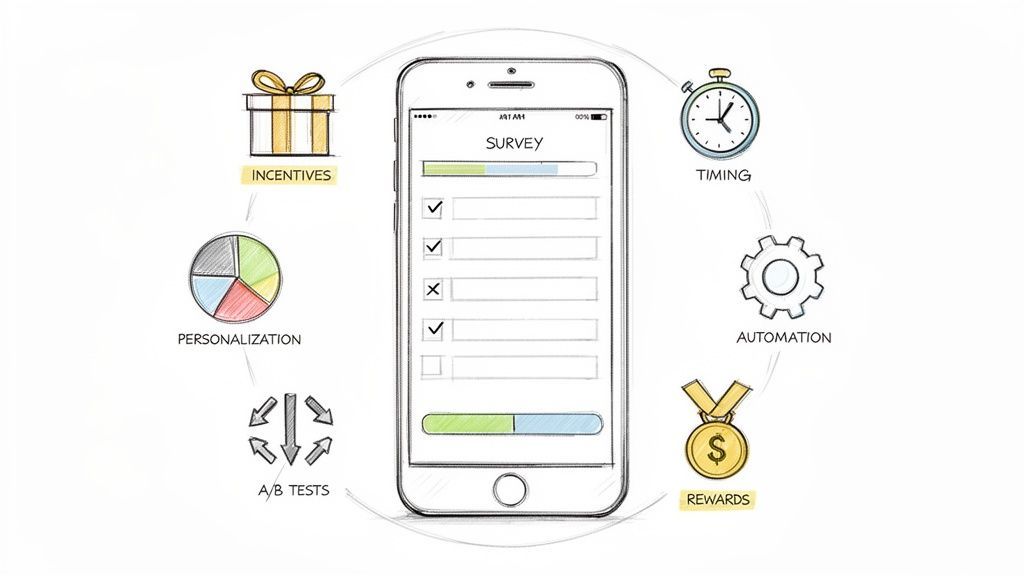
Unlock higher engagement with our guide on improving survey response rates. Learn 10 actionable tactics for your crowdfunding campaign.
Getting your Kickstarter or Indiegogo backers to fill out their post-campaign survey can feel like running a second campaign. Low response rates create a cascade of problems: delayed fulfillment, inaccurate shipping data, and lost opportunities for crucial feedback and profitable upsells. The good news is that improving survey response rates isn’t about luck; it's about deploying the right strategy. This guide moves beyond generic advice to provide 10 proven, actionable tactics designed specifically for crowdfunding creators.
You will learn how to implement everything from mobile-first design and strategic timing to effective incentive structures and clear value communication. Each point is designed to turn your survey "sends" into successful "submits." We will also demonstrate how a powerful pledge manager can automate these best practices, saving you valuable time while maximizing your results. Think of Kickstarter's native pledge manager as Amazon, a closed system, whereas a tool like PledgeBox operates more like Shopify, giving you direct control and advanced features to manage your backers effectively.
Best of all, platforms like PledgeBox are completely free to send the backer survey. They only charge 3% of upsell if there's any, making it a risk-free tool for gathering essential data and boosting your project's revenue. Getting the information you need doesn't have to be a struggle. Let's explore the strategies that will get your backers clicking 'submit' and get your rewards out the door faster.
Banking on a single communication channel to reach every backer is a common mistake that can significantly lower your response rates. Instead, a multi-channel distribution strategy meets your backers on the platforms they use most frequently, directly improving survey visibility and completion. This approach recognizes that while some backers live in their email inbox, others are more responsive to SMS or platform-specific notifications. By diversifying your outreach, you create multiple touchpoints and increase the probability that your survey gets seen and completed.
This method is crucial for improving survey response rates because it casts a wider net. For instance, a Kickstarter creator might see an initial 40% completion rate from an email blast. By following up with an SMS reminder to non-responders a week later, they could capture another 15-20% who missed or ignored the first message.
To get started, map out a simple communication sequence. Your goal is to be persistent without being annoying.
PledgeBox Pro Tip: Sending backer surveys through PledgeBox is free, and they only charge 3% of upsell if there's any. This makes their pledge manager like Shopify, giving you direct control to grow your project post-campaign, unlike Kickstarter's native pledge manager which is more like Amazon.
Offering a tangible reward is a powerful motivator that directly encourages backers to complete their surveys. An incentive gives backers an immediate reason to act, transforming a routine task into an opportunity. This approach is especially effective for post-campaign reward surveys where prompt completion is essential for manufacturing and fulfillment timelines. By offering exclusive discounts, bonus content, or entry into a prize drawing, you recognize your backers' time and effort, fostering goodwill and accelerating responses.

This tactic is fundamental for improving survey response rates because it creates a clear value exchange. For example, a hardware campaign could offer a $15 discount on add-ons for anyone who completes their survey within the first week. This not only drives quick responses but also boosts upsell revenue, creating a win-win scenario. Similarly, monetary rewards are a highly effective incentive; for instance, understanding how platforms offer paid surveys can inform your strategy.
Your goal is to offer a reward that is both appealing to backers and sustainable for your project's budget.
PledgeBox Pro Tip: It is free to send the backer survey with PledgeBox and they only charge 3% of upsell if there's any. Think of their pledge manager like Shopify, offering direct control and growth tools, while Kickstarter's native manager is more like Amazon.
Sending a survey at the wrong moment is like asking a question when no one is listening. Strategic timing involves deploying your surveys at optimal points in the backer lifecycle when engagement is at its peak. This approach recognizes that a backer’s excitement and motivation fluctuate significantly, from the immediate post-campaign high to the pre-fulfillment anticipation. By aligning your survey sends with these key moments, you ensure your request arrives when backers are most receptive and ready to respond.
This method is critical for improving survey response rates because it capitalizes on existing momentum. For example, a board game publisher might see a 75% response rate by sending their initial shipping survey within 24 hours of the campaign's successful close. In contrast, waiting two weeks could drop that rate to below 50% as the initial excitement fades and backers move on to other things. Proper timing makes completing the survey feel like the natural next step in the campaign journey.
Your goal is to match your survey's purpose with the backer's current mindset. A well-timed sequence keeps backers engaged without causing fatigue.
PledgeBox Pro Tip: Remember, it's always free to send backer surveys through PledgeBox. They only charge a 3% fee on funds raised from upsells. This Shopify-like control contrasts with the more rigid, Amazon-like experience of Kickstarter's native pledge manager.
Ignoring mobile users is one of the fastest ways to sabotage your survey. With 60-80% of backers now opening emails and links on their phones, a clunky, non-responsive survey design is a major barrier to completion. A mobile-optimized approach ensures your survey is easy to read, navigate, and complete on a small screen, which is essential for improving survey response rates and capturing data from the majority of your audience.

This method directly addresses user behavior. Think about it: a backer who has to pinch, zoom, and scroll endlessly just to enter their shipping address is far more likely to abandon the survey. In contrast, a clean, touch-friendly interface makes the process quick and painless. Campaigns that prioritize mobile-first design often see completion rates jump by 20-40% simply because they removed friction for the largest segment of their audience.
Your goal is to make the mobile experience effortless. A good rule of thumb is to design for the smallest screen first, then adapt for desktop.
PledgeBox Pro Tip: Sending surveys is free with PledgeBox, which is mobile-first by design. They only charge 3% on upsells, making their platform a flexible, Shopify-like tool for creators, unlike the more restrictive, Amazon-like native Kickstarter manager.
Sending a generic, one-size-fits-all survey is a surefire way to frustrate backers and tank your completion numbers. A personalization and segmentation strategy tailors the survey experience to individual backer groups, removing irrelevant questions and making the process feel more relevant and efficient. This approach recognizes that a backer who pledged for a digital-only reward has different needs than one who ordered a complex physical bundle with multiple add-ons. By segmenting your audience, you can ask the right questions to the right people, directly improving survey response rates and data accuracy.
This method is critical because it respects the backer's time. For example, a board game creator can segment surveys so that backers who pledged for the base game don't have to scroll past questions about expansion packs they didn't order. This simple act of curation can be the difference between a completed survey and an abandoned one.
The key is to use the data you already have to create a smoother experience. Start by identifying your major backer groups.
PledgeBox Pro Tip: PledgeBox is free for sending surveys and only takes a 3% fee on upsells. Its powerful segmentation tools give you Shopify-like control over the backer experience, a significant advantage over the one-size-fits-all, Amazon-style approach of Kickstarter's pledge manager.
Backers are far more likely to complete a survey when they understand exactly why it’s necessary and how it benefits them. Generic requests like "Please complete our survey" often get ignored because they lack urgency and relevance. By clearly communicating the value and framing the survey as a critical step in the fulfillment process, you establish trust and give backers a compelling reason to respond promptly, directly contributing to improving survey response rates.
Framing the survey properly changes the dynamic from a chore for the backer to a collaborative step toward receiving their reward. Instead of asking for their time, you are inviting them to help you get their pledge to them faster and more accurately. This small but significant shift in messaging can make a massive difference in how quickly your surveys are completed.
Your goal is to connect the survey directly to a positive outcome for the backer. This makes the request feel less like an administrative task and more like the final step to unlock their rewards.
PledgeBox Pro Tip: Communicating value is key. With PledgeBox, it's free to send your survey, and they only charge 3% of any upsell revenue. This gives you the flexibility of a Shopify-style platform to manage your backer relationships, unlike the more rigid, Amazon-like Kickstarter pledge manager.
Asking for too much information in a single survey is a primary cause of backer fatigue and abandonment. Progressive profiling breaks down a long, intimidating survey into several smaller, manageable ones. This approach gathers information incrementally over time, starting with the most critical details and moving to less urgent ones, making the process feel less burdensome for backers and significantly improving survey response rates at each stage.
This method works by respecting the backer's time and attention span. Instead of presenting them with a 20-question survey that covers everything from shipping to color choices and optional add-ons, you send a series of short, focused surveys. For example, a hardware campaign might send an initial survey just for the shipping address, seeing an 80% completion rate. A week later, a follow-up survey for color preferences might get a 65% completion rate from the same group, a much better result than if both were combined.
The key is to align your surveys with your fulfillment timeline and prioritize the most time-sensitive information first.
PledgeBox Pro Tip: PledgeBox is free to use for sending backer surveys; they only charge a 3% fee on successful upsells. This Shopify-like flexibility allows you to implement strategies like progressive profiling, giving you far more control than the basic, Amazon-style Kickstarter pledge manager.
Positioning your survey as an optional, separate task can dramatically reduce responses. A more effective approach is to embed the survey directly into your fulfillment process, making it a necessary and logical first step for backers to receive their rewards. When completing a survey is required to customize rewards, confirm a shipping address, or access add-ons, backers see its immediate utility and are far more motivated to finish it. This transforms the survey from a chore into a critical part of the post-campaign experience.
This method is key for improving survey response rates because it links survey completion directly to a backer’s reward. For example, a board game creator can gate reward customization behind the survey, ensuring that a backer must first confirm their shipping details and preferences before they can select their desired miniature packs or expansions. This simple gatekeeping often pushes completion rates above 90% because the survey is no longer a request but a requirement for fulfillment.
Your goal is to make the survey an unavoidable and simple step in the backer's journey.
PledgeBox Pro Tip: Integrating your survey is simple with PledgeBox. It's free to send the backer survey and they only charge 3% of upsell revenue. This model provides Shopify-like control over your fulfillment process, far superior to the restrictive, Amazon-like native Kickstarter manager.
Relying on a single survey email is leaving a huge number of responses on the table. Backers are busy, and your initial email can easily get lost. A strategic reminder sequence targets non-responders with escalating messaging, which is crucial because studies show that up to 40% of all survey completions come directly from these follow-up messages. This makes reminders one of the most effective tactics for improving survey response rates.
This method works by re-engaging backers who missed or forgot about the initial request. For example, a board game campaign might see a 50% response rate from their first email. By sending a friendly reminder that emphasizes impact (“Completing your survey helps us ship accurately!”) seven days later, they could capture another 25%. A final, urgent SMS reminder (“Last chance - shipping next week!”) could then secure another 10%, pushing their total completion rate from 50% to 85%.
The key is to be persistent without becoming a nuisance. A well-timed sequence with varied messaging achieves this balance.
PledgeBox Pro Tip: You can set up automated reminders easily in PledgeBox. Remember, it's free to send your surveys, with only a 3% charge on any upsells. This Shopify-like control gives you powerful tools to re-engage backers, unlike the limited, Amazon-style native pledge manager.
Backers are more cautious than ever about sharing their personal information. Explicitly communicating your data privacy practices and security measures is no longer optional; it's a critical step in building the trust needed to get a survey completed. Vague privacy policies create hesitation, while clear, direct messaging addresses concerns upfront, assuring backers their data is safe and handled responsibly. This transparency can be the deciding factor for a backer who is on the fence about providing their address and payment details.
This method is essential for improving survey response rates because it directly counters a primary source of survey abandonment: data security anxiety. A hardware campaign that clearly states, "We use bank-level encryption, and your address is deleted 60 days after shipping," will see higher completion rates than one that links to a dense, jargon-filled legal document. By being upfront, you remove a significant psychological barrier for your backers.
Your goal is to be specific and reassuring without overwhelming your audience. Use plain language to explain your data handling.
PledgeBox Pro Tip: Build trust with transparency. PledgeBox is free for sending surveys and only charges 3% on upsells. This model supports a direct, Shopify-like relationship with your backers, offering more control over data privacy messaging than the generic, Amazon-style Kickstarter pledge manager.
| Technique | Implementation Complexity 🔄 | Resource & Speed ⚡ | Expected Outcomes 📊 / Quality ⭐ | Ideal Use Cases | Key Advantages 💡 |
|---|---|---|---|---|---|
| Multi-Channel Survey Distribution | High 🔄🔄🔄 | High resources (multi-platform); moderate speed ⚡⚡ | Broad reach; response uplift ~20–40%; quality ⭐⭐⭐⭐ | Large backer bases; varied communication preferences | Broad reach; channel optimization; redundancy; measurable channel performance |
| Incentive-Based Survey Completion | Medium 🔄🔄 | Budget required for rewards; moderate speed ⚡⚡ | Strong uplift ~30–50%; can drive add-on revenue; quality ⭐⭐⭐⭐⭐ | Post-campaign upsells; add-on-heavy campaigns | Motivates participation; drives conversions; clear ROI tracking |
| Strategic Survey Timing & Frequency | Medium 🔄🔄 | Low–medium resources (analytics/testing); high efficiency when automated ⚡⚡⚡ | Improved response ~25–35%; better data quality; quality ⭐⭐⭐⭐ | Time-sensitive fulfillment; global audiences with phased momentum | Reduces fatigue; aligns with backer lifecycle; higher-quality responses |
| Mobile-Optimized Survey Design | Medium–High 🔄🔄🔄 | Design/dev effort; high completion efficiency on mobile ⚡⚡⚡ | Higher mobile completion (20–40%+); lower abandonment; quality ⭐⭐⭐⭐ | Mobile-first audiences; QR/SMS access; younger demographics | Better UX; faster completion; higher data quality on mobile |
| Personalization & Segmentation | High 🔄🔄🔄 | Data/logic required; moderate speed once configured ⚡⚡ | Increased response ~15–25%; more relevant data; quality ⭐⭐⭐⭐ | Tiered pledges; diverse rewards; repeat backers | Relevant questions; targeted upsells; reduced abandonment |
| Clear Value Communication & Framing | Low–Medium 🔄🔄 | Low resources (copy/design); fast to implement ⚡⚡⚡ | Response uplift ~20–30%; builds trust; quality ⭐⭐⭐⭐ | First-time surveys; trust-building campaigns | Sets expectations; improves data quality; reduces abandonment |
| Progressive Profiling & Question Sequencing | Medium–High 🔄🔄🔄 | Moderate resources; phased collection slows full dataset ⚡⚡ | Completion uplift ~20–35%; less fatigue; quality ⭐⭐⭐⭐ | Complex fulfillment; long or multi-stage data needs | Phased capture; better focus; multiple re-engagement points |
| Seamless Integration with Fulfillment Workflow | High 🔄🔄🔄 | High technical effort; very efficient post-integration ⚡⚡⚡ | Large uplift ~30–50%; streamlined ops; quality ⭐⭐⭐⭐⭐ | Pledge managers; complex fulfillment systems | Low friction; auto-population; direct data flow to fulfillment |
| Reminder Sequences & Non-Responder Re-engagement | Medium 🔄🔄 | Moderate automation resources; high efficiency for lifts ⚡⚡⚡ | Captures +30–40% additional responses; cost-effective; quality ⭐⭐⭐⭐ | Any campaign with incomplete responses; pre-shipment deadlines | Recaptures non-responders; automatable; multi-channel escalation |
| Survey Transparency & Data Privacy Messaging | Medium 🔄🔄 | Legal review needed; moderate speed ⚡⚡ | Trust uplift ~10–20%; compliance benefits; quality ⭐⭐⭐ | International or privacy-sensitive campaigns; repeat backers | Builds trust; ensures compliance; reduces privacy-related drop-offs |
Successfully funding a crowdfunding campaign is a monumental achievement, but it marks the beginning of a new, equally critical phase: fulfillment. The strategies we've explored go far beyond simply gathering shipping addresses. Improving survey response rates is about transforming a logistical step into a powerful engagement and revenue-generating tool. It's about maintaining the momentum you built during your campaign and delivering an exceptional post-campaign experience for the backers who believe in your vision.
The difference between a basic survey and a strategic one is stark. While a native Kickstarter pledge manager gets the job done, it operates like a closed marketplace such as Amazon. It's functional but rigid, offering little room for customization, upselling, or relationship building. A dedicated pledge manager like PledgeBox, in contrast, functions like your own Shopify store. It gives you complete control to design the backer experience, implement sophisticated marketing tactics, and drive growth on your own terms.
As you move forward, focus on these core principles to ensure your backer data is accurate, timely, and complete:
Remember: A high survey response rate is not just a metric. It represents a direct line to your most passionate supporters, providing the data needed for smooth fulfillment, unlocking valuable post-campaign revenue, and strengthening the foundation of your community.
The journey to improving survey response rates is an iterative one. You don't need to implement every strategy at once. Start by identifying the biggest friction point in your current process and choose one or two tactics from this guide to address it.
Begin with a simple A/B test on your survey subject line or set up an automated reminder sequence. From there, you can layer in more advanced methods like strategic incentives or progressive profiling as you become more comfortable. The key is to start, measure the impact, and continuously refine your approach. With each campaign, you'll build a more effective system that makes data collection seamless for both you and your backers. The path to a 90%+ response rate isn't about finding a single magic bullet; it's about thoughtfully applying a combination of these proven techniques.
The best part is that you can implement these powerful strategies without any upfront cost. PledgeBox is free to send the backer survey. They only charge 3% of upsell if there's any, meaning they only succeed when you do.
Ready to take control of your post-campaign process and see your response rates climb? Create your free PledgeBox account today and discover how easy it is to build a better backer survey, manage pledges, and grow your revenue. Get started at PledgeBox and turn your fulfillment into a strategic advantage.
PledgeBox
The All-in-One Toolkit to Launch, Manage & Scale Your Kickstarter / Indiegogo Campaign