 PledgeBox
Kickstarter RPG Game: kickstarter rpg game Success Guide
Kickstarter rpg game guide: kickstarter rpg game strategies for creators from pre-launch to post-campaign.

Kickstarter rpg game guide: kickstarter rpg game strategies for creators from pre-launch to post-campaign.
For any Kickstarter RPG game, the real work starts months before you even think about hitting the "launch" button. A successful campaign isn't an accident; it’s the result of carefully building momentum, validating your concept, and gathering a crowd that’s ready to back you the second you go live. You don't want to launch to crickets.
The dream of bringing your own RPG to life is an incredible motivator. But that dream starts long before you write a single word on your campaign page. The single biggest mistake I see new creators make is pouring all their energy into perfecting the game while spending zero time finding the people who will actually want to play it.
Let's be blunt: a brilliant game with no audience is just a cool project for your shelf. A good game with a dedicated following is a funded project that gets into the hands of players.
This early stage is all about answering two fundamental questions:
Here's a quick look at how these different stages fit together, from your initial spark of an idea all the way through to getting the games into your backers' hands.
This table breaks down the entire journey into manageable phases, each with its own clear goal and set of tasks.
| Phase | Primary Goal | Essential Activities |
|---|---|---|
| Pre-Launch | Validate the concept and build a core audience. | Market research, community engagement, build an email list, set up a pre-launch page. |
| Campaign | Hit the funding goal and unlock stretch goals. | Post regular updates, engage with backers, run targeted ads, manage comments and messages. |
| Post-Campaign | Collect funds and finalize backer orders. | Send out pledge manager surveys, charge for shipping/taxes, manage add-ons and upgrades. |
| Fulfillment | Manufacture and deliver rewards to backers. | Finalize manufacturing files, coordinate with logistics partners, ship packages, provide tracking. |
Think of this as your roadmap. Each phase builds on the last, and skipping a step, especially in the pre-launch phase, can seriously jeopardize your chances of success.
The tabletop RPG space is buzzing with new ideas, which is great, but it also means it's crowded. To get noticed, you have to be able to clearly and quickly explain what makes your game different. Are you making a gritty, low-fantasy survival game in a sea of high-magic epics? Or maybe you've designed a super simple, narrative-first system perfect for one-shots?
Don't just guess that your idea is unique. Get out there and test it. Jump into communities on Reddit (like r/rpgdesign), find relevant groups on Discord, and start conversations on forums like BoardGameGeek. Share your core concept—not the whole rulebook, just the juicy bits. Pay close attention to the feedback. What questions do people ask? What parts get them excited? This isn't just about validation; it's your first real step toward building a community.
A classic rookie mistake is to obsess over the game's design while completely neglecting the campaign page's design. Your Kickstarter page is the front door to your game's world. It needs to be an experience in itself, pulling potential backers into the theme and mechanics from the very first scroll.
This entire pre-launch process can be broken down into three key stages.
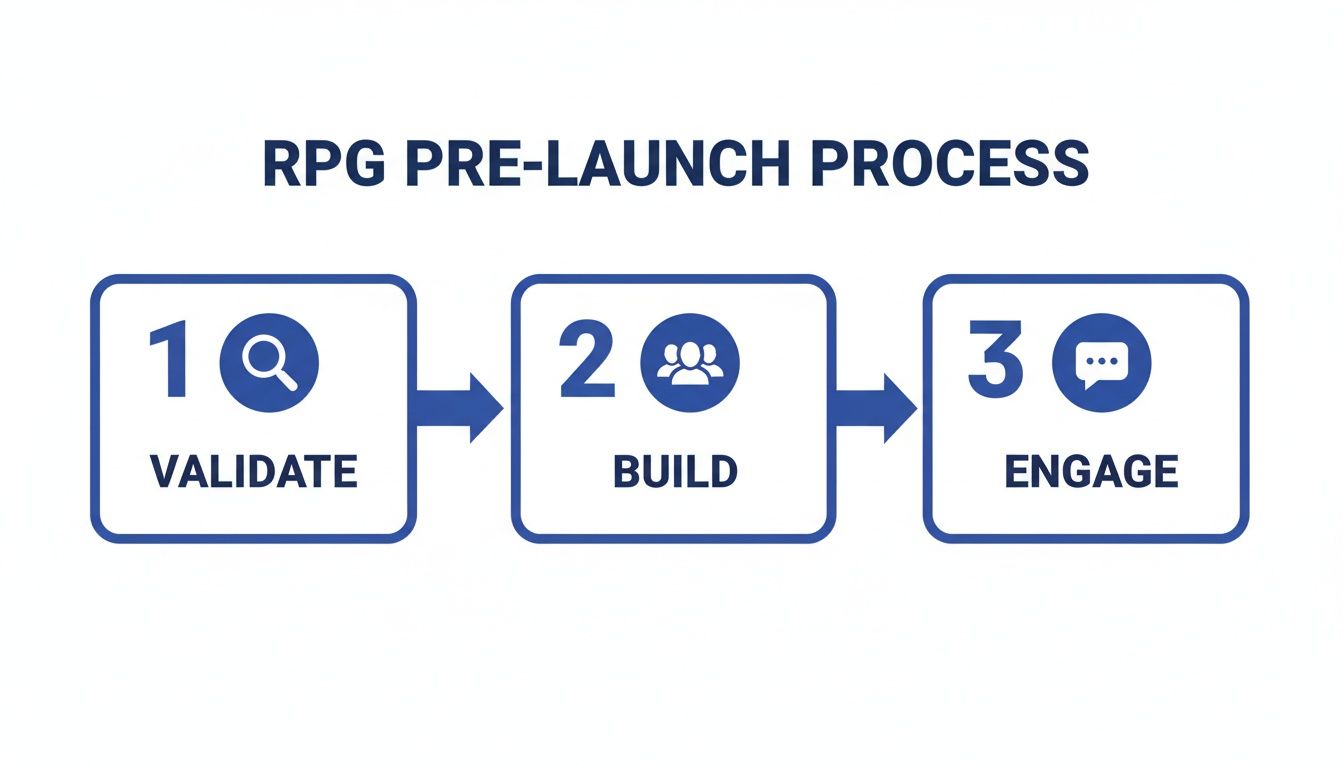
As you can see, you first validate your idea, then you build an audience around it, and finally, you engage that audience to get them primed for launch day. They all flow into one another, creating the momentum you need.
Once you've refined your concept and know people are interested, your top priority shifts to capturing that interest. A simple landing page is your best friend here. It needs a killer hero image, a short and punchy pitch for your game, and one crystal-clear call to action: "Sign up for updates."
Every single email you collect is a potential Day 1 backer. This pre-campaign audience is, without a doubt, the most valuable asset you will build for a successful Kickstarter RPG game. If you're looking for a good starting point, you can find a comprehensive Kickstarter prelaunch kit that packages many of the tools you'll need.
You've spent months building an audience, and now it's time for the main event: your Kickstarter campaign page. Think of this page as your digital storefront, your story's opening chapter, and your community’s home base, all in one. It’s the exact spot where a casual browser decides to become a passionate backer.
I've seen too many creators pour everything into game design, only to treat the campaign page as an afterthought. Don't make that mistake. Your page's design is just as critical as your game's mechanics. It should feel like an extension of the game itself—the very first chance a potential backer has to dive into your world.
To get there, you need to learn how to create truly engaging content that grabs your audience's attention and spells out your RPG's vision. We’re talking about a story that flows seamlessly from top to bottom, packed with compelling visuals and a video that hooks viewers in the first 15 seconds.
Your campaign story isn't just a list of features; it's an invitation to an adventure. Start with a powerful hook that gets right to the heart of your RPG. Who are the players? What world are they exploring? What makes your game stand out from the sea of fantasy and sci-fi RPGs already out there?
Use a clear hierarchy to present your information. GIFs showing off gameplay, high-quality character art, and mockups of the final book are non-negotiable. Break up walls of text with these visuals to keep people scrolling and make the whole page feel dynamic and exciting.
If you want to dig deeper into structuring your page for maximum impact, check out these proven Kickstarter campaign page design tips. They can help you turn those casual visitors into committed backers.
Your campaign page should guide backers on a journey. At each tier, they should think, "Okay, this looks good, but what if I scrolled down just one more tier?" This creates a natural funnel toward the pledge levels that provide the best value for them and the most support for your project.
The engine of your campaign page is its reward structure. This is where psychology and finance collide. Your goal is to create a "ladder" of pledge levels that gently encourages backers to climb up to the next tier. A well-designed structure can dramatically boost your average pledge value, which is a massive metric for success.
Start with the core game. This tier should be clean, simple, and represent the essential experience. From there, you build up by adding value, not just cost.
Whatever you do, avoid huge price gaps between tiers. A backer is unlikely to jump from a $30 pledge to a $150 one. Instead, guide them up the ladder with tempting options at the $50, $75, and $100 levels.
Early-bird specials are a ridiculously powerful tool for generating that crucial day-one funding surge. By offering a limited number of pledges at a slight discount for the first 24-48 hours, you give your pre-launch audience a compelling reason to back immediately.
This initial rush does two amazing things: it creates social proof that your project is a hit, and it pushes you up Kickstarter's discovery algorithms, exposing your game to a much wider audience. Just make sure the discount is sustainable and doesn't demolish your margins. It's a strategic loss-leader designed to build momentum that pays off big time over the rest of the campaign.
The first 48 hours of your campaign are pure adrenaline. If you've laid the groundwork, you’ll watch a huge wave of pledges roll in, often getting you close to—or even blowing past—your funding goal. It’s an incredible high. But then… silence.
Welcome to the mid-campaign slump. It's a quiet period that catches almost every first-time creator off guard and causes a ton of anxiety. Don't panic. This is completely normal and even expected. Your job now isn't to chase that launch-day frenzy but to maintain a steady, consistent pulse of excitement. This phase is less of a sprint and more of a marathon focused on communication, strategic reveals, and community building.
Think of your stretch goals as chapters in your campaign's story, not just a shopping list of upgrades. Instead of dumping all of them on day one, reveal them one by one as you approach the current goal. This creates a natural sense of suspense and gives you a legitimate reason to post exciting updates.
Most importantly, focus on goals that add real, tangible value to the game. Backers get way more excited about a new playable class, a bonus adventure module, or upgraded interior art than they do about slightly thicker cardstock.
A well-planned stretch goal map gives your community something to rally behind during those slow middle weeks. This is a huge reason the games category dominates Kickstarter, having raised over $2.63 billion in lifetime pledges. A staggering 92% of all $1 million+ projects on the platform are in the top three categories, and games lead that charge with massive RPG hits like Avatar Legends The Roleplaying Game, which pulled in $9.54 million from 81,567 backers. You can find more incredible Kickstarter statistics that show just how powerful this community is.
Add-ons are your secret weapon for boosting your average pledge amount. These are simply individual items that backers can add to their pledge, letting them customize their reward and grab extra goodies without you having to create a dozen complicated reward tiers.
Some of the most effective add-ons I've seen for RPG campaigns include:
Just be smart about fulfillment. Offering a dozen different t-shirt sizes and colors sounds cool, but it can quickly turn into a logistical nightmare. Stick to a curated list of high-value items that complement your game and are easy to manage.
My Daily Campaign Routine: Check comments and messages first thing in the morning with coffee. Draft an update or social media post around midday. Do one last check-in at night. Consistency is everything—it builds trust and shows your backers you're all in.
The middle of the campaign is all about staying visible and keeping your backers engaged. Aim to post updates at least two or three times a week, and make them about more than just the funding total.
This is your chance to go behind the scenes. Share interviews with your artists, do a deep dive into the game's lore, or post a short video explaining a unique mechanic. You're continuously selling the experience of your game. Jump into the comments section and answer every single question personally and promptly. That responsiveness shows backers you’re passionate, present, and trustworthy.
This steady drumbeat of communication will carry you straight through to the final 48 hours. That’s when Kickstarter sends a reminder email to everyone who followed your project, triggering a final, massive surge that can often account for 20-30% of your total funding and give your campaign a spectacular finish.
The funding bar is full, the confetti has settled, and your Kickstarter RPG game is officially a success. Pop the champagne—you’ve earned it. But once the celebration is over, the real logistical puzzle begins, and your most critical tool is a pledge manager.
This is where many first-time creators get completely bogged down. Kickstarter is amazing for getting your game discovered and gathering pledges, but its built-in tools are incredibly basic for the complex job ahead. I find it helps to think of it with an analogy.
Think of Kickstarter as Amazon: a massive, sprawling marketplace where millions of people can discover your project. It’s the perfect launchpad to attract a huge volume of backers for your kickstarter rpg game.
A dedicated pledge manager, on the other hand, is like your own Shopify store. It’s a powerful backend where you manage every customer relationship, handle complicated orders with add-ons and variants, and even grow your revenue after the campaign ends. It's how you turn a one-time transaction into an ongoing relationship with your new community.
When your campaign clock hits zero, Kickstarter gives you a simple, one-time survey. It can ask for a shipping address and maybe one other question. That’s about it. It can't calculate shipping based on weight or destination, it can't handle VAT, and it definitely can't let excited backers upgrade their pledge or grab more of your cool stuff.
This is exactly why a third-party pledge manager isn't just a "nice-to-have"—it's non-negotiable for any serious project. It’s the bridge between a funded campaign and a fulfilled one. While there are a few options out there, they often come with different fee structures that can quietly eat into your hard-earned funds.
This is where a tool like PledgeBox really shines. For any creator watching their budget, this is a game-changer: PledgeBox is free to send your backer survey. You can collect addresses, let backers select their rewards, and get all your data organized without paying a dime in platform fees on the money you already raised.
The only charge is a small 3% fee on upsell revenue—that’s new money you raise after the campaign through things like add-ons and late pledges. This model makes it a completely risk-free decision because you only pay if you make more money.
This structure means the pledge manager's success is tied directly to yours. It’s a true partnership designed to help you increase your funding, not just manage it. To see how this system works in detail, you can explore the features of a modern pledge manager for Kickstarter and see how it would fit into your own post-campaign workflow.
A well-designed survey is the absolute foundation of a smooth fulfillment process. Your mission is to make it dead simple for backers to give you their info while ensuring you get clean, organized data to ship everything correctly.
Your survey setup should nail several key tasks:
The whole process should feel less like filling out a boring form and more like a final, exciting checkout experience for your backers.
One of the biggest financial traps for RPG creators is messing up shipping costs and taxes. It's a classic rookie mistake. A pledge manager solves this by letting you charge for shipping after the campaign, based on each backer's specific location and the final weight of their entire order (including all those last-minute add-ons).
Here’s how to set this up effectively:
Getting this calculation right prevents you from losing a massive chunk of your funding to logistics—a common but totally avoidable pitfall for a new kickstarter rpg game creator.
Alright, the confetti has settled. The campaign is done, the money is in the bank, and your pledge manager is all sorted out. Now comes the real test: turning your digital dreams into physical products for your Kickstarter RPG game. This is where your ideas become actual books, dice, and boxes that need to find their way to backers across the globe.
Getting this right is everything. Successfully delivering on your promises is the ultimate goal of any crowdfunding project. How you manage this final, often chaotic, stage will cement your reputation and decide if backers flock to your next big idea. It’s a marathon of logistics, but with smart planning and honest communication, you can cross the finish line.
First up, it’s time to turn those print-ready PDFs into a real, tangible product. The journey begins with getting quotes from multiple manufacturers. Don't just settle for the first company you find on Google. Reach out to at least three different printers to get a feel for their costs, production timelines, and the quality of their work.
Once you’ve locked in a partner, you'll hit a massive milestone: the pre-production copy (PPC). This is a single, fully assembled version of your game that the manufacturer sends you for final approval before they start the main print run.
I’m going to say this as clearly as I can: Never, ever skip the PPC. This is your last safety net. It’s your final chance to spot a typo, a weird color issue, or a component that just doesn't feel right. Fixing a mistake now is easy. Fixing it after 5,000 units have been printed is a project-killing nightmare.
Holding that first copy is an incredible feeling, but you have to be disciplined. Go through it with a fine-tooth comb. Check every single page, card, and token against your final digital files. Only when you give your enthusiastic, explicit approval will the factory fire up the machines for mass production.
With thousands of games rolling off the assembly line, you need a solid plan to ship them out. For most creators, this boils down to two options: doing it all yourself (self-fulfillment) or hiring a professional fulfillment center to handle the heavy lifting.
Let's break down what each path looks like:
| Strategy | Best For | Pros | Cons |
|---|---|---|---|
| Self-Fulfillment | Small projects, mostly local backers, or fewer than a few hundred orders. | You have total control, can add a personal touch, and might save on overhead. | It's incredibly time-consuming, international shipping is a minefield, and it doesn't scale well. |
| Fulfillment Center | Larger projects, lots of international backers, and complex orders with add-ons. | They are experts in global logistics, offer bulk shipping rates, and handle all the customs/VAT headaches. | It’s an added cost to your budget and you have less direct control over the final packaging. |
Honestly, for a first-time Kickstarter RPG game with more than a couple of hundred backers, partnering with a fulfillment center is almost always the right move. They have warehouses strategically placed in the US, UK/EU, Canada, and Australia, which dramatically cuts down on shipping costs and customs nightmares for your international supporters.
Throughout this whole manufacturing and shipping process, your single most important tool is clear, consistent communication. Remember, your backers aren't just customers; they are your earliest investors who put their faith in your vision. Keeping them in the loop—especially when things inevitably go wrong—is how you build unshakable trust.
This is more crucial now than ever. The TTRPG crowdfunding scene is maturing, but it's also cooling off a bit, with fewer campaigns hitting that million-dollar mark. This tells us that backers are getting more discerning. A polished campaign and a reputation for reliable fulfillment are becoming make-or-break factors. You can read more about the state of TTRPG crowdfunding to get a better sense of these trends.
Get into a rhythm with your backer updates—once a month is a great starting point.
Being transparent turns potential anger into shared understanding. Backers who feel informed and respected, even when there are delays, are the ones who will stick around and eagerly support whatever you decide to create next.
It's completely normal to have a ton of questions swirling around as you get ready to launch your first RPG on Kickstarter. Crowdfunding has a lot of moving parts, and getting clear answers now will save you from major headaches down the road.
Think of this section as a final gut check. We’re going to tackle some of the most common—and most critical—questions I hear from new creators.
Your funding goal is not a wish. It’s a promise. It must be the absolute bare-minimum amount of money you need to manufacture and ship your game to every single backer. Get this wrong, and your project can implode even after a "successful" campaign.
You need to be ruthless with your budget. Sit down and get quotes for every last expense.
Add it all up. That number—the real one—is your funding goal. Never set a lowball goal just hoping to smash it; set the goal you actually need to deliver on your promises.
This is a huge one, and misunderstanding the difference can torpedo your entire fulfillment process. Kickstarter’s built-in survey is a very basic, one-time form. It's really only good for collecting a shipping address and maybe a simple choice. That's it.
A real pledge manager is a powerful, dedicated platform for everything that happens after the campaign ends. It's where you handle the messy logistics of shipping and can actually increase your total funding. I always explain it like this: Kickstarter is like Amazon, a huge marketplace where you find your customers. A tool like PledgeBox is like Shopify, the powerful backend where you manage orders and build relationships.
Here's the kicker: with a service like PledgeBox, sending your backer survey is completely free. You only pay a small 3% fee on any new money you raise through add-ons and upgrades if there are any. It's a no-brainer for managing your project professionally and boosting your bottom line.
Let me be blunt: an engaged email list isn't just important; it’s everything. It is the single biggest predictor of whether your campaign will succeed or fail. A good list is the engine that drives your launch day.
A strong email list creates a tidal wave of pledges in the first 24-48 hours. This initial momentum does two things: it gives your campaign immediate social proof, making it look like a hit, and it trips Kickstarter's algorithm, which then starts showing your project to new people.
For a small-to-medium project, you should be aiming for a list of at least 500 to 1,000 genuinely interested people before you even think about hitting the launch button. That explosive start can truly make or break your entire campaign.
Bringing a Kickstarter RPG game to life is a marathon, not a sprint, and you need the right partners. PledgeBox provides a complete, risk-free toolkit for all your post-campaign needs, from sending surveys for free to growing your revenue with a powerful upsell system. Learn more at PledgeBox.com.
PledgeBox
The All-in-One Toolkit to Launch, Manage & Scale Your Kickstarter / Indiegogo Campaign