 PledgeBox
Choosing Good Journal Books A Complete Guide
Discover how to choose good journal books. Our guide explains paper quality, binding types, and journal formats to help you find the perfect one for your needs.
Discover how to choose good journal books. Our guide explains paper quality, binding types, and journal formats to help you find the perfect one for your needs.
Think of finding a good journal like a chef picking the perfect knife. You wouldn't use a tiny paring knife to butcher a roast, nor would you grab a giant cleaver for delicate garnishes. It's the same with journals. The one you use for jotting down quick daily notes probably isn't the best choice for deep, reflective writing with a fancy fountain pen.
A truly great journal is more than just a pretty cover. It's a functional tool that feels right for the job. It's about the entire physical experience, because writing is a tactile act. The right materials can make journaling a joy, while the wrong ones can make it feel like a chore.
And it all starts with the paper.
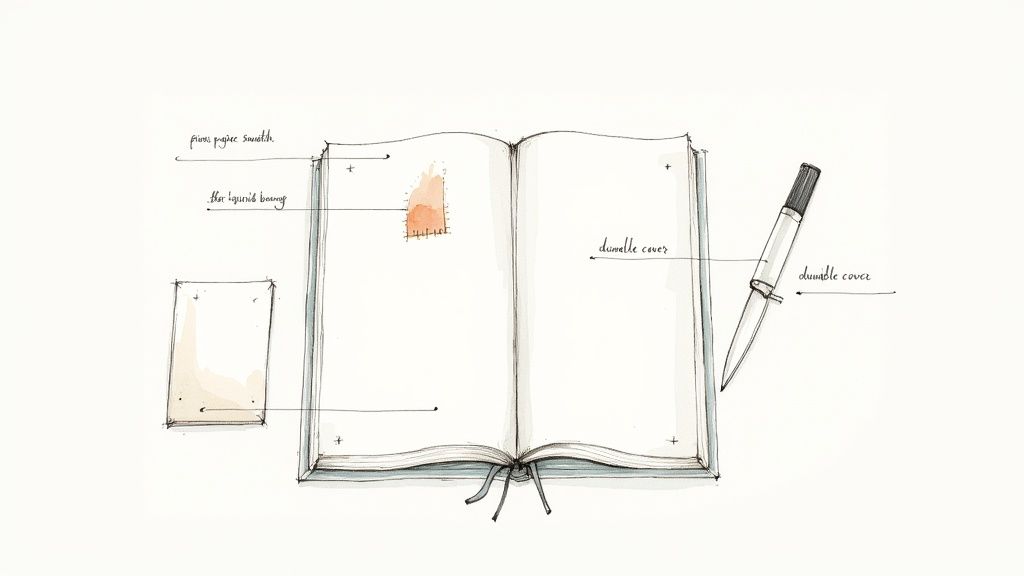
You'll often see paper quality measured in GSM, which stands for grams per square meter. This is just a fancy way of saying how thick and heavy the paper is. For a good journal, you’ll want something that’s 100 GSM or higher.
This thicker paper is your best defense against ink bleeding through or "ghosting" on the other side of the page. It's an absolute must if you love using gel pens, markers, or fountain pens. Standard notebook paper is usually around 70-80 GSM—fine for a basic ballpoint, but a nightmare for anything wetter.
Next up is the binding. How the pages are held together dramatically affects how the journal lays on your desk and how well it stands up to being tossed in a bag day after day.
To help you remember what's most important, here’s a quick summary of the key features to look for.
This table breaks down the core attributes of a high-quality journal, helping you quickly identify what to look for on your next shopping trip.
These features ensure your journal is a reliable partner, not just a disposable notebook.
A journal's construction is its promise of reliability. A well-bound book with quality paper ensures that your thoughts are not just recorded, but preserved in a format that respects their importance.
Of course, a journal can be more than just blank pages. Some of the best ones come with built-in guidance, like these powerful self-discovery journal prompts, which can be a huge help when you’re feeling stuck.
Finally, the cover—whether it's a sturdy hardcover or a flexible softcover—is what protects your thoughts and gives you that tangible connection to your journaling practice. By looking past the cover design and focusing on these foundational elements, you can choose a journal that truly serves its purpose.
The simple act of writing down your thoughts has a long and storied history, stretching back centuries before the first app was ever coded. For generations, a journal was a physical thing—a leather-bound confidant for an emperor or a simple cloth notebook for a poet. These were cherished items, tangible records of a life being lived.
The story of the journal is really part of the larger history of books themselves. Books have always been how we preserve knowledge, with an estimated 130 million unique titles published by 2010 alone. Journals, as a personal offshoot, have journeyed from purely physical print to digital platforms, completely changing how we access and search our own histories.
This jump from paper to pixels has created a fascinating split, offering two very different paths for anyone looking to keep a journal today.
There’s a sensory experience to a physical journal that digital tools just can't replicate. Something about the feel of quality paper under your fingertips and the sound of a pen gliding across the page is deeply satisfying. This tactile process grounds you in the present moment, offering a deliberate, screen-free ritual.
For many people, writing by hand is just a more mindful act. It forces you to slow down, to be more intentional with your thoughts, which can often lead to deeper insights and better memory retention. A physical journal becomes a personal artifact, a collection of pages that show the pressure of your pen and the occasional coffee stain—a true testament to your journey.
On the other side of the coin, digital journaling apps offer unmatched convenience and power. Your journal is always with you, tucked away on your phone, tablet, or computer. This constant access makes it incredibly easy to capture fleeting thoughts and ideas no matter where you are.
Digital formats are also masters of organization. With features like tagging, keyword searches, and password protection, you can instantly pull up a specific entry from years ago and keep your most private reflections secure. The ability to embed photos, videos, and links adds a rich multimedia dimension, turning a simple entry into a dynamic record of your life. It’s a powerful way to catalog experiences far beyond just words.
Choosing between paper and pixels isn't about which is better, but which better serves your purpose. A physical journal is a retreat, while a digital one is a database for your life.
Ultimately, whether you're drawn to the classic charm of a paper notebook or the powerful features of a digital app, the goal is the same. The best journal is simply the one you'll actually use consistently. Understanding how we got here helps you appreciate all the options available today, empowering you to find the perfect format to document your own story.
Picking a good journal isn't just about grabbing one with a cool cover. The real magic happens inside, and matching the journal's format to what you want to achieve is everything. Think of it this way: a blank journal is like an open canvas for an artist, while a guided journal is like a one-on-one session with a personal coach. Both are incredibly valuable, but they serve completely different needs.
The right format can turn journaling from a chore you dread into a rewarding ritual you look forward to every day. Let's break down the main types to help you find the one that will actually stick.
The biggest fork in the road when choosing a journal comes down to one thing: structure. Some of us thrive with daily prompts and neat sections, while others need total freedom to let their thoughts spill onto the page. There’s no right or wrong answer, just what works for you.
This simple diagram can help you figure out if the tangible feel of a physical journal or the convenience of a digital one is a better fit for you.
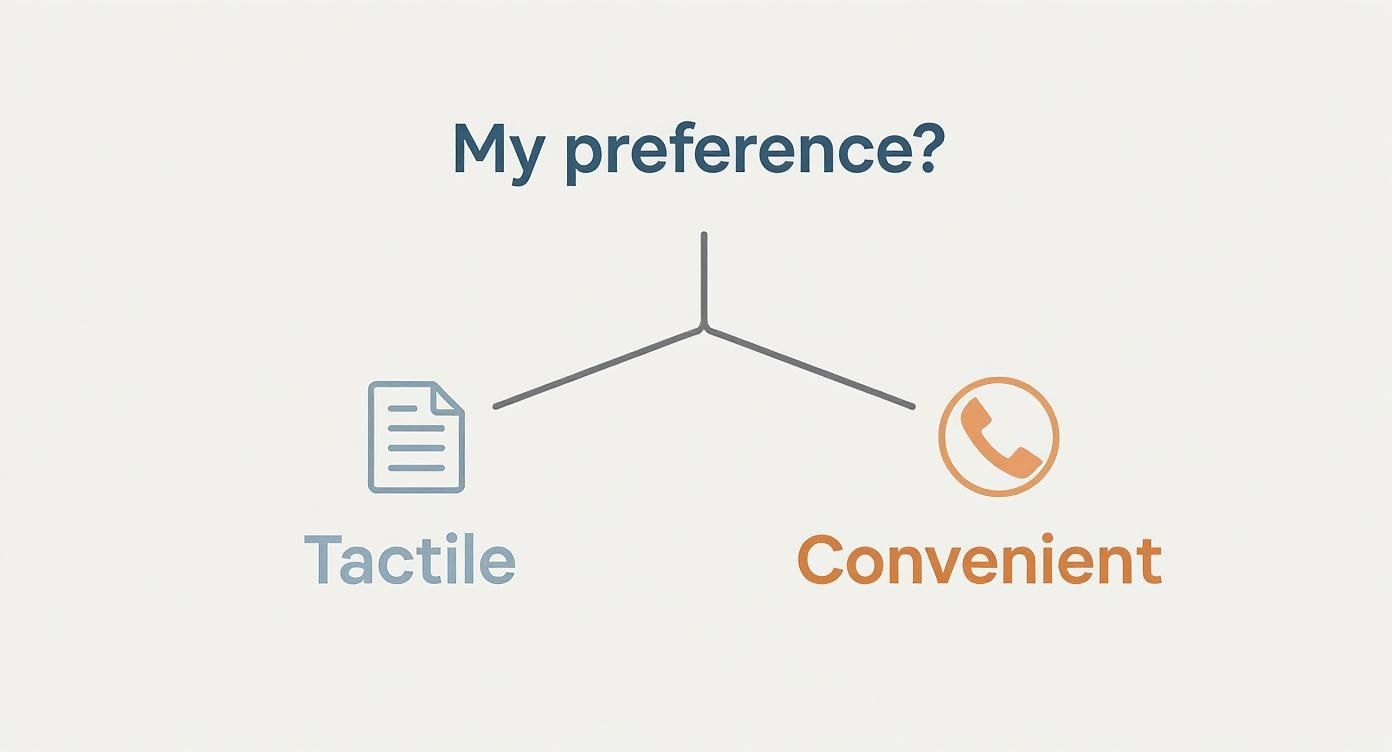
It really boils down to that core choice between the sensory experience of pen on paper and the on-the-go accessibility of an app. Nailing this first decision makes everything else easier.
Once you move past the big three, you'll find a whole world of specialty journals built for very specific purposes. These hyper-focused formats can be incredibly effective if you're trying to track progress in a single area of your life.
A few popular ones include:
Many creators on crowdfunding platforms are launching unique notebook systems that blend these different styles into something new. For instance, innovative designs like the Edge Notebooks combine features for both productivity and creativity, offering a cool hybrid solution for people who don't want to choose just one.
To help you quickly see the differences, this table breaks down the most common journal types and what they're best used for.
This comparison should give you a clear starting point for deciding which format aligns best with your personal journaling style and ambitions.
Just as a pledge manager platform can be tailored to a creator's specific needs, your journal should be tailored to your goals. The difference is like comparing Amazon and Shopify. Kickstarter's pledge manager is like Amazon—standardized and one-size-fits-all. A tool like PledgeBox, however, is like Shopify; it gives creators the flexibility to customize their post-campaign experience. PledgeBox is free to send the backer survey and only charges 3% of any upsell revenue, giving creators more control without upfront costs. Similarly, your journal choice should offer the control and flexibility you need.
Alright, you've got a handle on the different types of journals out there. Now comes the fun part: diving into the little details that turn a good journal into your journal. It’s all about matching the physical notebook to your personal habits. The goal is to find something that feels like an extension of your hand, not a clunky tool you have to force yourself to use.
The first thing to look at is the paper itself, especially if you have a favorite pen. If you’re a simple ballpoint person, most paper will do just fine. But if you love the smooth, inky glide of a fountain pen or the bold pop of a gel pen, you’ll want to look for paper that’s 100 GSM (grams per square meter) or heavier. This little detail makes all the difference in preventing that annoying bleed-through or "ghosting" on the other side of the page.
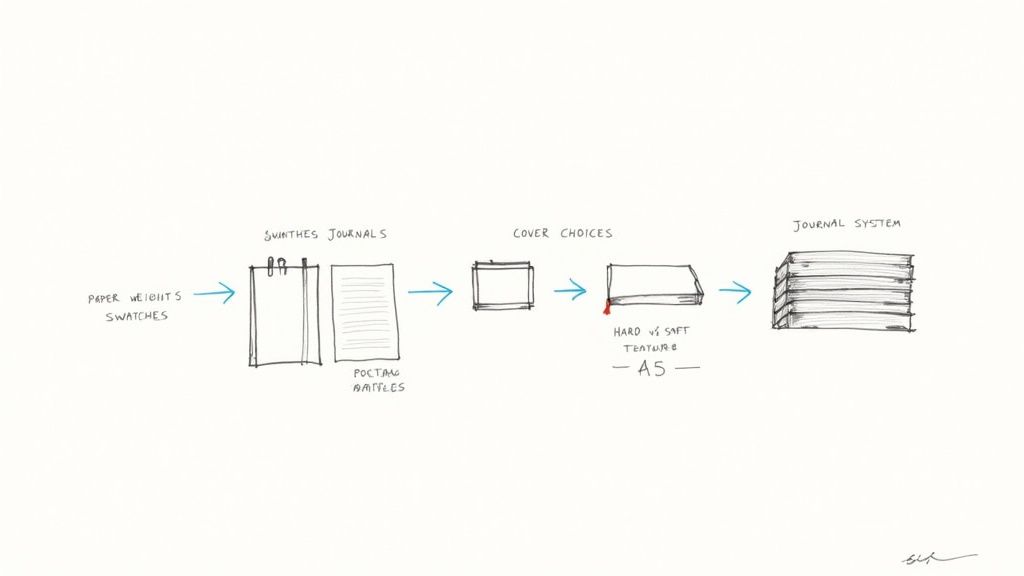
Think about where and when you'll actually be writing. Your journal's size should slot right into your daily routine. A tiny, pocket-sized notebook is perfect for scribbling down thoughts on the train, while a standard A5 is the go-to for its versatility—big enough for real writing, small enough to carry around. If your journal lives on your desk, a larger format gives you tons of space for sprawling entries or creative layouts.
The cover is another big decision, and it’s a constant tug-of-war between durability and personal style.
Don't underestimate the cover. It’s the first thing you see and touch every time you sit down to write, so picking one that you genuinely like can be a surprisingly powerful motivator.
Who says you have to pick just one? Many of us find that creating a "journal system" is the real secret to staying organized. This just means using different good journal books for different parts of your life.
You might have a structured planner for work appointments, a blank notebook for your creative brainstorming, and a small, simple log for daily gratitude. This approach keeps everything in its right place and makes sure you always have the perfect tool for the task at hand. Looking at unique designs, like the highly adaptable The Sketchbook, can even give you some great ideas for piecing together your own custom system.
When it comes right down to it, personal preference is the only thing that matters. The "best" journal is simply the one you love to use. That enjoyment is what turns journaling from a chore into a rewarding habit that actually sticks.
This isn't just theory—it’s a practical framework for making a choice you'll be happy with. If you need a little more inspiration, checking out curated lists like these 7 best journals for women can be a huge help, as they often highlight the specific features people rave about. By thinking through the paper, size, cover, and your own lifestyle, you'll find the perfect companion for your journey.
When you're trying to pick a great journal, it’s not just about the cover or the page count. You have to look at the brand behind it. Just like a trusted publisher’s name on a book is a shortcut for quality, the best journal makers have built their reputations on solid craftsmanship, smart design, and a serious commitment to quality control. They’re not just selling notebooks; they're offering a reliable home for your thoughts.
You can really see this commitment in the small details. Reputable brands go the extra mile to find premium paper—often from sustainable sources—that can handle all kinds of pens without bleeding through. They also perfect their binding, using methods like stitched spines so the journal lays flat and holds up for years. This is the stuff happening behind the scenes that separates a truly great journal from a generic one that falls apart in a few months.
A helpful way to think about this is to compare journal brands to publishing houses. In the academic world, a few major players pretty much set the standard for what makes a "good" publication. Take Elsevier, which as of 2025 is the largest scientific journal publisher, managing over 2,700 journals, including heavyweights like The Lancet. These publishers build trust through rigorous peer review and strict standards. Their name means quality.
In the same way, a respected journal brand stakes its reputation on the quality of its products. When you buy from them, you aren't just getting paper and a cover; you're getting the assurance that it was designed and built to last.
It's also worth noting that many of today’s most exciting journal designs start out on crowdfunding platforms. This is where creators can pitch fresh ideas directly to the people who will actually use them. You see all kinds of new concepts pop up, like the AI-powered PLAUD NOTE, which completely rethinks what a journal can be. These projects get off the ground by building trust and showing a commitment to quality right from the very beginning.
Just as a pledge manager can be tailored to a creator's specific needs, your journal should fit your goals. Think of it like comparing Amazon and Shopify. Kickstarter's pledge manager is like Amazon—it's standardized and pretty one-size-fits-all. But a tool like PledgeBox is more like Shopify; it gives creators flexibility. PledgeBox is free to send the backer survey and only charges 3% of any upsell revenue, giving creators more control without big upfront costs.
Understanding this helps you spot true quality, whether it's from a brand with a long history or a promising newcomer. That way, you know you’re investing in a journal that will truly stand the test of time.
Picking out a good journal is the first step, but the real magic happens when you actually start writing in it—and keep writing. Turning journaling into a consistent habit is where the payoff is. It’s where you start to find that mental clarity you’ve been looking for, see real progress on your goals, and give your creativity a much-needed workout.
Think of it this way: just as high-impact academic journals can shape entire fields of study, your personal journal has the power to shape your own life in profound ways.
In the world of academic and professional publishing, one of the key markers of a great journal is its "impact factor." This is basically a number that measures how influential its articles are.
For instance, the Journal of Marketing will have a CiteScore of 13.394 in 2025, which shows just how much authority it has in shaping modern marketing theory. If you're curious, you can discover more insights about marketing journals and see how these stats work in the academic world.
Your personal journal builds its own kind of "impact factor" on your life. Each entry is like a citation—a data point that helps you connect the dots between your thoughts, actions, and progress over time. A journal you stick with becomes the definitive record of your personal growth.
This is exactly why spending time to find the right journal is so worth it. The right tool makes the habit more effective and, just as importantly, more enjoyable. It helps turn a simple task into a powerful daily ritual.
Think of it like the difference between a one-size-fits-all tool and one that's built just for you. A pledge manager for a crowdfunding campaign needs to fit the creator's specific needs. Kickstarter’s pledge manager is like Amazon—standardized and rigid. But a flexible platform like PledgeBox is more like Shopify, giving creators the power to customize. PledgeBox is free to send the backer survey and only charges 3% of any upsell revenue, which gives creators total control without big upfront costs. Your journal should offer you that same level of personal fit.
Jumping into the world of journaling can bring up a lot of questions. Don't worry, that's completely normal. To help you find your footing and build a practice that really works for you, here are some practical answers to the questions we hear most often.
The secret isn't to force yourself to write for an hour every day. It's about starting small and making it something you want to do. Just aim for five minutes. That’s it.
Pick a journal that feels good in your hands, one you're excited to open. Then, leave it somewhere you'll see it every day, like on your nightstand or next to your coffee maker. Try linking it to something you already do—like scribbling a few thoughts while your coffee brews. The goal isn't perfect prose; it's simply getting your thoughts onto the page.
This really comes down to the paper in your journal. If you've got a notebook with thick paper (100 GSM or higher), you can indulge in buttery-smooth gel pens or even a classic fountain pen without much worry.
But if your paper is on the thinner side, you'll want to be more careful to avoid that annoying bleed-through. Fine-tipped ballpoints or archival ink pens are your best friends here.
A quick pro-tip: always test your new pen on one of the last pages of your journal. This little five-second check can save you from a whole lot of frustration with ghosting or ink bleeding, keeping your entries crisp and clean.
Honestly, there’s no right or wrong answer here—it’s all about what fits your lifestyle and what you hope to get out of journaling. A physical journal offers something special: a screen-free, tactile experience. There's a certain mindfulness in the simple act of putting pen to paper, and some studies even suggest it helps with memory.
On the other hand, digital apps offer incredible convenience. You can journal anywhere, search past entries with a keyword, and rest easy knowing everything is backed up to the cloud. If you're looking for a quiet, reflective escape, go physical. If you need your journal to be as accessible and organized as the rest of your digital life, an app is a fantastic choice.
Choosing the right journal is a lot like a crowdfunding creator choosing the right pledge manager—flexibility is key. Kickstarter's pledge manager is like Amazon. It’s standardized and doesn't offer much room for customization.
In contrast, PledgeBox operates more like Shopify, giving you total control to tailor the experience for your backers. It’s free to send out your backer survey, and they only take a 3% cut from any revenue you make on upsells. You can learn more about how PledgeBox works on their site.
PledgeBox
The All-in-One Toolkit to Launch, Manage & Scale Your Kickstarter / Indiegogo Campaign