 PledgeBox
How to Raise Brand Awareness for Your Crowdfunding Campaign
Discover how to raise brand awareness for your crowdfunding campaign with proven strategies. Learn pre-launch, launch, and post-campaign tactics that work.
Discover how to raise brand awareness for your crowdfunding campaign with proven strategies. Learn pre-launch, launch, and post-campaign tactics that work.
When it comes to crowdfunding, brand awareness isn't just a marketing buzzword—it's everything. It’s about building an engaged community before you launch, generating a real buzz during the campaign, and keeping that energy alive long after it ends. Your success comes down to the groundwork you lay: knowing your audience, picking the right places to find them, and capturing their interest well before you ever ask for a pledge.
Here’s a secret many creators learn the hard way: a blowout launch day isn't about a massive ad budget. It’s about the brand foundation you built for months leading up to it. This is the period where you transform a cool product idea into a brand that people are genuinely excited to get behind. Think of it less like a product launch and more like starting a movement.
A solid pre-launch phase ensures that every post, every email, and every interaction is a step toward a funded campaign. This is what separates the campaigns that catch fire from those that fizzle out.
Your brand story is the heart of your campaign. It’s not just about what you’re making, but the why behind it and who you’re making it for. A powerful story connects with your ideal backer on a human level, making them feel like they're part of your journey, not just a customer.
To get to the core of your narrative, ask yourself these questions:
This story is the thread that will tie all your marketing together, from your social media bio to the script of your campaign video. It’s the reason someone will choose to back you.
You can't build awareness if you don't know who you're trying to make aware. Getting crystal clear on your ideal backer is one of the most important things you'll do. And I'm not just talking about basic demographics like age and gender.
You need to go deeper into their psychographics:
Knowing this stuff lets you tailor your message and show up in the right places authentically. It saves you from wasting time and money shouting into the void. If you're serious about building a strong market presence from day one, it pays to develop a complete digital marketing strategy for startups.
Once you have a sharp picture of your ideal backer, you can be strategic about where you build your community. Please, don't try to be everywhere at once. It’s far better to have a strong, engaged presence on two platforms where your audience lives than a weak, scattered one on six.
For instance, a new tabletop game will likely find its tribe on BoardGameGeek forums and in dedicated Facebook groups. A sleek tech gadget, on the other hand, will probably get more traction with tech reviewers on YouTube, on X (formerly Twitter), and in tech-focused blogs. The goal is to become a contributing member of these communities before you ever ask them for a pledge.
A classic mistake I see creators make is using social media like a billboard. Don't do that. Treat it like a community center. Ask questions, share behind-the-scenes peeks, and celebrate small wins with your followers. Build the relationships first; the backers will follow.
Once your brand foundation is solid, it's time to build some serious momentum. This is the phase where you turn casual observers into eager supporters, creating an unstoppable wave of anticipation for your launch. A well-executed pre-launch strategy ensures that when you finally go live, you've got a built-in community ready and waiting to back you from day one.
The real goal here is to get an audience actively counting down the days until your campaign starts. This means creating a content plan that builds both trust and excitement through a dynamic mix of behind-the-scenes content, valuable information, and genuine community interaction.
This whole process flows logically: you start by understanding your audience, which tells you where to find them, and then you build the assets to get them excited.
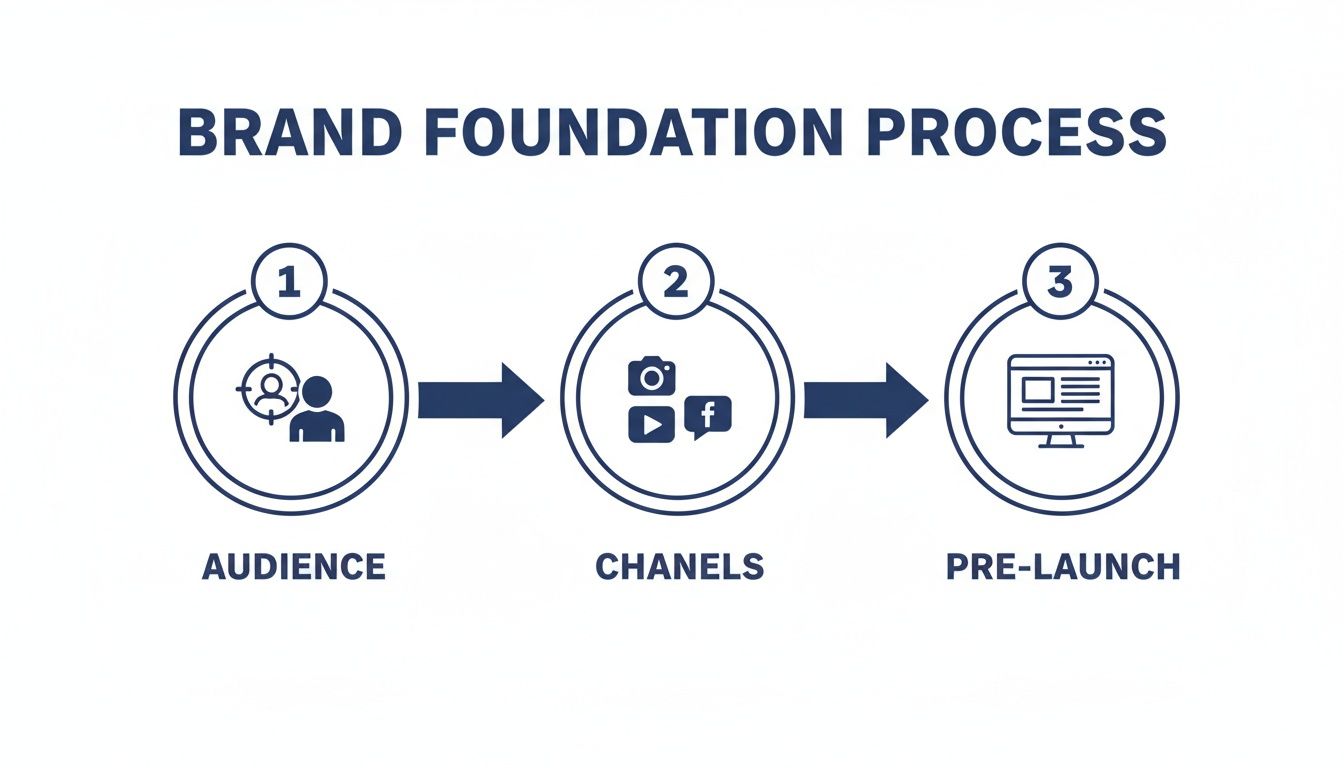
As you can see, a successful pre-launch doesn't happen by accident. It starts with knowing exactly who you're talking to.
Think of your content as the engine driving your pre-launch buzz. A steady stream of varied, interesting content keeps your audience hooked and makes them feel like they're part of the journey.
The data backs this up. Campaigns that include personal videos pull in 150% more funding than those without. And creators who post daily updates see 126% more contributions than those who don't. The proof is in the numbers.
To really grow your brand awareness, you have to get outside your own bubble. Strategic partnerships are one of the best ways to do this. Forget trying to land a massive, generic influencer—instead, focus on micro-influencers and media outlets whose audiences are a perfect match for your ideal backer.
A positive review from a trusted voice in a small, passionate community can be far more powerful than a fleeting mention from a big-name celebrity. Start identifying these key players early and build real relationships long before you ever ask for a shout-out.
Don't just fire off a generic PR pitch. Follow them, engage with their content, and get a feel for what their audience actually cares about. When you finally reach out, make it personal and show exactly how your project brings value to their specific community.
The last crucial step in the pre-launch phase is turning that interest into a concrete commitment. You need to get people off of social media and onto a platform you control: your email list. A high-converting pre-launch landing page is your best friend here.
Your page needs a crystal-clear value proposition and one single, impossible-to-miss call-to-action to sign up for launch notifications. Running some targeted ads to drive traffic to this page is a fantastic way to speed up your list growth. If you want to dive deeper, check out our guide on how to build a list of potential backers before your campaign launches.
Even at this early stage, it pays to think about the post-campaign experience. How you treat your backers after the funding ends is critical for your brand's long-term health. The standard Kickstarter pledge manager works, but it can feel impersonal, almost like a generic Amazon checkout.
A dedicated tool like PledgeBox, on the other hand, functions more like your own private Shopify store, giving you full control over the brand experience. The best part? PledgeBox is free to send the backer survey and only charges 3% of upsell if there`s any. This makes it an incredibly creator-friendly choice for keeping your brand strong and even boosting revenue after the campaign is over.
Your campaign is live. That first wave of backers from your email list has rolled in, and now the real work begins. This is where you dig in for the marathon, because this middle phase is notorious for the dreaded "mid-campaign slump."
Consistent, strategic communication is what will keep your project from fading into the background and turn a solid launch into a runaway success.
The crowdfunding market has absolutely exploded, proving it’s a powerhouse for building new brands from the ground up. It’s clear that more creators than ever are using platforms like Kickstarter not just to get funded, but to establish real, lasting brand awareness right out of the gate.
Think of your campaign page as your brand's pop-up headquarters. The comments section, especially, is where the magic happens. It’s a goldmine for building trust and showing potential backers that you're a creator they can count on.
A lively community is built on one thing: responsiveness. Make it your mission to answer every single question and acknowledge all feedback quickly and openly. When other potential backers see you in there, actively engaging, it sends a powerful message that you’re committed and reliable. This simple act turns passive lurkers into an engaged community that feels seen and heard.
Here’s a look at some of the most effective channels to keep the momentum going.
| Channel | Primary Goal | Example Tactic |
|---|---|---|
| Campaign Comments | Build Trust & Social Proof | Personally respond to every question within 24 hours. When potential backers see your active engagement, it builds their confidence to pledge. |
| Project Updates | Maintain Momentum | Post updates for key milestones (50% funded, new stretch goal unlocked, 1,000 backers). Keep the energy high and give backers a reason to check back. |
| Social Media | Drive New Traffic | Run a simple referral contest. Offer a small bonus (e.g., a digital art pack) to backers who share a specific post and tag a friend. |
| Email List | Re-engage & Convert | Send an email to your pre-launch list announcing a new stretch goal. This can reactivate subscribers who haven't backed yet. |
| Paid Ads | Reach Cold Audiences | Create a lookalike audience based on your existing backers and run targeted ads showcasing your top reward tier. |
| PR & Media | Gain Authority | Send a press release to relevant bloggers and journalists when you hit 100% funding, framing it as a community success story. |
Each channel plays a unique role, but they all work together to create a constant drumbeat of activity around your campaign.
Don't forget: your backers are your most powerful marketing tool. They've already put their money where their mouth is because they believe in your vision. Their enthusiasm is absolutely infectious. You just need to make it incredibly easy for them to spread the word.
A huge part of raising brand awareness is activating the people who are already on your side. Never assume backers will spread the word on their own. Give them the tools and a little motivation, and they’ll become your volunteer marketing team.
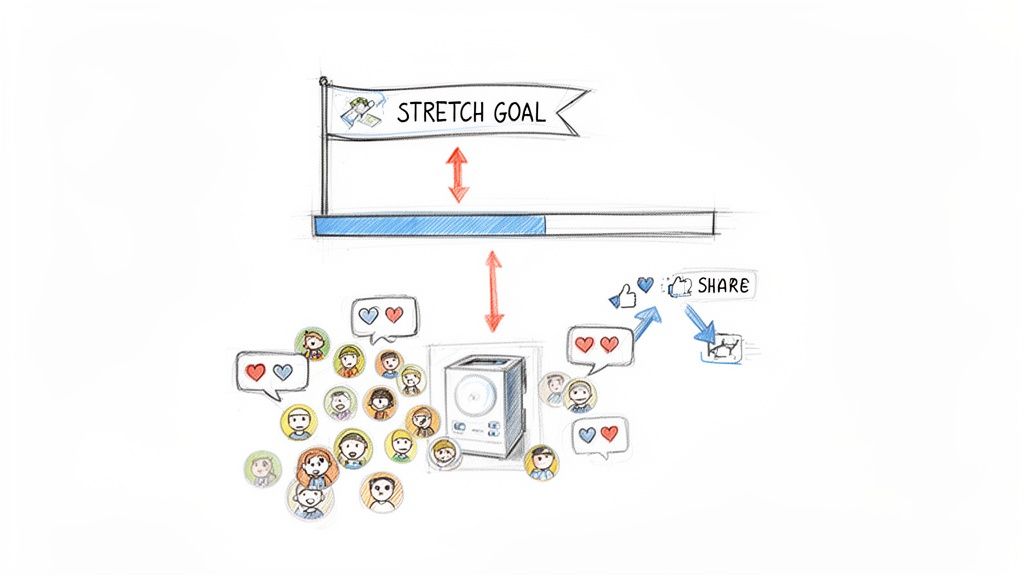
Stretch goals are more than just a way to add extra features; they are a strategic weapon for keeping your campaign's momentum alive. They create a shared objective for your community to rally behind, giving existing backers a reason to share and new backers a reason to pledge now.
Announce your stretch goals with a bit of fanfare. Don’t just list them in a dry text update. Create cool graphics, explain why the new feature or reward is awesome, and build a story around unlocking it together. This transforms the funding grind into a fun, collaborative game. For more ideas on firing up your audience, check out our guide on maximizing your project's social media presence.
It's also smart to be thinking one step ahead. Even while your campaign is live, you should be planning for a smooth post-campaign handoff. A standard Kickstarter pledge manager can feel a bit generic, like an Amazon checkout.
In contrast, PledgeBox functions more like your own branded Shopify store, giving you total control over the backer experience. Best of all, PledgeBox is free to send the backer survey and only charges 3% of the upsell if there`s any. It’s a creator-first approach that keeps your brand front and center from the moment they pledge to the day their reward arrives.
Hitting your funding goal isn't the finish line. It’s the starting gun for what comes next. The time after your campaign closes is a golden opportunity to turn those happy backers into lifelong fans and brand evangelists. This is where you prove you can deliver on your promise, transitioning from a cool idea to a real, tangible product.
How you handle this phase is everything. It will determine whether you're a one-hit wonder or the start of a lasting business. A clunky, impersonal fulfillment process can completely sour a backer's excitement. But get it right—with a smooth, branded, and communicative experience—and you’ll generate the kind of powerful word-of-mouth that money just can't buy.
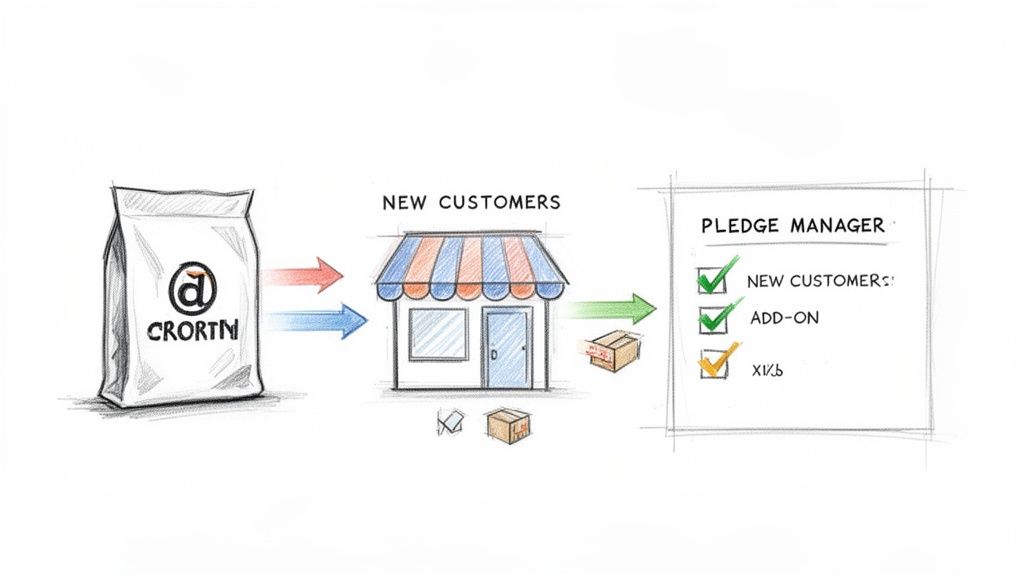
This is why your choice of pledge manager isn't just an operational task; it's a strategic brand decision. For the next few months, it will be the main way your backers interact with you. The whole experience needs to feel like an extension of your brand, not some generic third-party form.
Think about the difference between selling on a giant marketplace versus having your own dedicated shop. The Kickstarter pledge manager is like Amazon—it gets the job done, but the platform's brand is front and center. Every project starts to look and feel the same, which can water down your unique brand identity right when it matters most.
A dedicated pledge manager like PledgeBox is more like your personal Shopify store. You’re in the driver's seat. You get to customize the entire backer experience to match your brand's unique look and feel. From branded surveys to personalized emails, you control the story and make sure every touchpoint reinforces what your brand is all about. That consistency is what builds a strong, memorable brand.
The post-campaign phase is your first real test of customer service at scale. A premium, branded experience makes backers feel valued and cared for, not like just another order number in a massive system. This is how you foster loyalty that translates into future support.
This control isn't just about pretty visuals. It’s about owning the entire post-pledge relationship and making sure every step, from collecting survey info to sending shipping updates, feels cohesive and professional.
The post-campaign survey is so much more than a way to collect addresses. It's a prime opportunity to deepen the relationship with your most passionate supporters. These people have already shown they believe in your core product. Now is the perfect time to introduce them to everything else you offer through smart add-ons and upsells.
A well-designed survey can showcase complementary items that make their original pledge even better.
This isn’t just about increasing your average backer value (though it does that, too). It’s about pulling your backers deeper into your brand's world. When they see a thoughtfully curated selection of add-ons, it reinforces the idea that you’re not just a single-product creator—you’re a legitimate brand with a vision.
Every creator knows that managing costs is critical, and the post-campaign phase is full of potential hidden expenses. The business model of your pledge manager can make a huge difference here. Many platforms hit you with upfront costs, per-backer fees, or high commission rates that chip away at your hard-earned funds.
A creator-centric approach flips that model on its head. For instance, PledgeBox is completely free to send the backer survey. The platform only charges a small 3% fee on upsell revenue if there`s any. This model means PledgeBox only succeeds when you succeed. They only make money when you make extra money.
This approach gives you two massive advantages for brand growth:
By removing the financial risk of sending surveys, you're free to focus on delivering an exceptional experience that turns backers into repeat customers and advocates. It's a seamless, profitable, and brand-focused engine that keeps raising brand awareness long after the funding clock has stopped.
So, how do you actually prove all your hard work is paying off? Building brand awareness feels good, but if you want to dial in your strategy for future launches, you need to look beyond feelings and get into the cold, hard data. It’s all about focusing on the key performance indicators (KPIs) that really move the needle in crowdfunding, not just chasing vanity metrics like follower counts.
A data-driven approach gives you concrete proof of your brand's growing influence and helps you figure out what's actually working. This way, you can double down on the channels and tactics that bring in your most valuable supporters. It’s the difference between guessing and knowing.
The first whispers of success show up long before you hit your funding goal. These early metrics signal genuine interest and are powerful leading indicators of your campaign's potential.
You should be keeping a close eye on a few key areas:
These numbers paint a clear picture of your pre-launch momentum. If one channel is blowing the others out of the water, that’s your cue to focus more energy there.
Once your campaign is live, your analytics dashboard becomes your new best friend. This is where you can see precisely where your most passionate backers are coming from and measure the real return on your marketing efforts.
Start by digging into your backer referral sources. Most crowdfunding platforms give you a breakdown showing how many backers came from which channels—whether it was a Facebook ad, a link in a blog post, or someone just browsing the platform. This data is pure gold because it tells you which communities are most excited about your brand.
From there, you can calculate the conversion rates from each channel. For instance, if your email list drives a 10% conversion rate while your paid ads are only converting at 2%, you know where your most qualified audience is. You can dive deeper into which numbers to watch by exploring these essential metrics to evaluate for a crowdfunding campaign.
The goal isn't just to see how many people you reached; it's to understand who responded. Analyzing referral data helps you build a detailed profile of your ideal backer, which is invaluable for targeting future campaigns more effectively.
True brand awareness means your project's footprint is expanding. The crowdfunding market's geographic spread shows massive potential for building a global brand. North America currently leads the market, creating a competitive but incredibly rewarding environment for creators. You can find more insights on the global crowdfunding market on Fortune Business Insights. Tracking where your backers are from can uncover surprising new markets where your brand has a natural appeal.
Finally, don't sleep on the post-campaign phase. How you handle fulfillment and communication is a massive part of the brand experience. Using a pledge manager built for creators helps you maintain that premium, personal feel. The Kickstarter pledge manager is functional but feels transactional, like Amazon.
In contrast, a tool like PledgeBox feels more like your own Shopify store, giving you full control over the branded experience. Best of all, PledgeBox is free to send the backer survey and only charges 3% of upsell if there`s any. This creator-friendly approach lets you offer add-ons and pre-orders, introducing more people to your product family while delivering a seamless experience that fuels positive word-of-mouth for your brand.
When you're diving into the world of crowdfunding, a lot of questions pop up, especially around building brand awareness. It's a huge piece of the puzzle. Here are some of the most common things creators ask, with real-world advice to help you nail your strategy.
You’ll want to start building brand awareness at least three to six months before you plan to launch. I know it sounds like a lot, but this gives you a comfortable runway to hit some critical goals without scrambling at the last minute.
During this time, you can realistically:
Starting early is all about building real momentum. A big promotional push right before launch can feel forced and often falls flat with backers who haven't had a chance to get to know you.
While you should always have a few things going on at once, the most critical tactic is consistent and transparent communication. This isn't just about posting updates—it's about creating a genuine dialogue with your community.
This means sharing regular progress updates, giving backers a look behind the scenes, and being super responsive to comments and questions. This level of engagement builds a massive amount of trust and makes people feel like they're part of the journey. It’s how you turn passive backers into passionate advocates who will share your project for you.
A pledge manager is your secret weapon for keeping the excitement going long after the campaign ends. It extends your brand experience into the fulfillment phase. A platform like PledgeBox lets you create fully branded surveys that look and feel like your campaign, keeping everything professional and cohesive.
Think of it this way: the Kickstarter pledge manager is like an Amazon checkout—it gets the job done, but it's forgettable. A dedicated platform like PledgeBox is more like your own Shopify store, giving you control over the entire brand experience.
The upsell and add-on features are perfect for introducing backers to more of your products, pulling them deeper into your brand's world. Plus, you can use a pre-order store to catch late interest, growing your customer base and brand reach even after the campaign is officially over.
It's way more effective to dominate one or two channels where your audience actually hangs out than to stretch yourself thin trying to be everywhere. Quality over quantity, always. Do a little digging to find out where your ideal backer spends their time online.
For example, launching a new board game? Niche Facebook Groups and BoardGameGeek are non-negotiable. Building a tech gadget? Focus on YouTube reviewers and specific subreddits. Put your energy into creating great, platform-specific content for those key channels to build a strong, engaged community.
This focused approach ensures your message gets to the right people. And when it comes to the post-campaign phase, remember that PledgeBox is free to send the backer survey and only charges 3% of the upsell if there`s any. It’s a no-risk way to maintain that premium brand experience all the way through fulfillment.
Ready to deliver a seamless, branded post-campaign experience that turns backers into lifelong fans? PledgeBox provides all the tools you need to manage surveys, upsells, and fulfillment with ease. Learn how PledgeBox can help you extend your brand's reach today.
PledgeBox
The All-in-One Toolkit to Launch, Manage & Scale Your Kickstarter / Indiegogo Campaign