 PledgeBox
A Creator's Guide to a Gaming Table Kickstarter
Discover how to launch a successful gaming table Kickstarter. Our guide covers product development, campaign strategy, pledge management, and fulfillment.
Discover how to launch a successful gaming table Kickstarter. Our guide covers product development, campaign strategy, pledge management, and fulfillment.
Launching a gaming table on Kickstarter isn't just about selling a cool piece of furniture. It’s a massive undertaking that involves sharp product design, smart marketing, and some serious logistical planning. You’re not just funding a product; you’re building a premium brand from the ground up. This guide is your complete roadmap, taking you from the first sketch to the final delivery.
Let's be clear: launching a high-end gaming table on Kickstarter is ambitious, but the payoff can be huge. This isn't a guess—this niche is one of the most profitable on the entire platform.
Just look at The Wyrmwood Modular Gaming Table. They pulled in a staggering $8.81 million from 7,713 backers. That’s not just a success story; it’s proof that there's a massive, hungry market for premium gaming furniture. If you want to see what's possible, you can find more Kickstarter success stories and statistics on SearchLogistics.
But getting from a great idea to a table in a backer's home isn't a single leap. It’s a journey with distinct stages, and you have to nail each one.
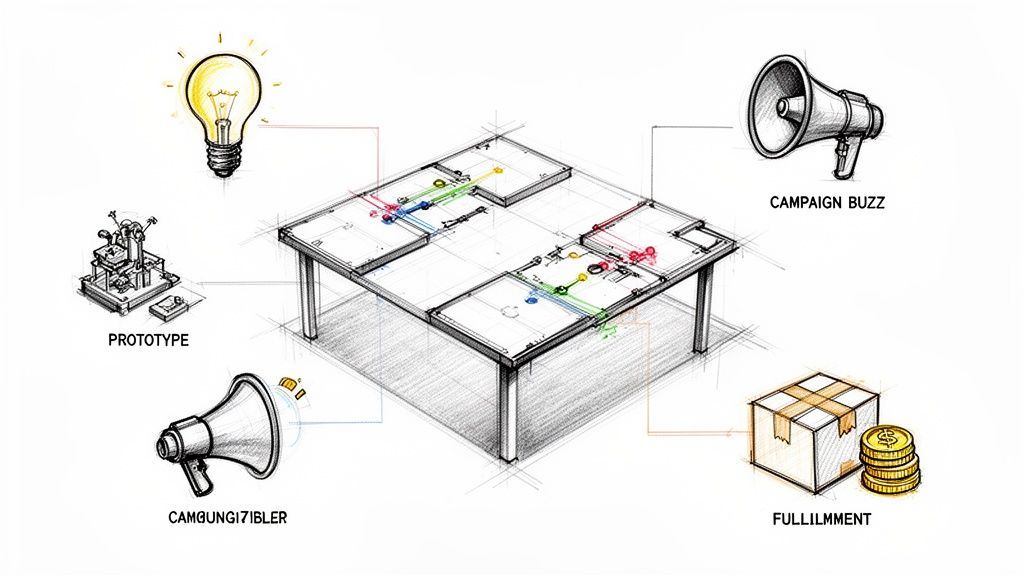
Here’s a simple way to visualize the path ahead. It breaks down into three core phases: Design, Campaign, and Fulfillment.

This map shows how a project flows from the drawing board, through the whirlwind of the campaign itself, and finally into the nitty-gritty of getting your tables delivered.
Thinking about the project in distinct stages helps you focus your energy where it's needed most and keeps you from getting overwhelmed.
A common—and costly—mistake is treating the post-campaign phase as an afterthought. This is where a great pledge manager isn't just nice to have; it's essential. Think of it this way: Kickstarter's pledge manager is like Amazon for getting discovered. A tool like PledgeBox's pledge manager is like your own personal Shopify, giving you total control over backer relationships and the entire fulfillment process.
Using a dedicated pledge manager is one of the smartest strategic moves you can make. It’s not just for sending surveys; it’s a tool for boosting your profits and making your life easier.
For instance, PledgeBox is free to send the backer survey and only charges a 3% fee on any new funds you raise through upsells. This makes it a totally risk-free way to increase your revenue after the Kickstarter clock runs out. It turns a logistical headache into a new revenue stream and gives you the power to handle everything from address updates to complicated international tax collection.
A great idea is one thing, but a high-quality, tangible product is what backers actually open their wallets for. Before your gaming table can take Kickstarter by storm, you have to turn that concept into something real—something that people can see, touch, and get genuinely excited about. This is where the real work begins, moving from a simple sketch to a solid prototype.
Let's be honest, the gaming table market is crowded. To get noticed, you can't just build another table. You need to zero in on what makes your table different and better. Don't try to appeal to everyone. Instead, find your unique selling proposition (USP) and own it.
Maybe your table offers incredible modularity, letting gamers switch from a sprawling RPG to a tight board game in minutes. Or perhaps you’re using premium, sustainably sourced hardwoods to attract a more discerning buyer. You could even go the tech-heavy route with built-in wireless charging, slick LED lighting, or a hidden TV lift for digital maps.
Your USP is the soul of your product. It will guide everything from your material choices and design features to how you talk about your table in your marketing. Think about the specific problems you’re solving for gamers.
Once you have a clear vision, it’s time to start prototyping. This isn't a one-shot deal. It's a loop: build, test, tweak, repeat. The end goal is what we call a "looks-like, works-like" prototype—a final version that’s ready for its spotlight in your campaign video and photos.
The best prototypes are battle-tested. Get early versions in front of actual gamers. Watch them use it. Do they find the vault too deep? Is the armrest comfortable after a four-hour game session? Their feedback is pure gold.
Don't be shy about asking for honest critiques from your local gaming group or on forums online. You'll uncover design flaws and see opportunities for improvement you might have completely missed. For a deeper dive, check out our guide on crafting a crowdfunding prototype. This hands-on testing is what makes sure your final design is both gorgeous and functional.
With a final design locked in, your next big challenge is figuring out how to actually make it. A beautiful prototype is completely worthless if you can't manufacture it at scale and on budget. So many first-time creators get this wrong, and it can lead to absolute disaster after the campaign funds.
Start talking to potential manufacturing partners and sourcing materials early. Get quotes from multiple factories, but don't just pick the cheapest one. Dig into their experience, check their production capacity, and ask about their quality control. Always request samples to see and feel the quality for yourself.
At the same time, you need to build a detailed Bill of Materials (BOM) and get a real handle on your Cost of Goods Sold (COGS). I’ve seen too many campaigns fail because the creator didn’t truly understand their costs before setting prices. Always add a buffer—a "what if" fund for those surprise expenses that always seem to pop up.
Doing this homework pays off in two huge ways:
By the time you sit down to write your Kickstarter page, you won't just be selling a dream. You'll be offering a proven, desirable, and manufacturable gaming table that’s ready for the big leagues.
A successful gaming table Kickstarter doesn’t just happen overnight. It launches with a bang, fueled by momentum you’ve built for months. Your campaign’s success really comes down to two things: an audience that’s excited to back you on day one, and a campaign page that turns that excitement into pledges. I've seen it time and again—creators who skip the pre-launch phase are making a huge mistake.

The real work starts long before you hit that "launch" button. The goal is to build a community of supporters who feel like they're a part of your table's story from the very beginning. A simple "coming soon" page just doesn't cut it; you have to give people a real reason to sign up and stick around.
Your pre-launch strategy needs one core focus: capturing emails. An email list is the single most valuable asset you have for a launch. It’s not uncommon for this list to drive 30-40% of your total funding in the first 48 hours. That initial surge provides powerful social proof and is exactly what you need to start climbing Kickstarter’s discovery rankings.
To get those emails, you need a solid lead magnet—something valuable you offer in exchange for their email address. For a gaming table, you could try:
Once you have their email, don't just go silent. Keep them in the loop with weekly updates. Share prototype progress, manufacturing insights, and sneak peeks of your campaign video. This consistent communication builds trust and serious anticipation. If you want to dig deeper, you can learn more about perfecting your Kickstarter pre-launch strategy with more advanced tools and tips.
Think of your Kickstarter page as your digital storefront, marketing brochure, and investor pitch all rolled into one. It needs to tell a great story while clearly showing off the value and features of your gaming table. The best pages I've seen feel like an extension of the gaming experience itself.
Your ideas are good. Don’t let trends or others convince you to compromise on your creation. Make the game [or table] that you want to play, test it to make sure it plays well, and find people who want to play it, too. They’re out there.
Start by answering one simple question: why did you create this table? What problem does it solve for gamers? Put that "why" front and center to grab attention and forge an immediate emotional connection.
For a physical product like a gaming table, visuals are everything. You absolutely have to invest in professional photography and video. Your main video should be a quick, energetic showcase of the table in action. Get real gamers using it, highlight its best features, and show off its modularity or other unique selling points. To help create visuals and marketing materials that really pop, an AI product advertisement generator can be a fantastic tool for your campaign page.
Make sure to use a mix of high-quality photos, GIFs, and graphics throughout the page. This breaks up the text and keeps backers scrolling. Show every angle, every feature, and every possible use case you can think of.
Your reward tiers are where the magic happens. If they’re structured poorly, you can confuse backers and completely stall your funding. The goal is to create a clear, simple path that guides backers toward your ideal pledge level.
Try to avoid overwhelming people with too many choices. A simple, effective structure usually works best:
Position that "All-In" tier as the best possible value. Many successful campaigns find their average pledge value lands somewhere between $85 and $150, and it's often these value-packed upper tiers driving that number. Don't make the price jumps between tiers too big, as that can create a mental block. Instead, make each step up feel like a small, logical, and worthwhile upgrade. This approach nudges backers to spend just a little bit more to get a lot more in return, which can seriously boost your overall funding.
Your campaign just crushed its funding goal, and the confetti is flying. It's an amazing feeling. But once the celebration winds down, the real work begins. The post-campaign phase is where many gaming table Kickstarters either sink or swim, and it all boils down to managing thousands of backers, complicated orders, and massive shipping logistics. This is where a dedicated pledge manager becomes the most valuable player on your team.
A lot of first-time creators figure Kickstarter's built-in survey tool is good enough. Trust me, it’s not. The native survey is a simple, one-time form. Once a backer hits submit, that's it—they can't change their address, you can't offer them awesome new add-ons, and you can't collect extra funds for shipping or taxes. For a complex, high-value item like a gaming table, this rigid system is a recipe for logistical chaos and lost revenue.
Think of it this way: Kickstarter is the world's best marketplace—it's like Amazon. It has a huge, built-in audience of buyers ready to discover and fund your project. But once the sale is made, you need a different tool.
A pledge manager like PledgeBox is your own customizable storefront—more like Shopify. It gives you total control over your relationship with backers after the campaign ends, turning a logistical nightmare into a powerful business opportunity.
The cracks in Kickstarter's native tools show up fast. Imagine a backer moves six months after your campaign ends but before you're ready to ship. With the basic survey, they have no simple way to update their address. That leads to mis-shipments, unhappy backers, and expensive re-delivery fees you have to eat.
A pledge manager solves this by giving backers their own portal where they can manage their pledge, update their address right up until shipping locks, and even upgrade their reward tier. This flexibility isn't a "nice-to-have"; for a long-lead project like a gaming table, it's an absolute necessity.
More importantly, it’s a revenue engine. The tabletop gaming market is on fire, raising $272 million on Kickstarter in 2021 alone. Research shows that pledge managers and late pledges add an average of 15% to a project's initial funding total. You can see more on this by checking out insights into tabletop industry statistics on Wifitalents. That 15% is pure profit you’d otherwise leave on the table.
A pledge manager is your chance to turn a backer’s initial excitement into additional sales. They’ve already bought into your vision; offering them matching chairs, custom playmats, or premium component trays in a survey is the easiest sale you will ever make.
The real power of a modern pledge manager is how it handles complex money matters after the campaign. This is where you solve two of the biggest profit-killers for any gaming table kickstarter: shipping and taxes.
This is where a tool like PledgeBox becomes a no-brainer for creators. PledgeBox is free to send the backer survey and only charges a 3% fee on any new funds you raise from add-ons and late pledges. If you don't raise any extra funds, you don't pay anything. It's a completely risk-free way to boost your project's bottom line.
The difference between using Kickstarter's basic survey and a dedicated pledge manager is night and day. Here’s a quick breakdown of what you get—and what you're missing out on.
| Feature | Kickstarter Native Surveys | PledgeBox Pledge Manager |
|---|---|---|
| Address Updates | No. Backers cannot edit their address after submission. | Yes. Backers can update their address until you lock orders. |
| Upsells & Add-Ons | No. Surveys are for information collection only. | Yes. Create a full post-campaign storefront experience. |
| Raise More Funds | No. You cannot collect additional payments. | Yes. Charge for shipping, taxes, and new items. |
| Late Pledges | No. Once the campaign ends, new backers can't join. | Yes. Capture sales from people who missed the campaign. |
| Shipping Calculation | No. You must estimate costs during the campaign. | Yes. Calculate and charge precise shipping fees by region. |
| Pledge Upgrades | No. Backers are locked into their original reward tier. | Yes. Allow backers to upgrade to a higher reward level. |
| Customer Support | Limited to Kickstarter's platform. | Dedicated support for you and your backers. |
As you can see, relying on the native survey puts serious limits on your project's potential and creates a lot of manual work. To dive deeper, check out this guide on the importance of a pledge manager for Kickstarter projects.
Choosing the right post-campaign tool isn't just an operational choice; it's a strategic one that directly impacts your profit, backer happiness, and the long-term success of your gaming table. Don't let a simple survey tool cap your potential.

Getting your gaming table funded is an incredible feeling, but that's really just the beginning. Now comes the hard part: getting a massive, heavy piece of furniture into the hands of thousands of backers all over the world. This is the stage where many promising gaming table kickstarter projects fall apart.
A gaming table isn't like shipping a board game. You're not dealing with parcels; you're dealing with freight. That means navigating the world of Less-Than-Truckload (LTL) carriers, dealing with extra fees for residential deliveries, and understanding that costs can swing wildly from one zip code to another.
Getting this wrong is more than just a headache—it can be catastrophic. If you underestimate shipping, you could wipe out your profit margins or even end up deep in the red. Finding the right fulfillment partner isn't just a good idea; it's essential for your project's survival.
A good Third-Party Logistics (3PL) partner is far more than just a warehouse. They are your command center for all things shipping. You need one that specializes in storing, packing, and shipping oversized products, and ideally, one with deep experience in crowdfunding fulfillment.
When you're vetting potential 3PLs, ask them tough, direct questions:
A solid partner will have confident, clear answers and a proven history. They'll help you build a shipping plan that protects your budget and gives your backers a smooth experience. Don't just pick the cheapest option; go with the team that has real expertise.
Shipping a gaming table overseas adds a whole new layer of complexity, and it all comes down to taxes. You absolutely have to understand two acronyms: VAT (Value-Added Tax) and GST (Goods and Services Tax). These are taxes that many countries will require you to collect from your backers and pay on their behalf.
The single biggest mistake you can make is trying to roll these taxes into your Kickstarter pledge price. It’s a recipe for disaster. The industry standard is to state clearly on your campaign page that all VAT, GST, and any customs duties will be calculated and collected after the campaign, based on each backer's specific country.
This is where a good pledge manager becomes your best friend. It lets you set up complex shipping and tax rules for every country or region. You can configure the system to automatically add the right VAT for a backer in Germany and a different rate for one in the UK. This way, you collect exactly what’s needed and your backers don’t get hit with surprise bills from their local customs office—a surefire way to kill your brand’s reputation.
The demand for these products is global and exploding. The European board game market alone is projected to grow by $1.57 billion between 2021 and 2026, and Brandon Sanderson's Cosmere RPG shattered records by raising over $15 million. With the global tabletop games market projected to hit $49.17 billion by 2029, a smart international strategy is no longer optional. You can see more on crowdfunding project funding trends on Statista.
Once you've locked in your 3PL and have a plan for taxes, your pledge manager ties it all together. This is where your backer data lives and breathes. Instead of fighting with chaotic spreadsheets, you have one central dashboard to run your entire post-campaign operation.
Here’s how it makes the entire fulfillment process simpler:
This organized workflow frees you up to focus on manufacturing and talking to your community instead of being stuck in administrative hell. It’s where the real power of a pledge manager comes to life.
For example, a platform like PledgeBox acts as your mission control. Remember, PledgeBox is free to send the backer survey and only charges a 3% fee on any new funds you raise through upsells. It’s like using Amazon for discovery but having your own powerful Shopify-style backend to run your business and nail your fulfillment. This approach turns a logistical nightmare into a secure and profitable part of your campaign.
 As you've mapped out the journey of bringing a gaming table to life on Kickstarter, you've probably run into a few big questions. We see the same challenges pop up for creators all the time. Let’s tackle the most common ones head-on with some straight-to-the-point answers to help you cross the finish line with confidence.
Set aside 10-20% of your funding goal for marketing. Honestly, for a high-ticket item like a gaming table, treating this budget as anything less than essential is a recipe for a stalled campaign.
This isn't just for running a few ads. This money covers the essentials: professional video and photography to make your table look incredible, and targeted social media ads before and during your launch. You should also earmark some of that budget for getting your table into the hands of trusted tabletop content creators for reviews—their validation can be a massive driver of backers.
Pre-launch ads are your secret weapon for building an email list. We’ve seen that early, engaged email list account for up to 40% of total funding on day one. That’s the kind of momentum that gets you noticed by Kickstarter's algorithm.
By far, the most catastrophic mistake we see is underestimating shipping costs. I'm not just talking about being off by a few dollars; I mean miscalculations so huge they can sink an otherwise successful project. A gaming table is heavy furniture, and it ships via freight—not in a small box via standard mail.
So many creators forget to research the gritty details of LTL (Less-Than-Truckload) freight, residential delivery fees, and the tangled mess of international customs and VAT. These oversights often lead to devastating financial losses after the campaign has already funded.
The absolute safest way to handle this is to charge for shipping after the campaign using a pledge manager. This lets you give backers accurate, real-time quotes based on their location, protecting your margins from any nasty surprises.
Kickstarter's survey tool is incredibly basic. It’s a one-and-done static form. Once a backer fills it out, they can’t change their address, and you can’t offer them cool add-ons or charge for shipping and taxes. For a complex project like a gaming table, that’s a complete non-starter.
You need a system where backers can manage their pledge, pay for those variable shipping costs, and maybe even add a set of matching chairs or cupholders. This is exactly what a dedicated pledge manager is for. Think of Kickstarter’s tool as a simple checkout, whereas a tool like PledgeBox is your own customizable storefront.
For instance, with PledgeBox, it’s free to send your backer survey, and we only charge 3% on any upsells you make. This approach turns what is normally a logistical headache into a risk-free way to boost your project's bottom line.
Getting VAT and GST right is non-negotiable for a smooth fulfillment experience. The industry standard—and the method that will save you the most headaches—is to never include taxes in your Kickstarter pledge prices.
Instead, make it crystal clear on your campaign page that all taxes and import duties will be calculated and collected after the campaign through your pledge manager. A good pledge manager will let you set up specific tax rules for different countries, like the UK, EU nations, and Canada.
The system then automatically applies the correct tax to each backer's final order based on their shipping country. This ensures you collect exactly what’s owed to the authorities, avoiding legal trouble for you and surprise fees for your backers.
At PledgeBox, we've built an all-in-one toolkit designed to help you plan, launch, and grow your gaming table Kickstarter. From building your pre-launch audience to managing post-campaign surveys and fulfillment, our platform gives you the control you need to succeed. Learn more and get started today.
PledgeBox
The All-in-One Toolkit to Launch, Manage & Scale Your Kickstarter / Indiegogo Campaign