 PledgeBox
Critical Role Kickstarter Breakthrough: Secrets to Success
Discover the critical role kickstarter's success story, key strategies, and lessons to boost your own crowdfunding campaign. Learn more now!

Discover the critical role kickstarter's success story, key strategies, and lessons to boost your own crowdfunding campaign. Learn more now!
When the team behind Critical Role decided to crowdfund an animated special for The Legend of Vox Machina, they ended up making history. Their Kickstarter campaign didn't just succeed; it exploded, pulling in a staggering $11.4 million from over 88,000 backers.
What started as a modest dream for a single episode turned into a full-blown series, completely rewriting the rules for fan-funded projects.

The story starts with a popular Dungeons & Dragons web series. Critical Role, a show where a group of talented voice actors play D&D, wanted to give back to their community—known as "Critters." Their idea was to create a 22-minute animated special based on their first adventure, Vox Machina.
To make it happen, they set an initial funding goal of $750,000. But the community's response was something no one saw coming.
The campaign didn't just creep past its goal; it blew it out of the water. The funding meter rocketed past $2 million in under four hours, finally closing out at an incredible $11.4 million.
This massive success cemented its place in crowdfunding lore. It became the fastest TV/movie project to hit $1 million and, at the time, the most-funded film project ever on Kickstarter.
This campaign is a masterclass for any creator thinking about crowdfunding. It shows just how powerful a dedicated, engaged community can be, pushing a project far beyond its initial vision. The success wasn't an accident; it was the result of years spent building a genuine connection with their audience.
The Critical Role Kickstarter proves a fundamental truth of crowdfunding: a project's success is often determined long before the launch button is ever pressed. The "magic" is not in the platform, but in the community you build around your creative vision.
This phenomenon is common among the most funded gaming projects on Kickstarter, where passionate fanbases are the driving force behind massive raises.
Of course, raising the money is just the beginning. The real logistical headache is fulfilling rewards for 88,000+ backers.
This is where creators need specialized tools. Think of it this way: Kickstarter's pledge manager is like Amazon—a huge marketplace to find backers and make a sale. But once the campaign is over, you need something more personal to manage the aftermath.
That's where a pledge manager like PledgeBox comes in. It acts like your campaign's personal Shopify—a dedicated storefront for everything post-campaign. You can send out surveys, collect shipping info, and even offer cool add-ons to your backers.
The best part? PledgeBox is free to send the backer survey. They only charge a small 3% fee on funds raised through upsells, if there's any. This makes it a no-brainer for managing fulfillment without eating into your budget.
The mind-boggling success of the Critical Role Kickstarter didn't happen by chance. It was the payoff from a perfectly executed plan, one built on years of groundwork. The campaign’s win wasn't just about a good idea; it was about having an army of fans ready to storm the gates on day one.
This pre-launch foundation is everything. Critical Role spent years building a real, authentic bond with its "Critter" community through their web series. This wasn't just an email list—it was a deeply invested audience that trusted the creators and felt a true sense of ownership in the world of Exandria.
Another masterstroke was their use of ambitious stretch goals. Instead of just adding minor perks, each new funding milestone unlocked massive expansions to the project. What started as a single 22-minute special grew into a full, ten-episode season. This strategy kept the energy electric, giving backers a compelling reason to keep sharing and pledging. It turned the campaign from a simple fundraiser into a 45-day event.
Of course, none of this would have worked without clear and constant communication. The team kept everyone in the loop with regular updates, shared their genuine excitement, and made backers feel like they were part of the inner circle. That kind of transparency builds incredible trust and keeps the momentum rolling.
The chart below shows just how far ahead of the curve the Critical Role Kickstarter really was. It puts the massive gap in funding, backers, and engagement into stark visual terms.
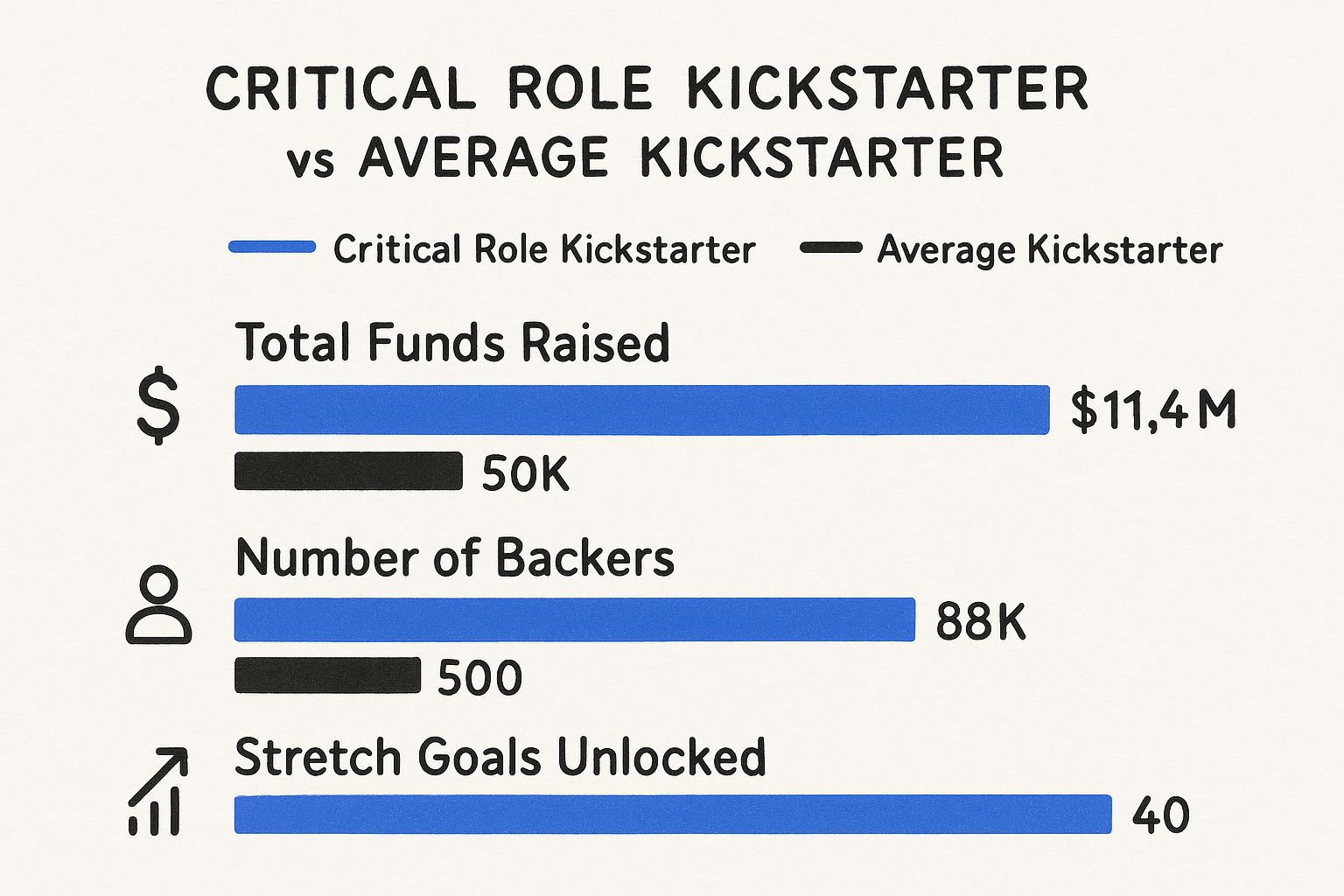
You don't need to squint to see the difference. Their success wasn't just a step above average; it was playing in a completely different stadium, all thanks to that hyper-engaged community.
Let's put this into perspective. Since its launch, Kickstarter projects have raised over $8.51 billion, with a success rate hovering around 39.11%. Most successful campaigns raise fairly modest sums. Critical Role, however, joined an exclusive club of just 883 projects (at the time) that have ever broken the $1 million mark.
A knockout crowdfunding campaign actually shares a lot of DNA with a traditional product launch. To sharpen your own strategy, it's worth digging into effective product launch strategies.
Figuring out what makes these outlier campaigns tick is mission-critical for any creator with big ambitions. You can learn more about how to increase your chances of success on Kickstarter in our article. In the end, the Critical Role campaign is proof that when a powerful community rallies behind a vision they believe in, the results can be legendary.

Hitting your funding goal feels incredible, but experienced creators know it’s just the halfway mark. For a massive campaign like Critical Role’s, the real work starts after the campaign ends: fulfillment. We’re talking about a logistical monster of managing tens of thousands of backers, each with different rewards, addresses, and questions.
This post-campaign phase is where so many projects get bogged down. They get overwhelmed by the sheer volume of spreadsheets, emails, and manual tracking. Kickstarter's own pledge manager isn't built for the complex backend management needed to get rewards out the door and into backers' hands.
So, what's the difference? Let's use an analogy.
Think of Kickstarter's pledge manager as the Amazon of crowdfunding. It’s a huge, bustling marketplace where you list your idea, find a massive audience, and handle the initial transaction. It's built for discovery and getting that first sale.
A pledge manager like PledgeBox, on the other hand, is your campaign's personal Shopify. It’s your own dedicated, flexible storefront that gives you total control over everything that happens after the campaign. You can manage relationships, calculate tricky shipping costs, and even bring in more revenue through add-ons and late pledges.
No matter the platform, a huge part of fulfillment is managing client expectations effectively. A good pledge manager is designed to do just that by making communication clear and backer management simple.
To really see the difference, let’s compare Kickstarter’s built-in survey tools to a dedicated platform like PledgeBox.
While Kickstarter gets you funded, a pledge manager is what helps you actually deliver on your promises efficiently and professionally.
Tools like PledgeBox are specifically built to fix these post-campaign headaches. They create a central hub where your backers can finalize their orders, update their address if they move, and grab those extra items they decided they wanted after all. This one feature alone dramatically cuts down on support emails and ensures packages go to the right place.
A pledge manager transforms the chaotic process of fulfillment into a structured, manageable workflow. It empowers creators to focus on producing their project rather than getting lost in spreadsheets and email chains.
One of the best things about PledgeBox is its pricing. It is completely free to send your backer survey. The platform only takes a small 3% fee on any new funds you raise through upsells, if there's any. It’s a totally risk-free model. You can use their powerful survey tools without paying a dime upfront, and the fee only kicks in if you successfully make more money.
This is a huge deal for creators. It levels the playing field, giving smaller campaigns access to the same professional tools used by the big players. For a deeper look, check out this guide on the importance of pledge managers in Kickstarter projects. It’s how massive successes like the Critical Role Kickstarter can manage the mind-boggling complexity of getting rewards to every single backer, smoothly and on time.
 For The Legend of Vox Machina, the story didn't end once the last backer reward was in the mail. The absolute tidal wave of support from the Critical Role Kickstarter was just the beginning. It became a launchpad for something much, much bigger, transforming a fan-funded passion project into a mainstream media powerhouse.
Why? Because the campaign served as undeniable proof that a massive, paying audience was desperate for this story.
That kind of market validation is a creator's ultimate bargaining chip. Big studios and streaming platforms are always weighing the risks of investing in new intellectual property. Critical Role walked in and essentially erased that risk, presenting a project not just fully funded with $11.4 million, but also passionately supported by over 88,000 fans who were already bought in.
That incredible proof-of-concept didn't go unnoticed. Shortly after the campaign wrapped, a partnership was announced that would catapult the project onto the global stage. Amazon swooped in, acquiring the exclusive streaming rights for The Legend of Vox Machina.
But the deal went way beyond simple distribution. Amazon also ordered more episodes to round out the first season and greenlit a second 12-episode season right off the bat—a massive vote of confidence. You can get the inside scoop on how the Amazon deal came together on Tubefilter.
This move was a total game-changer. It guaranteed the series would get the high-end production and marketing muscle it needed to stand shoulder-to-shoulder with established animated shows. Suddenly, millions of people who had never even heard of the original web series were just a click away.
Making the jump to Amazon Prime Video wasn't just about a bigger budget; it was about blowing the doors wide open on the audience. The Kickstarter built the foundation, but the streaming deal built the skyscraper on top of it.
This journey holds some powerful lessons for any creator out there:
The Critical Role Kickstarter didn't just fund an animated series; it acted as a pilot program for a global franchise. It proved that a dedicated community could launch a project with enough momentum to attract the attention of industry giants.
The show's wild success on Amazon cemented Critical Role's place as a major player in the entertainment world. It was the final proof that a story that started around a Dungeons & Dragons table could truly captivate the entire world.
The wild success of the Critical Role Kickstarter wasn't just a lucky break; it's a playbook for creators. By digging into their strategy, we can pull out real, practical lessons that work for any campaign, whether you're a solo creator or shooting for the moon.
The single biggest takeaway? They already had an audience. Critical Role didn't just launch a Kickstarter and cross their fingers. They spent years building a genuine connection with their fans—the "Critters"—who were fired up and ready to go the moment the campaign dropped. That community-first mindset is the absolute foundation of a killer crowdfunding launch.
On top of that, their whole campaign was an event. The pledge tiers weren't just about buying something; they made backers feel like they were part of the crew. And the stretch goals? They were smart, exciting, and turned the entire month into a collective mission to make something awesome even better.
Long before you even draft your Kickstarter page, you need to be building your crowd. Start that newsletter, get active on social media, or create a Discord server. Share your work, be open about the process, and build the kind of trust that makes people want to throw their support behind you.
This pre-launch work is non-negotiable. It's how you find your die-hard fans and build the momentum you need to get funded fast—often in the first 24 hours.
Raising the money is only half the job. Fulfillment is where so many campaigns fall apart. You have to plan for the logistics of collecting addresses, managing rewards, and handling shipping from the very beginning. This is where a dedicated pledge manager becomes your best friend, saving you from spreadsheet hell and an inbox full of angry backer emails.
Here’s a simple way to think about it: Kickstarter's pledge manager is like Amazon—perfect for that initial sale. A tool like PledgeBox, on the other hand, is your campaign’s Shopify—a powerful, flexible hub for everything that happens after the funding ends.
A smooth fulfillment process is just as vital as a successful funding campaign. It proves you can deliver on your promises and turns one-time backers into loyal fans for life.
Using a specialized tool like PledgeBox makes this whole process feel professional and effortless. You can send out detailed backer surveys, let people update their addresses, and even bring in more cash through add-ons and late pledges.
Best of all, PledgeBox is free to send the backer survey and only charges 3% on new funds raised through upsells, if there's any. This makes it a totally risk-free way to manage fulfillment and give your budget a final boost. When you make logistics a priority from day one, you guarantee a great experience for your backers and set yourself up for future success.
Crowdfunding can seem like a tough world to navigate, but the lessons from the Critical Role Kickstarter are a goldmine for creators. Here are some of the most common questions people ask when they look at this monster campaign.
Hands down, it was their massive, pre-existing community. Before they ever launched, Critical Role spent years building an incredibly dedicated fanbase—the "Critters"—through their live-play web series.
This wasn't a cold launch. Their audience was already emotionally invested and ready to open their wallets on day one. That foundation of trust, paired with a product they were dying to see and smart stretch goals, was the real secret sauce. It was less of a campaign and more of a celebration for a community that had been growing for years.
Think of it this way: Kickstarter's pledge manager is like Amazon—a huge marketplace where you make the initial "sale." But once that's over, you need your own personal Shopify to handle the nitty-gritty details. That's what a pledge manager like PledgeBox does.
Kickstarter's built-in tools just aren't designed for complex post-campaign logistics. A pledge manager lets you send detailed surveys, allows backers to upgrade their pledges, and—crucially—lets you sell add-ons or accept late pledges to keep the funding coming. For instance, PledgeBox is free for sending the backer survey and only charges a 3% fee on new funds raised through upsells, if there's any, making it a no-brainer for boosting your total and simplifying fulfillment.
A pledge manager turns the post-campaign chaos of surveys, shipping, and add-ons into a manageable, professional operation. It’s the difference between being a project creator and a business owner.
It frees you up to focus on creating an amazing product instead of getting buried in spreadsheets and hundreds of backer emails.
Absolutely. You might not be aiming for millions of dollars, but the core strategies that made Critical Role successful are completely universal.
The number one takeaway is to build your community before you launch. Don't wait until your campaign is live to find your audience. Start engaging with people on social media, in forums, or through a newsletter now. Be transparent, be authentic, and create funding tiers and stretch goals that feel like a genuine thank you to your early supporters. The campaign was built on trust, and that’s a currency every single creator can start earning today.
The Kickstarter was the ultimate proof-of-concept. When you raise over $11 million from more than 88,000 backers, you're not just pitching an idea anymore—you're showing up with a validated market and a guaranteed audience.
For a giant like Amazon, this completely de-risked the investment. Critical Role didn't just have a great story; they had the data to prove that people would pay to see it. That incredible show of force is what turned their creative passion project into an attractive business deal, leading directly to the Amazon acquisition and a global streaming series.
Running a Kickstarter is a huge job, but you don't have to do it all by yourself. PledgeBox gives you all the tools you need for a smooth run, from pre-launch to fulfillment. It makes it easy to manage backer surveys, sell more with add-ons, and get your rewards out the door on time. See how it works at https://www.pledgebox.com.
PledgeBox
The All-in-One Toolkit to Launch, Manage & Scale Your Kickstarter / Indiegogo Campaign