 PledgeBox
Your Guide to a Successful Battletech Game Kickstarter
Launch a successful Battletech game Kickstarter with our complete guide. Learn proven strategies for pre-launch, campaign design, and fulfillment.
Launch a successful Battletech game Kickstarter with our complete guide. Learn proven strategies for pre-launch, campaign design, and fulfillment.
The secret to a monster battletech game kickstarter isn't a flashy video or a last-minute ad spend. It’s decided months before you hit the launch button, and it all comes down to one thing: a fired-up, engaged community that’s ready to storm the gates the moment you go live. The biggest campaigns don’t just happen. They’re the explosive result of careful, strategic audience building that creates a tidal wave of support from the first minute.
The road to a funded project starts long before day one. It begins with building a movement and a shared sense of excitement for the universe you’re creating. This is so much more than marketing—it’s about finding your tribe, pulling back the curtain on your vision, and making them feel like they’re part of the team.
This pre-launch phase is where you turn curious onlookers into die-hard advocates. You’re not just pitching a product; you’re inviting people on an adventure. A solid community doesn’t just get you funded. It gives you priceless feedback, shouts your message from the rooftops, and becomes your most valuable asset long after the campaign clock runs out.
Before you can rally the troops, you need a clear banner for them to gather under. What’s the core fantasy of your game? A deeply tactical mech simulator? A sprawling narrative RPG? A lightning-fast skirmish brawl? Nail down your project's scope and be brutally realistic about what you can deliver.
Once that vision is crystal clear, you need a smart, achievable funding goal. This number has to cover your absolute essentials—manufacturing, art, design, and initial freight—without being so high it scares people off. A great way to start is by digging into the numbers of similar, successful projects.
Just look at the first big BattleTech digital game Kickstarter by Harebrained Schemes. It pulled in an insane $2,785,537 from 41,733 backers, crushing its initial $250,000 goal. That wasn't a fluke. It was proof that a massive, hungry community was already there, waiting for a modern take on the franchise. The average pledge of around $67 showed that these weren't casual fans; they were seriously invested. You can still see the campaign's meteoric rise on Kicktraq.
To stay organized and on target, a pre-launch checklist is your best friend. It helps you map out the critical path to a strong launch day.
Here's a quick rundown of the essential groundwork you should be laying in the months leading up to your campaign. Following this will help you build momentum and ensure you're not scrambling at the last minute.
| Activity | Primary Goal | Recommended Timeline |
|---|---|---|
| Project Definition | Solidify game concept, mechanics, and art style. | 6-12 months pre-launch |
| Funding Goal Calculation | Get quotes for manufacturing, art, and fulfillment. | 4-6 months pre-launch |
| Build a Landing Page | Create a central hub to collect email sign-ups. | 4-6 months pre-launch |
| Content Creation | Develop art, gameplay videos, and rulebook previews. | 3-6 months pre-launch |
| Email List Growth | Offer a print-and-play or exclusive content. | Ongoing, ramp up 3 months out |
| Social Media Engagement | Post regularly on relevant platforms (BGG, Reddit). | Ongoing, ramp up 3 months out |
| Kickstarter Pre-Launch Page | Set up your page and start collecting followers. | 1-2 months pre-launch |
This checklist isn't just a to-do list; it’s a strategic roadmap. Each item builds on the last, creating a groundswell of excitement that will peak right when you need it most—on launch day.
Social media is fantastic for generating buzz, but your email list is your direct line to your most passionate supporters. These are the people you can count on to back you on day one. To get this right, you'll need to look into some effective email marketing strategies that focus on building real relationships.
Give them something genuinely valuable for their email address. Think about offering:
This isn't just about harvesting emails. It’s about starting a conversation and earning trust long before you ever ask for money.
Your email list is the single most important asset for a successful Kickstarter launch. It represents a warm audience that has explicitly given you permission to contact them, making them far more likely to convert into backers than a cold social media follower.
Think of your social media channels as your public workshop. You need to be where your people are. For a Battletech-style game, that means hitting up BoardGameGeek forums, diving into dedicated Reddit communities like r/battletech, and getting active in Facebook groups or Discord servers.
Share your journey, not just your sales pitch. Post pictures of clunky prototypes, share snippets of amazing new art, and give people a peek behind the curtain of your design process. Most importantly, engage. Ask for opinions, listen to feedback, and make your followers feel like they have a real stake in the project. That’s how you build a community that feels true ownership.
For more ideas, check out our guide on the 7 actions to build your community before your Kickstarter campaign. When you combine a killer story with a dedicated community, you’re not just setting yourself up for a successful launch—you’re setting yourself up for a phenomenon.
Your Kickstarter page is so much more than a project description. Think of it as your digital storefront, your rally point, and the single most important sales tool for your Battletech game Kickstarter. It has to do more than just lay out the facts—it needs to build trust, create excitement, and give visitors a compelling reason to become a backer right now.
A killer campaign video is an absolute must. It’s your best shot at telling your story, showing off those amazing miniatures, and demoing the core gameplay that makes your game a must-have. You have to show, not just tell. Use quick cuts, dynamic shots of the components, and maybe some animated graphics to explain the rules. Most importantly, let your passion shine through. Backers want to see the creator behind the game, someone who is just as hyped as they are.
Let's be real: people don’t read Kickstarter pages, they scan them. Your job is to break up the dreaded wall of text with eye-catching visuals and clear, distinct sections. Use high-quality photos, professional renders of your mechs, and, most importantly, gameplay GIFs. A short, looping GIF can explain a complex mechanic way faster and better than a whole paragraph of text ever could.
You want to guide visitors through the page with a natural flow:
The tabletop category on Kickstarter is an absolute beast, and it’s not slowing down. In 2021, tabletop campaigns hit a massive $270 million in funding. Even with a slight dip to $236.4 million in 2022, the market is incredibly healthy. This just proves that a well-put-together campaign has a massive, eager audience waiting for it.
Your pledge levels are the engine of your campaign. The goal is to create a clear ladder of value that nudges backers to climb up to higher tiers. Don't overwhelm people with a dozen different choices; keep your core pledge levels focused—usually three to five distinct options are plenty.
Here’s a look at the top section from the incredibly successful BattleTech: Mercenaries campaign. It’s a perfect example of a strong visual hook and a clear call to action right from the start.
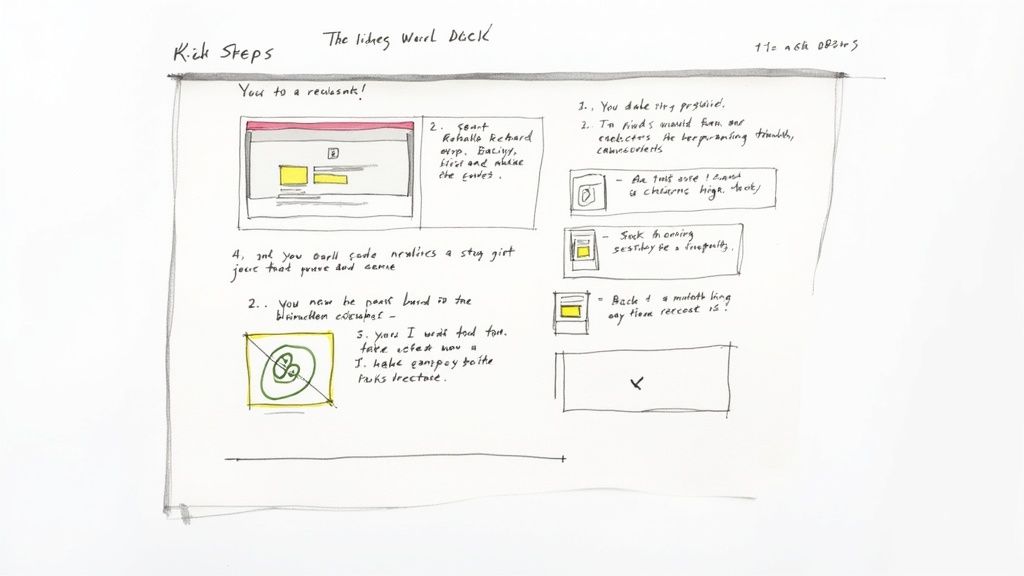
This layout immediately shows the video, funding status, and backer count. For a new visitor, that creates instant social proof and a feeling that they're joining something big.
Think beyond just the base game. Can you offer a deluxe version with upgraded components? An "all-in" pledge that bundles in expansions? Maybe even a premium tier with custom artwork? Each step up needs to feel like a significant, worthwhile upgrade. For more ideas on page layout, check out our guide on Kickstarter campaign page design tips.
One of the biggest mistakes I see is creators undervaluing their rewards. Price your pledges with confidence. Make sure they cover manufacturing, shipping, fees, and a healthy buffer for those inevitable surprises. Your backers are investing in a unique, premium product—not something they can grab from a discount bin.
At the end of the day, your campaign page is a specialized landing page built for one thing: getting pledges. It has to be clear, compelling, and trustworthy. To really dial in its effectiveness, you can dig into these landing page optimization best practices. When you combine a great story with smart design, you make hitting that "Back this project" button an easy and exciting decision for anyone who lands on your page.
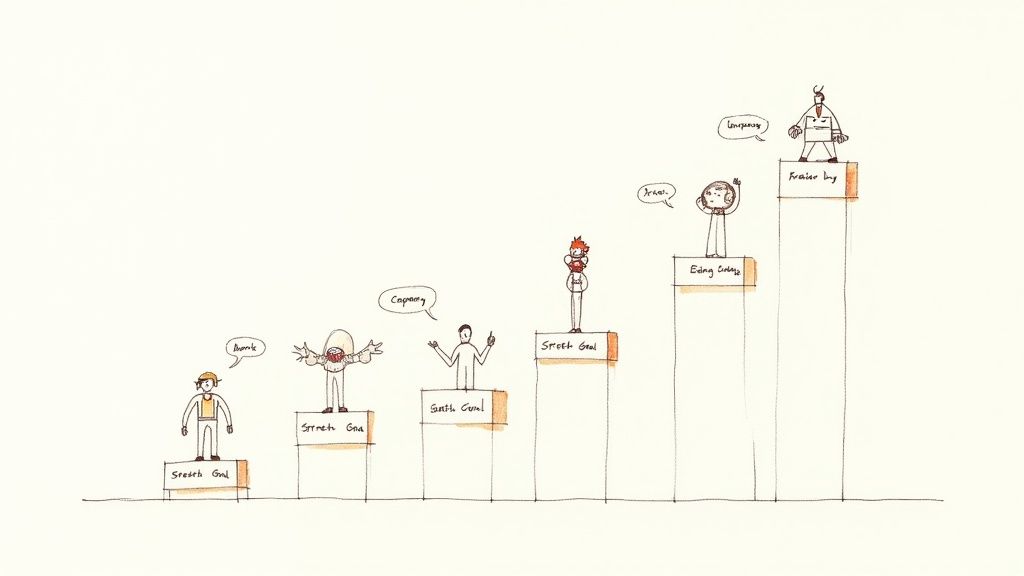
Hitting your initial funding goal for a battletech game kickstarter isn't the finish line—it's just the starting pistol. The truly massive campaigns build a sense of unstoppable momentum that carries them to incredible heights. This is where the art of smart stretch goals and genuine backer engagement turns a simple fundraiser into an exciting, shared event.
Once you’ve smashed that first target, the real fun begins. Stretch goals are the fuel that keeps the hype train chugging along. They give your existing backers a reason to share the project and entice new people to jump on board. More importantly, they make your community feel like they are actively improving the game they helped bring to life.
Let’s be clear: a poorly planned stretch goal can be a logistical nightmare, blowing up your budget and timeline. The key is to map out a series of upgrades that add real value without fundamentally changing your production pipeline. Think incrementally. Focus on enhancements that backers will genuinely appreciate.
Smart stretch goals often fall into these categories:
Catalyst Game Labs' BattleTech: Mercenaries campaign is a prime example of this strategy in action. It didn't just meet its goal; it soared past $6 million with the help of around 20,000 backers. Their team brilliantly used stretch goals to unlock new mech packs and component upgrades, which kept the community energized and sharing the project relentlessly. You can dig into the details of how this massive campaign maintained its drive and pull some lessons for your own project.
Your job isn't done after you post your stretch goal map. The comment section and project updates are your command center. Be present, be responsive, and be transparent. When you unlock a new goal, celebrate it! Post a dedicated update showing off the new art or a fresh render.
If you hit a potential snag or get a question you can't answer immediately, just say so. Backers appreciate honesty far more than radio silence. Actively participating in the comments shows you’re invested and listening, which builds immense trust and turns passive backers into your most vocal advocates. You're not just running a campaign; you're leading a community that is personally invested in your success.
The middle of a campaign, often called the "mid-campaign slump," is where your communication is most critical. This is the perfect time to reveal an exciting new stretch goal, run a poll to let backers vote on a component design, or share a deep-dive video into a specific game mechanic. Keeping the energy high is your primary job.
By combining well-planned, value-adding stretch goals with a constant, open line of communication, you create a powerful feedback loop. The more engaged your backers feel, the more they'll share the project. That sharing helps you smash through more goals, which in turn gets everyone even more excited. This is the secret sauce that defines the most memorable and successful Kickstarter campaigns.
When the final second ticks off your campaign clock and the confetti settles, the celebration is real—but it’s also short-lived. The moment your battletech game kickstarter successfully funds, a whole new phase of work kicks off. This is where you pivot from fundraising to logistics, and the tools you pick now will directly impact your profits and your backers’ happiness.
A lot of first-time creators figure Kickstarter's built-in survey tool is all they need. And while it can grab basic info, it's incredibly bare-bones. This is where a dedicated pledge manager becomes your command center, handling everything from collecting shipping fees to offering last-minute add-ons that can seriously boost your bottom line.
Here's a simple way to think about it. If Kickstarter's pledge manager is like Amazon—a standardized marketplace—then a pledge manager like PledgeBox is like Shopify. It gives you a powerful, customizable storefront to manage your business, grow revenue, and handle complex logistics your way.
On the other hand, using a dedicated pledge manager is like setting up your own professional storefront. It gives you a powerful, customizable hub to not only manage your existing backers but to keep the revenue flowing. You can craft a branded, smooth experience that makes it dead simple for backers to finalize their orders, add more cool stuff, and even jump in late if they missed the campaign.
Take a look at the clean, creator-focused dashboard from a platform like PledgeBox.
You can see right away this is more than a survey tool. It’s a control panel for upselling, managing complex shipping, and keeping a close eye on your project's financial health after the campaign ends.
One of the biggest myths is that a powerful pledge manager will eat into your budget. PledgeBox flips that script with a creator-first model: it's completely free to send the backer survey to collect shipping details and manage pledges. They only charge a 3% fee on new funds you raise through add-ons and late pledges. If you don't make extra money, you don't pay.
A smart survey is the backbone of a smooth fulfillment process. The goal is to make it painless for backers to give you what you need. A good survey lets you knock out several critical tasks at once.
By putting these upsells right inside the survey, you're reaching backers when they're most excited about your project. It’s not uncommon for successful campaigns to see an additional 10-20% of their initial funding raised in the pledge manager alone.
What about all those people who found your game the day after the campaign ended? A pledge manager lets you open a "late pledge" or pre-order storefront. This is like opening the doors again to a whole new wave of fans who missed out, adding to your total funds without any extra marketing effort on your part.
To make the choice crystal clear, let's compare what you're really getting with each option.
Trying to decide between Kickstarter's basic tools and a full-fledged platform can be tough. This table breaks down the core differences in what they let you accomplish after your campaign funds.
| Feature | Kickstarter Pledge Manager | PledgeBox |
|---|---|---|
| Basic Surveys | Yes | Yes |
| Upsell Add-Ons | No | Yes (customizable storefront) |
| Late Pledges | No | Yes (dedicated pre-order page) |
| Charge Shipping/VAT | No (only basic questions) | Yes (complex calculations supported) |
| Address Validation | No | Yes |
| Cost to Send Survey | Free | Free |
| Fee Structure | N/A | 3% on upsell funds only |
At the end of the day, a robust pledge manager isn't just another expense—it's an investment. It ensures you have clean, accurate data for your fulfillment partners, maximizes your revenue, and provides a professional, satisfying experience for the community that brought your game to life in the first place.
Getting that massive box of mechs and maps into the hands of thousands of backers across the globe is the final boss battle of your battletech game kickstarter. This is where fortunes are made or lost, and where a smooth process creates lifelong fans. Let me be blunt: mismanaging logistics can single-handedly sink an otherwise successful project.
The biggest mistake I see new creators make is charging for shipping during the campaign itself. Don't do it. Freight costs are wild and can swing dramatically in the 9-18 months between your campaign and the actual fulfillment date. The professional approach is to provide estimated shipping costs on your campaign page but collect the actual payment much later in your pledge manager.
This strategy ensures you charge the correct amount based on real-time rates and the final weight of each backer's specific order—add-ons included. It protects your budget from sudden price hikes and shows your backers you know what you're doing.
For a project with global appeal like a BattleTech-style game, you simply cannot afford to ship everything from a single location. The cost of international postage and the nightmare of customs duties will cripple your finances and infuriate your backers.
The only real solution is to partner with regional fulfillment centers. At a bare minimum, you'll want partners in these key hubs:
By freighting your games in bulk to these centers, you can then ship to individual backers domestically. This move drastically reduces postage costs, speeds up delivery times, and makes the whole customs process a non-issue for everyone involved.
The core of this entire operation hinges on a well-managed pledge manager. It's a simple, three-step flow: survey, upsell, and fulfill.
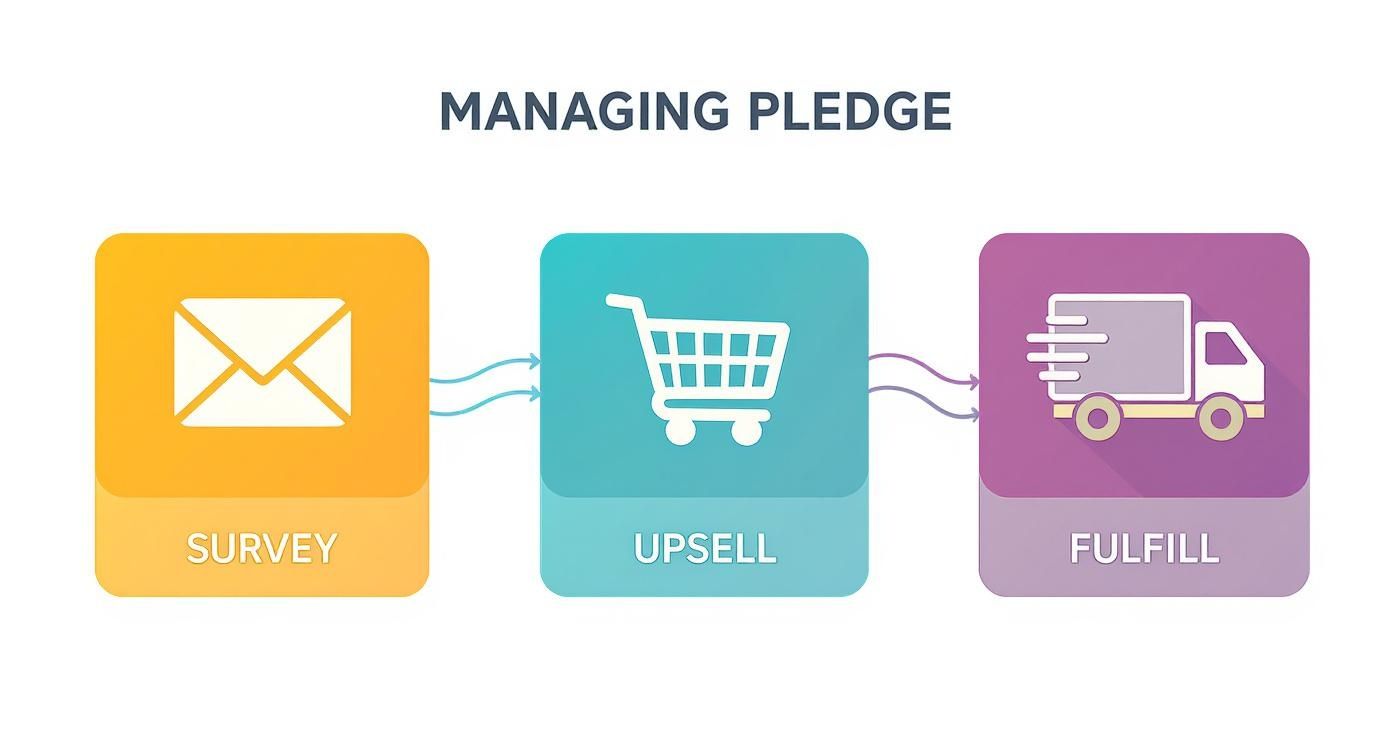
This process shows how a pledge manager connects the dots between collecting data, growing your revenue, and handling the actual logistics after the campaign confetti settles.
Ignoring Value-Added Tax (VAT) and sales tax isn't just a bad idea; it's a legal landmine that can destroy your project's profitability. When shipping to backers in the EU and the UK, you are responsible for collecting and remitting VAT. Full stop.
This is another area where a robust pledge manager becomes your best friend. It can automatically calculate and add the correct tax based on each backer's location and the value of their pledge plus shipping. Trying to handle this manually is a recipe for disaster. Be upfront about these taxes on your campaign page so backers know what's coming.
Think of it this way: Kickstarter's pledge manager is like Amazon—a standardized marketplace. A tool like PledgeBox, however, is like Shopify; it gives you a powerful, customizable storefront to manage your business, grow revenue, and handle complex logistics your way.
This level of control is crucial for managing the tangled web of global fulfillment. It gives you a central hub to manage backer data, charge for shipping and taxes, and export clean, organized spreadsheets for each of your regional fulfillment partners.
To make this whole process as painless as possible, you need a tool built for the job. While Kickstarter’s native surveys can collect an address, they fall woefully short for a complex tabletop project. This is where a dedicated platform like PledgeBox becomes your most valuable partner.
It's built on a creator-friendly model that removes financial barriers. It is completely free to send the backer survey and collect all the crucial shipping and pledge information you need. A fee only kicks in if you successfully generate extra income. PledgeBox charges a small 3% of the upsell revenue you generate from add-ons or late pledges. If you don't raise any extra money, you don't pay.
This structure allows you to use a professional-grade logistics tool with zero upfront cost, letting you manage your fulfillment efficiently while maximizing your campaign’s final revenue. Your logistics plan is the promise you make to your backers, and executing it perfectly is how you build a loyal community that will show up for you again and again.
Launching a big Kickstarter can feel like dropping into a hot zone. Even the best-laid plans hit unexpected snags, and questions are guaranteed to come up. Let's tackle some of the most common ones I hear from creators so you can stay focused on what matters: making an awesome battletech game kickstarter and giving your backers a great experience.
Lots of the confusion seems to bubble up right after the campaign ends. Creators, especially first-timers, get anxious about the post-campaign phase, and one question comes up again and again: what's a professional pledge manager really going to cost me?
This is a critical question because surprise fees can absolutely demolish your project's budget. It's also where you see the real difference between platforms.
With PledgeBox, the model is built to be totally creator-friendly. You can set up your entire project and send out all your backer surveys to collect shipping info and lock in pledges for completely free.
We only charge a fee if you make more money. PledgeBox takes a small 3% fee on any additional funds you raise after the campaign—things like selling add-ons, offering upgrades to deluxe editions, or running a late pledge store. If you don't use those features to upsell, you don't pay a dime for the survey and backer management service. Simple as that.
This is the big one. Get this wrong, and your campaign might be over before it even launches. The answer? Yesterday. But seriously, start as early as you possibly can.
For a miniatures game with the kind of scope we're talking about, you need to be building your audience at least 6 to 12 months before you plan to launch.
That's the kind of runway you need to build a real email list, get active and known on social media and forums like BoardGameGeek, and stir up genuine excitement. A fired-up, engaged community is the single best indicator that you'll fund on day one, which is the secret sauce for creating the momentum you need for a monster campaign.
Think of Kickstarter’s pledge manager like Amazon—it's a basic, one-size-fits-all marketplace. A dedicated pledge manager like PledgeBox is like Shopify, giving you a powerful, customizable storefront to manage your backers, grow your revenue, and handle complex logistics your way.
Ah, shipping and taxes. These are the two specters that haunt every project, and they can absolutely sink you if you're not careful. The two most common—and devastating—mistakes are underestimating shipping costs and completely ignoring VAT (Value-Added Tax).
So many new creators make the fatal error of charging for shipping during the Kickstarter campaign itself. Don't do it! Freight costs can swing wildly in the year (or more!) between when your campaign ends and when you actually ship. The only smart way to do it is to charge for shipping in the pledge manager, much closer to your fulfillment date.
As for VAT, people just forget it's a legal requirement for backers in the EU and UK. Failing to properly calculate, collect, and pay those taxes can wipe out your entire profit margin, turning a huge funding success into a financial nightmare. You have to plan for this from the very beginning. It's not optional.
At PledgeBox, we're here to help you nail every step of your campaign, from pre-launch to fulfillment. Learn more and sign up for free.
PledgeBox
The All-in-One Toolkit to Launch, Manage & Scale Your Kickstarter / Indiegogo Campaign