 PledgeBox
Ogre Board Game: Your Complete Player's Guide for 2026
New to the classic Ogre board game? Our complete guide covers rules, strategy, editions, and where to start with this legendary asymmetric wargame.
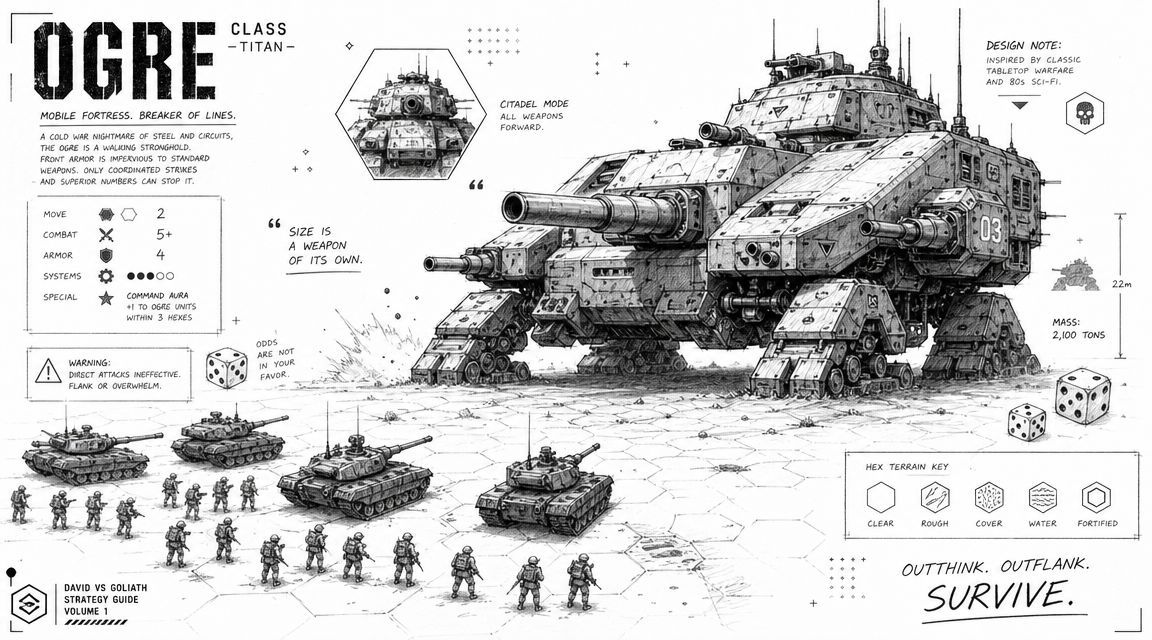
New to the classic Ogre board game? Our complete guide covers rules, strategy, editions, and where to start with this legendary asymmetric wargame.
You've probably seen Ogre in one of two ways. Maybe it was a name older wargamers kept bringing up with that “you had to be there” tone. Or maybe you found it while browsing classic sci-fi board games, looked at the setup, and thought: wait, one player gets a giant robot tank and the other gets an army?
That reaction is the right one. The Ogre board game is built on an unfair fight, and that unfairness is what makes it work. One side has a terrifying machine with concentrated power. The other has numbers, space, and the chance to turn discipline into survival. If you're new to Ogre, the hardest part isn't learning what the pieces do. It's learning why the game asks you to think so differently depending on which side you play.
For collectors and creators, Ogre also sits in an interesting place. It comes from the older school of tabletop design, but it still feels current because asymmetry, scenario design, and crowdfunding have kept games like this alive. That makes Ogre worth learning not just as a game, but as a piece of hobby history that still matters.
The battlefield is quiet for a moment. The defenders have tanks in place, infantry spread across key approaches, artillery waiting for a shot. Then the Ogre enters.
Not a squad. Not a platoon. One machine.

That's the emotional hook of Ogre. The game doesn't try to simulate a balanced meeting engagement. It gives one player a cybernetic behemoth and asks the other player to stop it before it reaches the command post. The tension comes from a simple question: can a well-handled conventional defense slow down something designed to smash through it?
If you've never played an asymmetric war game, consider this analogy: Most strategy games feel like two boxers entering the ring with similar tools. Ogre feels more like one boxer facing a charging bulldozer while a team on the sidelines throws chains, spikes, and barriers into the path. You don't win by being stronger. You win by making the machine spend time, movement, and firepower in the wrong places.
That's why Ogre still grabs people. Every unit on the defending side matters because every loss changes the geometry of the map. Every weapon on the Ogre matters because every shot has an opportunity cost. New players often expect the Ogre to just flatten everything. Sometimes it does. More often, it wins or loses on a handful of key decisions.
A practical note for anyone setting up a long first session. Good table space helps more than fancy accessories, especially with hex maps and multiple unit types. A dedicated game table with storage ideas article can help if you're building a better play area for heavier tabletop sessions.
The first lesson of Ogre is simple. Fairness isn't the goal. Pressure is.
Ogre began in 1977 as a science-fiction board wargame designed by Steve Jackson and first published by Metagaming Concepts, which is why so many players still treat it as a foundational title in modern tabletop wargaming (Wikipedia's Ogre overview)).

What made that original design stick wasn't chrome or complexity for its own sake. It was clarity. Ogre took a big military idea, asymmetric warfare between a superweapon and a defending force, and turned it into a ruleset that players could grasp quickly but spend years mastering. That's a rare combination.
A lot of older games feel locked to their era. Ogre doesn't. Its map, units, and combat logic still feel readable because the core problem is timeless. One side must break through. The other must delay, damage, and disrupt. Those incentives create sharp decisions right away.
Here's why that matters:
That structure helped Ogre survive changes in publishing style, component expectations, and player tastes. A game can get new art, cleaner counters, or larger editions, but if the central decision engine is weak, none of that lasts. Ogre lasted because the central decision engine is strong.
The modern hobby gave Ogre another kind of life. Crowdfunding made it possible for classic designs to return in more elaborate physical forms, often with bigger production values and collector appeal. That's especially important for older war games, because many of them were first released in formats that emphasized portability and utility over spectacle.
Why collectors care: Ogre works both as a playable design and as a snapshot of how tabletop gaming evolved from compact specialist products into premium hobby objects.
That split matters today. Some players want the cleanest, easiest version to learn. Others want a shelf-worthy edition that represents the game's legacy. Ogre supports both instincts, which is one reason it keeps resurfacing in conversations about classic designs worth owning.
The result is unusual. Ogre feels like a relic in the best sense. Not outdated. Preserved, tested, and still sharp.
The battlefield in Ogre is not two armies trading punches. It's a concentrated threat pushing into a distributed defense. Steve Jackson Games' strategy material describes the game as one Ogre versus a defending force of infantry, tanks, and artillery, with the Ogre trying to destroy the defender's command post (Steve Jackson Games strategy guidance).

If you're trying to understand the Ogre board game for the first time, start with this idea: the Ogre is not just one unit. It's more like an entire force compressed into one body.
New players often get confused because they see one giant counter and assume it behaves like a stronger tank. It doesn't. The Ogre has multiple systems, and those systems matter separately. It's similar to an RPG character sheet. You don't just track whether the character is alive. You track what they can still do well.
An Ogre can lose weapons. It can lose movement. It can become dangerous in one way and weak in another. That means damage allocation is part of the game's personality. If you damage the wrong part, the machine may still do exactly what it came to do.
For defenders, that leads to an important mental shift. You're not always trying to “kill the monster” in the ordinary sense. Sometimes you're trying to slow it, strip key weapons, or force it into a less efficient attack line.
A quick visual can help before your first setup:
The defending force is the opposite of the Ogre. Its strength is spread out across many smaller units. Tanks bring direct pressure. Infantry can screen, clog, and threaten key spaces. Artillery punishes exposure and punishes bad timing. The command post gives all that effort meaning, because it is the reason the defense exists.
This creates a useful analogy. The Ogre is a hammer. The defenders are a net. A hammer wins by striking the right target with force. A net wins by catching, tangling, and slowing something stronger than any single strand.
That's also why good defending play can feel odd at first. Beginners often throw units forward one at a time. That usually helps the Ogre. A better defense layers threats so the Ogre has to choose between movement, targets, and survival.
Use this checklist during early games:
Some Ogre attacks only score “two or three” kills, which is a useful reminder from official strategy guidance that massive firepower still has limits when positioning goes wrong.
That point helps new players a lot. The Ogre is scary, but it's not magic. It can be surrounded, delayed, and forced into bad trades if the defender understands the map.
At its heart, Ogre is a tactical hex-map wargame where one side wins by destroying the Command Post and the other wins by eliminating the Ogre, a structure summarized in TV Tropes' overview of Ogre.

The cleanest way to learn your first game is to stop thinking about every edge case and focus on the turn rhythm. Ogre becomes much easier once you feel that rhythm.
A beginner-friendly way to remember the flow is this:
That sounds straightforward because it is. The challenge comes from sequencing. In Ogre, movement and fire aren't separate puzzles. Each movement decision creates the next combat problem.
If you're the Ogre, your first turns are about pathing. Don't think, “How do I destroy the most units?” Think, “How do I keep advancing while reducing the units that can stop me later?” That usually means choosing high-value threats rather than sweeping the board.
If you're the defender, your first turns are about shaping lanes. Don't spread out because it looks realistic. Spread out only if it creates overlapping pressure. A defender who leaves gaps often watches the Ogre punch through the center before concentrated fire can matter.
Here's a practical example. Suppose the Ogre has a choice between firing on a nearby light threat and a unit that could later help trap its movement. The second target is often better, even if the first one feels like an easy kill. Ogre rewards long-view decisions.
New players sometimes freeze when they reach combat resolution because they assume the game is about memorizing charts. It isn't. The chart matters, but skill lies in deciding where your attacks go and how much force to commit.
Use these beginner habits:
Practical rule: If you can explain why a shot matters to the next turn, it's probably a better shot than one taken just because something is in range.
The beauty of the Ogre board game is that the end state is easy to understand. Either the Ogre destroys the command post, or the defenders stop the Ogre. That binary finish does something useful for learners. It keeps you focused on purpose.
A lot of first games are lost because players chase local victories. They protect a flank that doesn't matter. They kill a unit that wasn't part of the main problem. They admire a clever exchange and forget the actual objective.
Ogre teaches discipline fast. If your move doesn't help the win condition, it probably isn't the move you need.
The first strategic mistake most Ogre players make is trying to “play fair.” They spread fire, hedge too much, and avoid ugly trades. Ogre punishes that. The game rewards commitment.
You are the attacker, but that doesn't mean you should act reckless. The Ogre wins by staying purposeful. Every time you spend a shot on something unimportant, you let the defender convert numbers into time.
Start with target priority.
There's a subtle lesson in official strategy guidance. Even the Ogre may only score a small number of kills in a given attack. That means the attacker can't assume raw firepower will solve every problem immediately. Positioning still rules the game.
Your army is not a wall. It's a series of delays.
That idea helps beginners because they often think every unit should survive as long as possible. In Ogre, a unit that dies while forcing the Ogre to turn, stop, or spend key fire can be worth more than a unit that retreats cleanly.
Try these defender habits instead:
A good defense feels a little like fighting a wildfire. You usually can't stop it everywhere. You deny the paths that let it spread cleanly.
For the Ogre player, think like a raider. You are breaking a line before the line hardens.
For the defender, think like an engineer under pressure. You are not trying to win every exchange. You are trying to make the attacker spend the wrong resources in the wrong order.
That's why Ogre stays interesting after the rules become familiar. The game keeps asking both players a hard question: what matters most right now? New players improve quickly when they stop treating every unit as equally important and start treating time, route, and concentration as the true currency of the board.
Collectors usually reach Ogre through one of two doors. They want a playable copy of a respected classic, or they want a meaningful edition of a game with deep hobby history. Those are not always the same purchase.
The useful way to shop for Ogre is to ignore hype and ask a more grounded question. What kind of ownership do you want? Table-first ownership and collector-first ownership can point you toward different editions, conditions, and accessories.
Use practical criteria rather than nostalgia alone.
Here's a simple comparison framework.
| Edition | Original Release | Key Features | Best For |
|---|---|---|---|
| Classic early edition | 1977 | Compact presentation, foundational design identity | Players who want the historical core |
| Expanded boxed-era versions | Later era | Broader scenario possibilities and a bigger physical footprint | Hobbyists who want more battlefield variety |
| Large-format collector edition | Modern revival | Premium presence, event feel, collector appeal | Dedicated fans and collectors |
| Digital adaptation | Modern era | Easy access, lighter hardware demands, fast practice | Players who want repetition and convenience |
Second-hand Ogre shopping gets easier when you inspect for playability first.
Check these points:
A related modern angle is crowdfunding. Classic properties often return through campaigns that promise upgraded production, add-ons, and collector extras. For creators watching games like Ogre and thinking about their own project, the post-campaign layer matters almost as much as the campaign itself. If you're studying upcoming board games in crowdfunding, pay attention not just to what gets funded, but how creators handle surveys, add-ons, and fulfillment afterward.
Kickstarter's pledge manager is like Amazon. It sits inside a bigger marketplace logic. PledgeBox is more like Shopify. It gives creators a branded post-campaign storefront approach, and it's free to send the backer survey and only charges 3% of upsell if there's any. For tabletop publishers, that model fits projects with expansions, late pledges, and collector add-ons.
If you're new and mostly want to learn, buy the version you're most likely to set up.
If you already love classic wargames, a more substantial edition can feel rewarding because Ogre's premise benefits from physical presence. The giant tank, the spread of defenders, the sense of looming pressure, all of that lands harder when the production supports it.
If you're a collector, buy with your own use in mind. The “best” edition is not the most expensive one. It's the one that matches how you want to experience Ogre, on the table, on the shelf, or both.
The best thing about learning Ogre is that it doesn't end at the first box you buy. It opens into a wider habit of play. Strategy discussion, scenario tweaking, collector conversation, and digital practice all support the same goal: seeing the game from more than one angle.
Start with official material and active fan spaces. Rules questions, scenario recommendations, and edition comparisons all get easier when you can hear how experienced players think through the game rather than just what answer they reached.
Useful places to look include:
If you enjoy the hobby history side of Ogre, it also helps to follow broader conversations around revived tabletop designs and crowdfunded reprints. Lists of Kickstarter board games worth watching can show how older design ideas keep returning in new packaging.
The official digital adaptation of Ogre is a turn-based strategy game with modest requirements, including Windows 7, a 1.80 GHz dual-core processor, and 2 GB RAM, which makes it an accessible way for many players to try the system on PC (Ogre on Steam).
That matters more than it might seem. A digital version lowers the friction of repetition. You can test ideas, learn attack priorities, and get comfortable with the board state without needing a full physical setup every time. For newer players, it's often the fastest route to seeing why experienced Ogre fans talk so much about movement lanes and target choice.
Play both sides when you can. The fastest way to improve at Ogre is to learn what scares the other player.
Ogre has lasted because it offers more than nostalgia. It gives you a clean design problem, a strong theme, and enough tactical nuance to keep revealing new lessons. That combination is rare. It's why people still teach it, collect it, and bring it back to the table.
If you're a tabletop creator studying games like Ogre and planning your own campaign, PledgeBox is worth a look for post-campaign operations. It combines surveys, add-ons, shipping fee collection, tax handling, address validation, and fulfillment exports in one system, which is useful when a board game project has multiple reward tiers, expansions, and late backers.
PledgeBox
The All-in-One Toolkit to Launch, Manage & Scale Your Kickstarter / Indiegogo Campaign