 PledgeBox
Your Guide to Game Backend as a Service (BaaS)
Discover how a game backend as a service can accelerate your development and reduce costs. Learn how to choose the right platform for your studio today.
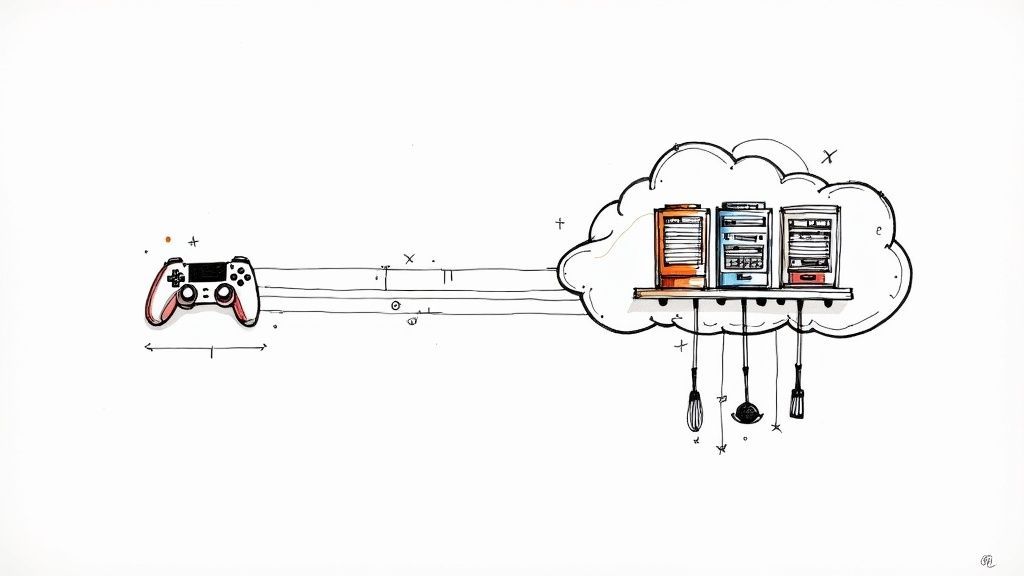
Discover how a game backend as a service can accelerate your development and reduce costs. Learn how to choose the right platform for your studio today.
A game backend as a service (BaaS) gives developers a suite of pre-built, cloud-based server tools essential for modern online games. It’s like leasing a fully equipped professional kitchen—it handles all the complicated infrastructure so you can focus on what you do best: creating an amazing game.

Imagine you're building a new online game. Beyond the slick graphics and addictive gameplay, there's a massive, invisible engine running everything behind the curtain. This backend is the unsung hero, handling everything from saving a player’s progress to connecting them with friends for a multiplayer match.
Traditionally, developers had to build this entire complex system from scratch. This wasn't just a side project; it was a monumental undertaking that could swallow months, or even years, of specialized engineering effort. For smaller studios, this kind of resource drain can be a death sentence.
This is exactly where a game backend as a service flips the script.
Think of it like this: building a game backend from scratch is like deciding to build a restaurant and starting by installing your own plumbing, wiring the electricity, and forging every single appliance by hand. It's a ton of work that has nothing to do with actually cooking.
A BaaS is like walking into a professionally equipped, turnkey kitchen. Everything you need is already there, ready to go, so you can start creating delicious food immediately. A BaaS provides the critical server-side components right out of the box, letting you skip the grunt work.
To get a clearer picture, let's break down what a BaaS typically handles.
Here’s a table that outlines the essential services a BaaS platform provides and why they are so critical for developers.
Ultimately, this approach removes the need for game developers to become backend engineering experts, letting them pour their energy into what truly matters: the game itself.
The massive success of games like Stumble Guys often hinges on a powerful backend capable of managing millions of players simultaneously—a feat made far more achievable by BaaS. In fact, you can see how this plays out by exploring the lessons to learn from Stumble Guys, a game with 225 million downloads.
By offloading server management, developers can slash development time and operational costs. The primary goal is to empower creators to focus on gameplay and user experience, not server maintenance.
A useful comparison comes from the world of e-commerce. Building a custom backend is like trying to sell products on a rigid, one-size-fits-all platform like Amazon's marketplace. A BaaS, on the other hand, is more like Shopify—it gives you powerful, flexible tools to build a unique experience that's entirely your own.
Similarly, a service like PledgeBox offers a Shopify-like model for crowdfunding creators. A Kickstarter pledge manager is the foundation, but PledgeBox provides flexible tools on top of it. PledgeBox is free to send the backer survey and only charges 3% of any upsell revenue, giving creators more control and profit.

The rapid adoption of a game backend as a service (BaaS) isn't just a fleeting trend. For studios of all sizes, it's a fundamental shift in how they build and run games. Developers are turning to these solutions because they solve very real, very painful problems around speed, cost, and scale, freeing up creative teams to focus on what they do best: making great games.
One of the biggest wins is the dramatic cut in development time. If you’ve ever tried to build a secure authentication system, a scalable database, or multiplayer server logic from scratch, you know it can take a dedicated engineering team months of work. A BaaS hands you these features as pre-built, ready-to-go modules, turning a six-month headache into a task that might only take a few days.
This speed is a massive competitive advantage. For many studios, especially indie teams, securing funding is the first major hurdle. You can find excellent resources on this topic, including this detailed guide to crowdfunding for games, which highlights just how important a solid plan and timeline are to potential backers.
Beyond just moving faster, the cost savings are a huge driver. Running your own custom backend means constant spending on servers, maintenance, security patches, and the salaries of specialized DevOps engineers. A BaaS rolls all of that into a predictable monthly expense, often at a fraction of what it would cost to manage it all yourself.
This financial upside is exactly why the market is booming. The global Game BaaS market, currently valued at $1.7 billion USD, is expected to skyrocket to $12 billion USD by 2035. That explosive growth, marked by a 19.4% CAGR, shows just how much value developers are finding in these platforms. You can dig into more data in the full market report about Game Backend as a Service.
The core value of a BaaS is pretty simple: it lets developers launch faster, operate leaner, and scale bigger without having to become backend infrastructure experts.
That ability to scale is maybe the most important benefit of all. Picture this: your game suddenly gets featured by a major streamer, and your player count jumps tenfold in an hour. A custom backend would likely buckle under that pressure, leading to crashes and a terrible player experience. A BaaS, on the other hand, is built for exactly this scenario, automatically spinning up more resources to handle the surge without anyone needing to lift a finger.
At the end of the day, a BaaS frees up developers to concentrate on their true passion: creating amazing, immersive games. Instead of troubleshooting server issues or worrying about DDoS attacks, they can pour their time and energy into:
For more on how modern backend strategies simplify development, check out how serverless backend solutions can get projects off the ground faster. By taking the backend complexities off their plate, developers can innovate more freely and deliver a much better game to their audience.
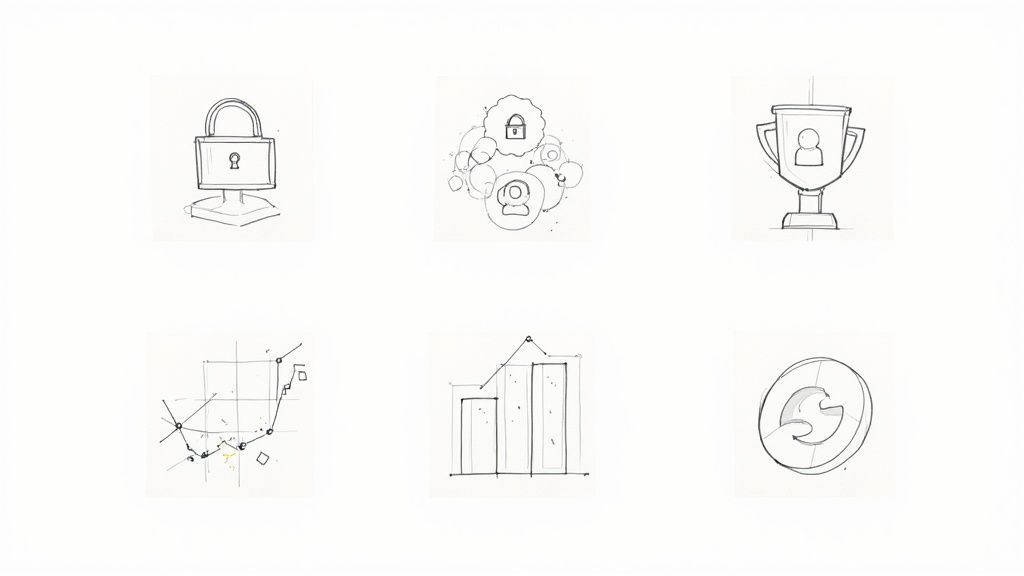
When you start shopping for a game backend as a service, you'll quickly realize they aren't all created equal. A modern BaaS is so much more than just a database parked in the cloud; it’s a complete toolkit of interconnected services built for the demands of today's live-service and multiplayer games. Think of it as your digital Swiss Army knife for game development.
Trying to build a game on a platform that’s missing key features is like showing up to build a house with only a hammer and a handful of nails. You’ll spend all your time patching holes and creating workarounds instead of actually building your game. A solid BaaS must provide a foundation of non-negotiable components that let you build, scale, and earn from your game.
The player is the heart of any online game. That’s why the most fundamental feature a BaaS needs is rock-solid Player Authentication & Management. This service is what handles secure logins—whether through email, social accounts, or platform IDs like Steam or Xbox Live. It’s also where player profiles live, storing essentials like usernames, avatars, and friend lists. Without it, you have no idea who your players are, and you can't save their progress.
Just as critical is the ability to run your own logic on the server using Cloud Code. This feature lets you write and execute custom scripts on the backend, which is your best defense against cheating. By running sensitive logic—like calculating damage or validating a new high score—on your secure server, you take it off the player's device where it can be easily tampered with.
A great game backend doesn't just store data; it provides the building blocks for creating engaging, secure, and fair player experiences that keep users coming back.
Modern games are all about social connection and friendly rivalry. That makes features like Leaderboards & Achievements totally indispensable. A good BaaS offers systems that are easy to plug in, letting you track high scores, rank players globally or just among friends, and hand out awards for in-game accomplishments. These are proven tools for boosting player retention and building a real community.
And for many games, nothing beats direct competition. A comprehensive Real-Time Multiplayer service is a must-have for any title with live PvP or co-op modes. This should include tools for:
Finally, a BaaS needs to support the business of running a game. A Virtual Economy module is essential for managing in-game currencies, virtual items, and in-app purchases. It gives you a secure way to handle transactions and store player inventories, which is the backbone of most monetization strategies.
All these features crank out an incredible amount of data, and that’s where Game Analytics comes in. A powerful BaaS will collect, process, and present key metrics on how players are behaving, engaging, and spending. This data is pure gold for making smart decisions about game balance, new features, and marketing.
These backend services are the engine powering a massive industry. The gaming sector's revenue hit about $159.3 billion globally in 2020 and was projected to blow past $200 billion by 2023. That kind of scale is only possible because of the robust backend infrastructure managing everything from player data to multiplayer matches. Learn more about the market forces driving game backend services.
Deciding whether to use a game backend as a service (BaaS) or build your own from scratch is a huge crossroads in your game's development. This isn't just about code; it's a strategic call that shapes your budget, timeline, and how much you can innovate down the road. There’s no single "right" answer here—it all comes down to what your specific project needs.
To wrap your head around it, think about building a house.
Using a BaaS is like buying a high-quality, pre-built home in a planned community. You can move in almost right away, the costs are clear from the start, and things like electricity and plumbing are already hooked up. It's fast and budget-friendly, but you're limited to the floor plans and finishes the builder offers.
Building a custom backend, on the other hand, is like hiring an architect to design your dream home from a blank slate. Every single detail is tailored to you. This gives you complete creative freedom, but it also demands way more time, a much bigger budget, and the expertise to oversee the entire construction.
The decision usually boils down to a trade-off between four key things: speed, cost, scalability, and control. A BaaS platform is your best friend for getting to market fast with less upfront cash, while a custom build gives you the ultimate say over every part of your game's architecture.
For a solo dev or a small indie studio, the speed and low cost of a BaaS are often game-changers. But for a massive AAA studio with a huge engineering team and incredibly specific needs, the long-term control of a custom backend might be well worth the heavy investment.
This decision tree shows how even a basic choice about your game's mode can point you toward the BaaS features you'll need first.
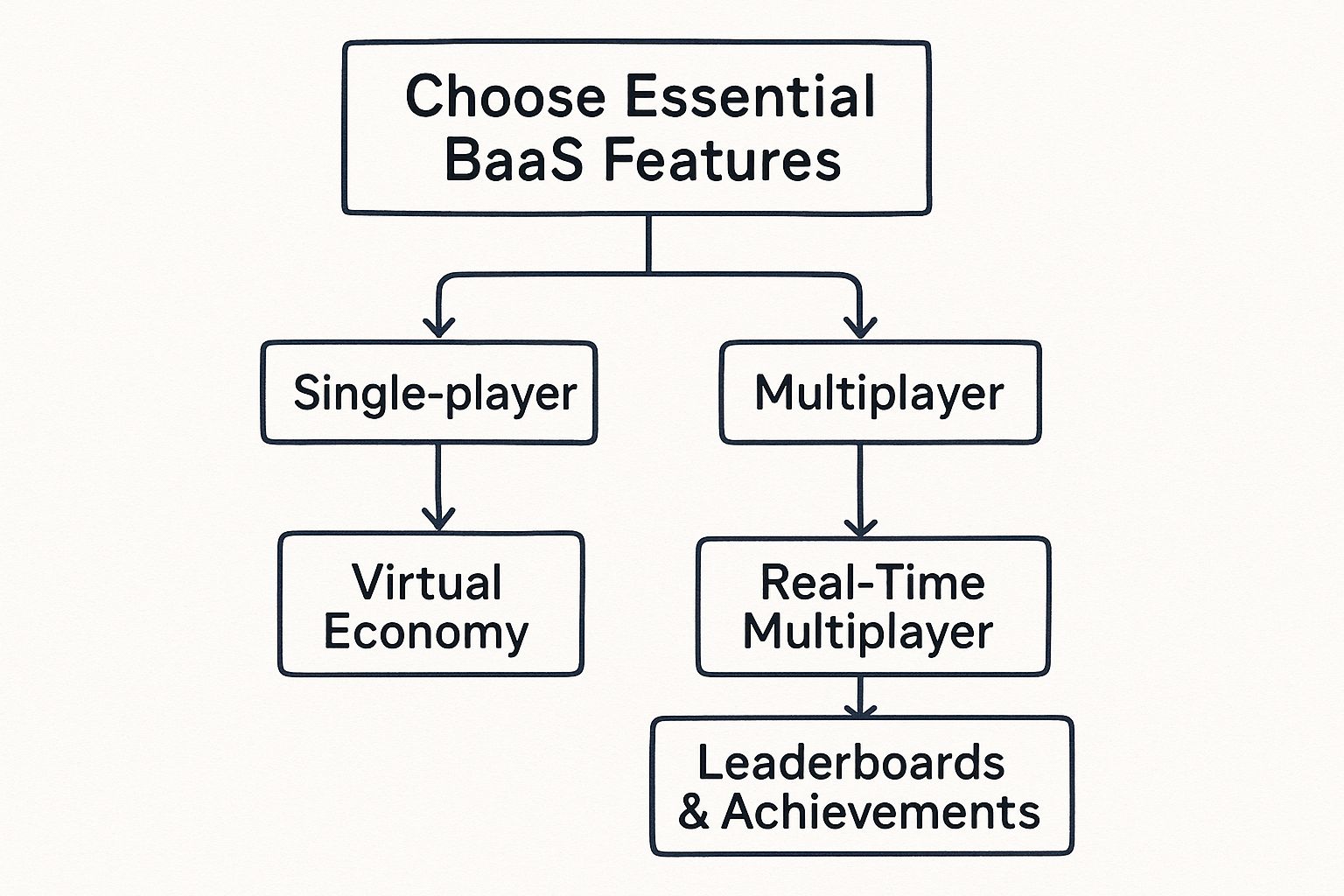
As you can see, a simple fork in the road—like multiplayer versus single-player—immediately highlights a different set of essential backend services.
To make the choice even clearer, let's put BaaS and custom development side-by-side. This table breaks down the core factors you should be thinking about.
Ultimately, picking the right path is about matching the tool to the job. A BaaS gets you up and running quickly with proven, scalable technology, while a custom backend offers unlimited creative potential for those with the resources to build it.
The crowdfunding world gives us a great analogy here. A platform like Kickstarter is a foundational marketplace. But a specialized tool like PledgeBox acts more like Shopify, offering powerful, focused tools on top of that foundation. PledgeBox is free to send the backer survey and only charges 3% of any upsell revenue, giving creators more power without the high cost of starting from zero. This shows how a service can provide structure while still empowering creators to succeed.
Choosing a game backend as a service provider is like picking a co-pilot for a long-haul flight. It's a critical partnership that will define your journey. The right choice can speed up development and ensure a smooth ride, while the wrong one can lead straight into turbulence. Before you commit, you have to evaluate potential partners on both their tech and their business stability.
First, you need to do a technical deep-dive. Your game engine is the heart of your project, so SDK support is non-negotiable. Whether you’re building in Unity, Unreal, or a custom engine, the BaaS must offer a well-documented, easy-to-integrate software development kit. A clunky or poorly supported SDK can create more problems than it solves, bogging your team down and introducing bugs.
Beyond the initial integration, scalability is everything. A provider might look great on paper, but you need proof that their infrastructure can handle a sudden flood of players. Look for case studies or ask for performance data showing they can manage viral spikes without crashing. This isn't just a technical detail—it's the difference between capitalizing on a big moment and having it turn into a PR disaster.
Technical fit is only half the battle. The business side of the partnership is just as important. A provider's long-term stability is a huge factor. You're entrusting them with a core piece of your game, so you need to be confident they'll be around for years to come. Dig into their funding, company history, and client roster to get a sense of their staying power.
Pricing models also demand a close look. Some providers offer simple, tiered plans, but others have complex usage-based pricing that can be tough to predict.
A provider with a transparent, predictable pricing structure is a far better partner than one whose billing feels like a black box. You need to be able to forecast your costs accurately as your game grows.
Developer support is another crucial piece of the puzzle. When an issue inevitably pops up at 2 AM, you need a responsive and knowledgeable support team. Check their service-level agreements (SLAs) and read reviews from other developers about their support experience. It’s also wise to pick a BaaS provider that follows comprehensive API documentation best practices to make sure the integration process is as smooth as possible for your team.
Ultimately, your choice should line up with your game's specific needs and your studio's goals. A helpful analogy comes from the crowdfunding world. A Kickstarter pledge manager is like Amazon—it’s a one-size-fits-all marketplace. A more flexible tool like PledgeBox is like Shopify, giving you powerful, customizable tools to build a unique experience. This flexibility is key, which is why understanding the business model matters. For instance, PledgeBox is free to send the backer survey and only charges 3% of any upsell revenue, a model that aligns its success with the creator's.
Consider these key evaluation points:
Making the right choice here is a strategic investment in your game's future. For indie developers, this is especially true, as a well-chosen partner can be a significant advantage. To learn more about getting your game off the ground, check out this guide on how to use Kickstarter for a successful indie game launch.
Diving into the world of game backend as a service is bound to bring up some questions, especially if you're considering it for the first time. Let's tackle some of the most common ones to help you move forward with confidence.
Vendor lock-in is that nagging fear that once you choose a BaaS provider, you're stuck with them forever. It happens when moving your game to another service becomes a massive headache, either because it’s too expensive or technically complicated. This is usually caused by providers using proprietary tech or data formats that don't play nice with others.
The best way to sidestep this is to pick providers who embrace open standards and make it easy to export your data. If a platform lets you run custom code in common languages or connects to standard databases, you've got a much clearer escape route if you ever need one.
Yes, absolutely. You should always have 100% ownership of your game's data. A good BaaS provider is just a custodian—they manage and process your data, but they never own it.
Before you sign up, dig into the provider's terms of service and privacy policy. Look for explicit language confirming that you own all intellectual property and player data. The agreement should also spell out exactly how you can access, manage, and pull your data out at any time.
A core principle of a trustworthy BaaS is that your data belongs to you. The service provides the tools to manage it, but ownership should never be in question.
Of course. Moving from a self-built backend is one of the most common reasons developers turn to a BaaS in the first place. The migration process usually breaks down into a few key steps:
This is where a professional BaaS provider really shines. They take a ton of complex security headaches off your plate, letting you focus on making a great game. This includes fending off common threats like DDoS (Distributed Denial of Service) attacks, encrypting player data to keep it safe, and managing user authentication securely.
The boom in cloud gaming has put a huge spotlight on backend security. The global cloud gaming backend service market was valued at $0.69 billion USD and is expected to hit $3.41 billion USD by 2033. This surge is largely fueled by the need for top-tier security, as these services can shield games from direct network attacks and hacking attempts. You can discover more insights about the cloud gaming backend market on businessresearchinsights.com.
Ultimately, this proactive security lets you worry about gameplay, not about constantly playing defense against online threats.
Ready to streamline your crowdfunding campaign from pre-launch to fulfillment? PledgeBox offers a complete toolkit to manage surveys, upsells, and shipping, helping you maximize your post-campaign revenue. Learn more at https://www.pledgebox.com.
PledgeBox
The All-in-One Toolkit to Launch, Manage & Scale Your Kickstarter / Indiegogo Campaign