 PledgeBox
Board Games Crowdfunding: The Complete Playbook
Your end-to-end guide to board games crowdfunding. Learn to validate your idea, build an audience, run a Kickstarter, and master fulfillment with this playbook.
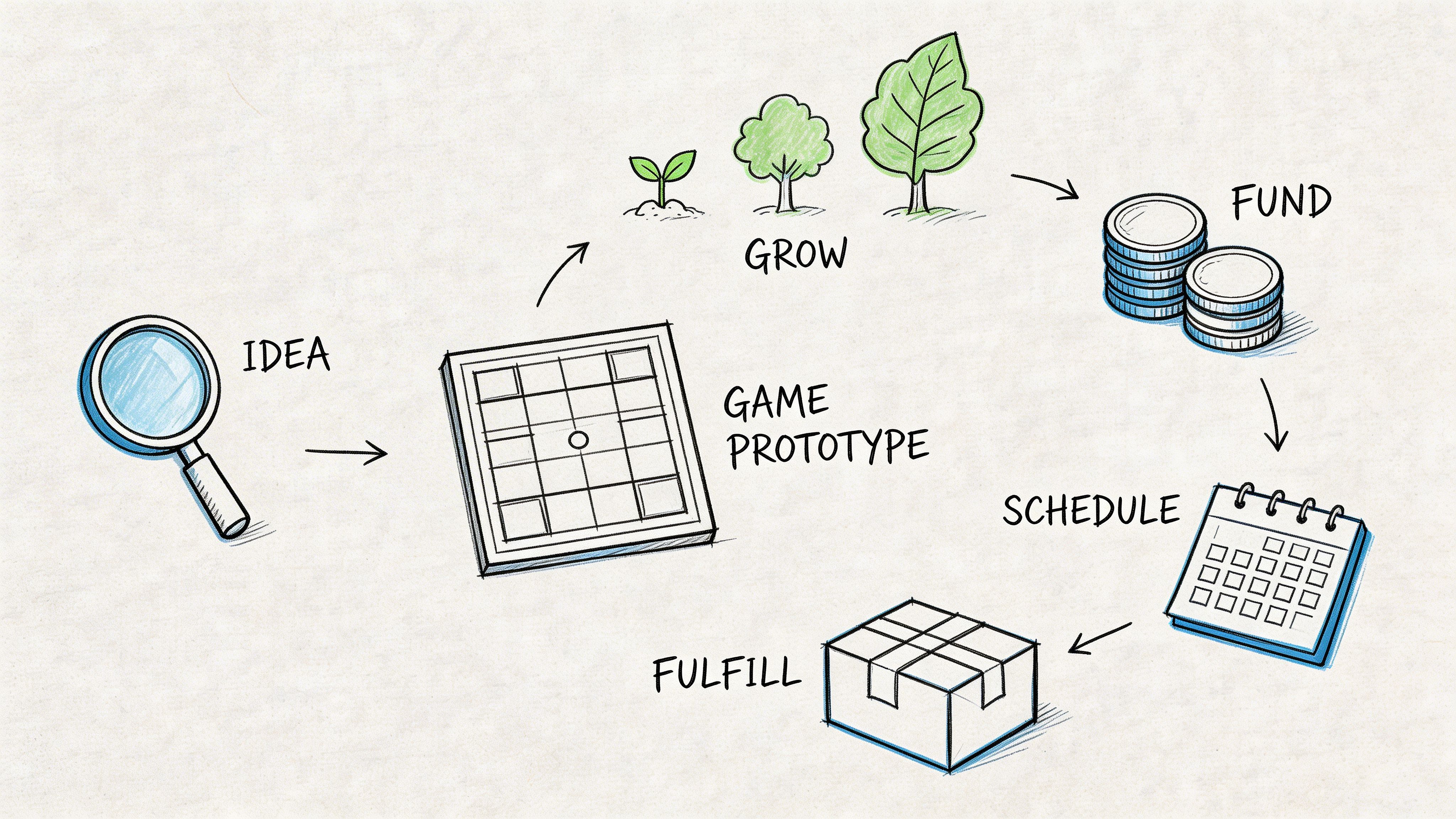
Your end-to-end guide to board games crowdfunding. Learn to validate your idea, build an audience, run a Kickstarter, and master fulfillment with this playbook.
You’ve got a prototype that works. People at your table ask when they can buy it. Your files are a mess, your manufacturing quotes don’t match, and you still haven’t decided whether your game needs a deluxe tier.
That’s where most board game creators are when they start looking seriously at board games crowdfunding. They don’t need inspiration. They need a path from tested idea to funded product, then from funded product to boxes on doorsteps.
Crowdfunding is still that path. The category has been durable for years, and the money is still there. But the campaigns that succeed usually aren’t the ones with the most dramatic pitch. They’re the ones run like a real product launch, with clear audience work before launch, disciplined page design, active campaign management, and serious post-campaign operations.
A strong game isn’t enough. I’ve seen polished prototypes stall because the creator treated crowdfunding like a popularity contest instead of a production process.
That’s the first mental shift to make. Board games crowdfunding is not only about proving demand. It’s also about proving that you can execute.
The category is still one of the clearest signs that crowdfunding works for tabletop. Kickstarter’s tabletop games category peaked at $270 million in 2021, then reached $185.4 million across 3,200 successful board game projects in 2024, which shows the market didn’t disappear when the peak passed. It stabilized at a meaningful level and remained a core route for publishers bringing new games to market (board game statistics roundup).
Board games are unusually well suited to crowdfunding because buyers want to feel involved early. They want to see art evolve, components improve, stretch goals are revealed, and designer updates land in their inbox.
Traditional retail rarely gives a new creator that room. A crowdfunding campaign does.
It lets you:
The mistake is assuming the campaign itself does all the work.
It doesn’t.
A bad launch page can kill a good game. A weak reward structure can flatten your average pledge. Poor fulfillment planning can turn a funded project into a brand problem you’ll spend years trying to fix.
Practical rule: Treat the campaign as one phase in a longer system. Audience comes first. Operations come next. Funding sits in the middle.
Creators also underestimate how much trust matters. Backers don’t only ask, “Do I want this game?” They also ask, “Will this team deliver it?”
That means your campaign has to answer more than theme and mechanics. It has to show product readiness, manufacturing awareness, freight planning, communication discipline, and a sane scope.
The upside is still substantial for creators who operate well.
Board game crowdfunding gives small teams a route that used to belong mostly to established publishers. You can test a niche concept, pre-sell a collector edition, or launch a first title without waiting for a distributor to take a chance on you.
But once money changes hands, the standard changes too. You’re no longer pitching an idea. You’re running a small publishing business.
Most failed campaigns don’t die on launch day. They die in the weeks before launch, when the creator convinces themselves that “the platform will find the audience.”
It usually won’t.

On Kickstarter, tabletop projects launched in 2024 had an 80% success rate, while the platform-wide average hovered around 42%, and that gap says a lot about how prepared tabletop creators tend to be before they go live (Kickstarter games data).
Before you spend money on a polished trailer or premium art assets, get evidence that the hook lands.
Ask a small group of target players to react to a simple pitch:
You don’t need a perfect logo for this. You need honest reactions from people who buy games like yours.
If responses are vague, fix the game’s positioning first. “It’s kind of a tactical euro with narrative bits” isn’t a pitch. It’s confusion.
The most useful pre-launch asset isn’t social reach. It’s an email list of people who want a launch notification.
That means your pre-launch page has one job. Capture interest from the right audience and make the game easy to understand in a few seconds.
A solid pre-launch page usually includes:
A clear one-line premise Say what the game is, who it’s for, and what makes it distinct.
A strong visual Box mockup, table presence, or core art. Show the promise fast.
A short benefit stack Focus on player experience, not lore overload.
An email capture form Keep it simple. Too many fields reduce signups.
A reason to follow now Preview content, launch reminder, or early access updates.
If you need a practical walkthrough, this guide on building a list of potential backers before your Kickstarter campaign launches is useful because it keeps the work grounded in actual campaign prep instead of vague “community building” talk.
A list is only valuable if subscribers stay warm.
Don’t send filler. Send proof.
Use your pre-launch emails to show:
Backers respond well when they can see progress. They don’t need constant hype. They need confidence that the game is real and improving.
If your pre-launch content sounds like ad copy before anyone has asked for the product, your audience will tune out.
Creators often think the page should attract everyone. It shouldn’t.
It should attract people who already like the kind of game you’re making, and repel people who would bounce later. A dense strategy game shouldn’t market itself like a party game. A premium miniatures project shouldn’t hide the fact that it’s a bigger commitment.
That filtering matters because bad-fit subscribers inflate your list and weaken launch-day performance.
You don’t need a huge content machine. You need consistency.
Here’s a practical rhythm:
| Focus | What to publish | Why it works |
|---|---|---|
| Early phase | Hook, art, broad concept | Tests whether the premise lands |
| Middle phase | Gameplay snippets, prototype photos, short rules explanations | Turns curiosity into informed interest |
| Late phase | Launch date, reward previews, social proof from testing | Converts warm followers into launch-day backers |
A creator who shows the game clearly usually outperforms a creator who hides behind cinematic branding.
A useful explainer on launch preparation sits below. Watch it after your pitch is stable, not before.
Launch momentum comes from concentration. You want as many qualified people as possible to show up early, not dribble in over weeks.
That means your pre-launch work should bias toward:
Ads can help. But ads sent to a weak page usually just buy confusion faster.
A lot of creators chase comments, likes, and broad reach because those signals feel good.
But a smaller list of people who understand the product is worth more than a larger crowd that barely remembers it. For board games crowdfunding, qualified attention beats ambient attention every time.
Your campaign page has one job. Remove doubt.
People arrive with questions: Is this game good? Is the value clear? Can this team deliver? Your page has to answer all of that fast, then support the answer with detail.

Too many creators start with lore, personal history, or a long explanation of how the game was born. That material has a place, but it doesn’t belong at the top.
The top of the page should answer these questions in order:
If your page starts with a wall of text, most visitors won’t reach the useful part.
A clean hero section paired with a high-converting landing page structure is a good model because it forces you to clarify the promise before you add detail. That discipline matters on crowdfunding pages too.
Board games sell better when people can see the experience, not just the components.
Use a mix of:
Don’t rely on one cinematic trailer to do everything. Your page still has to carry the sale even if nobody watches the video.
Most backers don’t read from top to bottom. They scan, pause, jump, compare, then decide.
Use sections with clear labels. Keep paragraphs short. Put the strongest visuals near the strongest claims.
A useful reference for campaign-page structure is this set of Kickstarter campaign page design tips, especially if you’re trying to avoid the common trap of stuffing every detail into one uninterrupted narrative.
Field note: A good campaign page doesn’t feel exhaustive. It feels easy to trust.
Bad tier design creates hesitation. Good tier design makes the next logical choice obvious.
The most common mistakes are:
A healthy tier structure usually has a clear anchor pledge, one upgrade path, and only a few exceptions.
Consider this simple breakdown:
| Tier type | When it works | Common risk |
|---|---|---|
| Core game | Most campaigns need this anchor | Underpricing it can hurt later |
| Deluxe edition | Works if upgrades are easy to understand | Component bloat and production creep |
| Retail or multi-copy | Useful for stores or group buys | Complicated logistics if poorly defined |
| Add-ons | Best for optional extras | Too many choices slow checkout |
Stretch goals can add excitement. They can also wreck production.
A famous example of momentum done well is Tekken: The Board Game, which hit its €50,000 goal in 35 minutes and finished at €350,000, using stretch goals after early funding momentum was already established (board game statistics analysis).
The lesson isn’t “add more stretch goals.” The lesson is “build momentum first, then use stretch goals carefully.”
Good stretch goals tend to be:
Bad stretch goals tend to create new packaging, new molds, new regional compliance issues, or new fulfillment exceptions.
If I’m auditing a page, I look for three trust signals before I care about the tone:
Stylish writing can help. It cannot rescue weak planning.
That’s also why I don’t overvalue “perfect campaign voice.” In practice, creators get more mileage from clear product explanation, realistic scope, and visible preparation than from trying to sound like a premium brand.
Launch day feels like the exam. It isn’t. It’s the start of customer service, sales, and public project management all happening at once.
A live campaign usually follows a familiar shape. Strong opening. Slower middle. Final surge. The creators who handle that shape well don’t panic when the middle gets quiet.
When the campaign opens, watch behavior more than emotion.
Look at what backers are asking in comments and messages. Their questions usually reveal one of three things:
Your updates should answer those gaps quickly. Not defensively. Cleanly.
A useful update in the first days might clarify a rules point, show a component sample, explain why a reward tier exists, or confirm shipping timing at a high level. A weak update just celebrates funding without adding information.
The mid-campaign slump gets treated like a mystery. It isn’t. People who were ready to buy early already acted. Everyone else needs another reason to care.
That reason usually comes from one of these moves:
What doesn’t work is posting noise because the graph dipped.
Backers notice when an update is trying to manufacture urgency instead of giving them useful information.
Creators underestimate how many potential backers read comments before pledging.
If your comments look ignored, combative, or vague, you create drag on conversions. Respond quickly. Be specific. If the answer is not final yet, say that directly and explain when you’ll confirm it.
The goal isn’t to sound polished. It’s to sound accountable.
One of the fastest ways to lose confidence mid-campaign is changing core pricing logic because a few loud people ask for it.
You can add clarity. You can package bonuses differently. You can improve communication. But if your structure is changing every few days, backers will assume you launched before you were ready.
The final days are not just for countdown posts.
Use the closing stretch to remind undecided followers what they’re getting, what changed during the campaign, and what they’ll miss if they wait. This is also the moment to frame what happens after funding, because many serious backers want reassurance about the operational path ahead.
Inexperienced creators relax too early in this phase.
Funding is the handoff, not the finish line. Once the campaign closes, you have to convert pledges into complete orders, collect addresses, manage shipping charges, handle tax and regional complexity, organize add-ons, and prepare clean data for fulfillment. If you don’t have a system for that, the project starts leaking money and goodwill fast.

A lot of content around board games crowdfunding obsesses over launch strategy and page polish. That matters. But operational mistakes after funding do more lasting damage.
Even large publishers struggle here. CMON reported a $20 million loss in 2025, partly attributed to fulfillment challenges tied to its crowdfunding operations, which is a sharp reminder that scale doesn’t protect you from post-campaign complexity (creator-side discussion of crowdfunding fulfillment issues).
That’s why creators need to think of post-campaign work as part of the business model, not admin.
The simplest way to explain the difference is this:
Kickstarter’s native pledge manager is like Amazon. It’s a straightforward checkout flow with fixed constraints.
A dedicated pledge manager is like Shopify. It gives you a configurable storefront for backer surveys, add-ons, shipping collection, tax handling, late pledges, and post-campaign order management.
That difference matters a lot for board games because board game campaigns often involve variant covers, optional expansions, playmats, sleeves, language editions, split shipping choices, retailer cases, and region-specific delivery needs. A fixed checkout can handle the simple version of that. It struggles once the campaign becomes operationally dense.
At minimum, you need a system that helps you:
This is why teams start comparing tools seriously after the campaign ends. If you’re evaluating options, this guide on how to select the right pledge manager is a practical place to start because it frames the choice around operations, not feature tourism.
Backer surveys often get treated like a basic address form. That’s a mistake.
A good survey should gather exactly what you need to fulfill correctly, without creating confusion or support overhead. That includes:
| Survey element | Why it matters |
|---|---|
| Shipping address | Needed for final-mile delivery and address validation |
| Region and tax details | Important for VAT and tax handling |
| Add-on selection | Captures extra revenue without manual invoicing |
| Reward confirmation | Prevents mismatched expectations |
| Contact confirmation | Reduces failed communication during fulfillment |
The wrong survey can create months of cleanup. Missing country logic, unclear add-on naming, and inconsistent SKU mapping are common failures.
A lot of creators still think the money stops when the campaign timer hits zero.
It doesn’t.
Post-campaign demand is one of the biggest reasons board game publishers use pledge managers in the first place. People discover the project late, wait for payday, miss the deadline, or decide they want expansions after seeing the full offering.
That’s why this phase deserves real strategy. Your late pledge store should feel like an organized extension of the campaign, not an improvised patch.
Among the dedicated options, PledgeBox is one example worth mentioning because of how its pricing model aligns with post-campaign use. It’s free to send the backer survey and only charges 3% of upsell if there’s any, which makes it a performance-based option for creators who want survey collection, add-ons, shipping fee collection, tax handling, and fulfillment exports without paying upfront platform fees. In practical terms, the comparison I use with clients is simple: Kickstarter’s pledge manager is like Amazon, and PledgeBox’s pledge manager is like Shopify.
That distinction helps creators think clearly about the trade-off. Do you need a basic checkout extension, or do you need a configurable post-campaign store and operations layer?
Operational warning: If your campaign has expansions, optional buys, regional shipping differences, or retailer orders, treat post-campaign setup as part of product design.
This part gets missed all the time.
A pledge manager isn’t only about collecting money and addresses. It’s one of the last places you can reinforce trust before the long manufacturing window starts. Clear confirmations, clean order summaries, good reminder emails, and transparent status updates reduce support load because backers feel informed instead of abandoned.
That matters more than people think. A chaotic post-campaign experience teaches backers to worry. A clean one teaches them to wait patiently.
Here’s the candid version.
What works:
What creates problems:
The more SKUs you create after the campaign, the harder manufacturing and picking become. Extra revenue is good. Operational entropy is not.
Many creators discover that logistics punishes ambiguity at this stage.
Your files, carton plans, SKU list, shipping assumptions, and backer data all need to match. If even one of those layers is messy, somebody pays for it later. Usually you.

Start by locking the product before you ask the factory for final certainty.
That means:
If your campaign sold multiple versions, make sure your manufacturer and fulfillment partner use the same naming and SKU conventions. This sounds basic. It causes real damage when teams skip it.
Board game creators often focus so hard on factory pricing that they under-plan everything after the factory.
You still need a path from manufacturer to regional hubs, then from those hubs to backers. That includes customs paperwork, inventory allocation, handoff timing, and exception handling for damaged or missing parcels.
A useful rule is to think in handoffs, not in one shipment:
Each handoff needs clean documents and one owner.
This is also why late pledges and add-ons have to stay organized. In 2024, Gamefound raised $85 million from campaigns and another $71 million from late pledges and pledge managers, which shows how much revenue can sit in the post-campaign phase and why execution after funding matters so much (current state of Gamefound).
If that revenue is captured but not fulfilled cleanly, it becomes a support burden instead of profit.
Shipping doesn’t rescue a disorganized campaign. It exposes one.
Delays happen. What backers hate is vagueness.
A good delay update says what changed, what it affects, what has already been done, and when the next update will come. It does not hide behind broad phrases like “unexpected circumstances” for three months.
Backers can handle bad news better than silence.
Use a short operational checklist before the first orders leave:
| Checkpoint | What to confirm |
|---|---|
| Product lock | Final SKUs and carton contents match sold orders |
| Data export | Addresses, add-ons, and shipping statuses are complete |
| Regional routing | Inventory split is assigned by destination |
| Support setup | Replacement and exception process is ready |
| Backer comms | Dispatch expectations are clear |
A funded campaign only becomes a finished project when the product arrives intact, correctly packed, and without forcing your team into months of manual cleanup.
If you’re preparing a board games crowdfunding campaign and want a cleaner path after funding, PledgeBox is built for the operational work creators usually struggle with most: surveys, shipping fee collection, tax handling, add-ons, late pledges, and fulfillment exports. It’s free to send backer surveys and only charges 3% on upsell revenue if any is generated, which makes it a practical option when you need post-campaign infrastructure without adding another fixed platform cost.
PledgeBox
The All-in-One Toolkit to Launch, Manage & Scale Your Kickstarter / Indiegogo Campaign