 PledgeBox
What Is a Kickstarter Campaign? Your Complete Guide
Wondering what is a Kickstarter campaign? This guide explains everything from idea to funding, showing you how creators bring their visions to life.
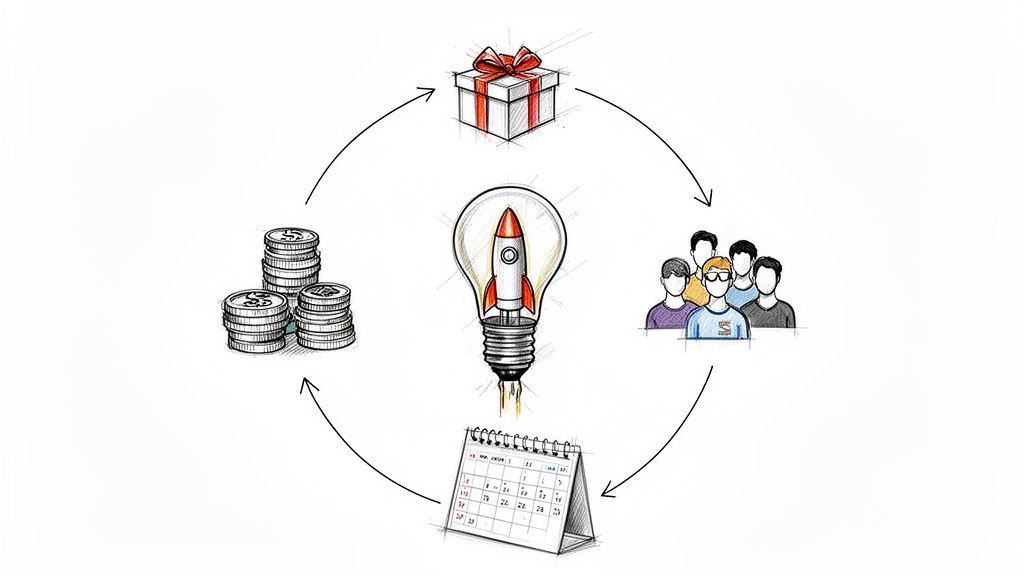
Wondering what is a Kickstarter campaign? This guide explains everything from idea to funding, showing you how creators bring their visions to life.
So, what exactly is a Kickstarter campaign? At its core, it’s a way for creators to bring their projects—whether it's a new board game, a clever gadget, or an indie film—to life with direct support from people who love the idea. Instead of pitching to traditional investors, you present your vision to a global community and offer unique rewards in exchange for their financial pledges.
If the project hits its funding goal before the deadline, it’s a go. If not, no money ever changes hands. It’s that simple.
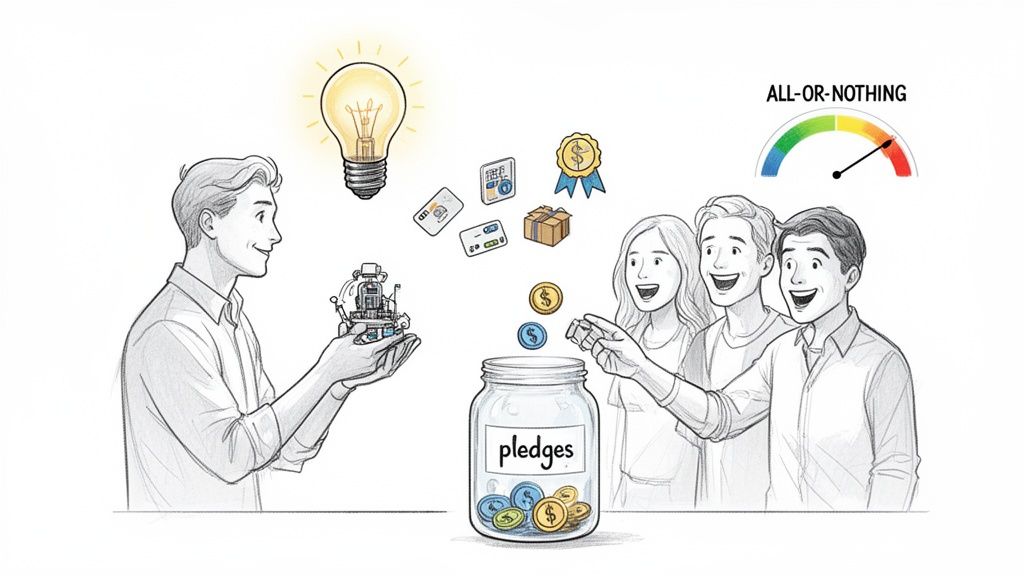
Think of a Kickstarter campaign as a massive, community-powered pre-order system. You’ve got a brilliant idea but don't have the cash to make it happen. Instead of going to a bank, you go straight to your future customers. These supporters, called backers, pledge money to help you get your project off the ground.
In return for their faith in you, backers get rewards. These can be anything from a digital thank-you note to the finished product, or even exclusive, limited-edition items you’ll never offer again. This turns the funding process into a true partnership between you and your most passionate fans, tearing down old barriers and letting anyone with a great idea build an audience and get funded.
The heart of every Kickstarter campaign is its signature "all-or-nothing" funding model. This means you have to reach your funding goal within a set timeframe (usually 30 days).
This model is genius because it minimizes risk for everyone. Backers only pay for projects with a real shot at success, and creators aren't stuck with too little money to actually fulfill their rewards.
This all-or-nothing approach creates a powerful sense of urgency and shared purpose. It encourages the community to rally behind a project, as every pledge brings the creator one step closer to making their vision a reality.
Here’s something first-time creators often overlook: the journey doesn't end when the campaign clock hits zero. In fact, that's when the real work begins. Managing thousands of backers, collecting shipping info, and coordinating fulfillment is a massive job. This is where a pledge manager becomes your best friend.
To put it in perspective, Kickstarter’s built-in tools are like a basic checkout page—functional, but limited. A dedicated pledge manager like PledgeBox, on the other hand, is like getting your own powerful storefront after the campaign ends. With a tool like this, you can easily send out backer surveys, manage add-ons, and even upsell new items to boost your funding total.
The best part? PledgeBox is free to send the backer survey and only charges 3% of upsell if there`s any. It’s a completely risk-free way to keep things organized, make fulfillment a breeze, and even raise more money after your campaign is over.
At its core, a Kickstarter campaign is built on a few key ideas every creator needs to get right. The most important one? The all-or-nothing funding model. This isn't just some arbitrary rule; it’s the engine that creates urgency and builds backer trust from the very beginning.
Here’s how it works: if you set a funding goal of $10,000 and raise just $9,999, you don’t get a dime. Every backer gets their money back, and the project doesn't go forward. This system is designed to protect everyone—backers won’t lose money on a project that can’t be finished, and creators aren't stuck trying to fulfill rewards without enough cash.
Picking the right funding goal is a careful balancing act. You need to calculate the absolute minimum you need to produce and ship your product, remembering to account for platform fees and a little extra for those inevitable surprises. A classic rookie mistake is aiming too high, which can scare off potential backers and make your goal feel impossible to reach.
Your campaign's timeline is just as critical. While Kickstarter allows campaigns up to 60 days, the sweet spot for most successful projects is a 30-day timeline. It’s long enough to build momentum but short enough to keep the pressure on. A shorter, more intense campaign helps focus your marketing efforts and keeps your community buzzing from start to finish. You can dive deeper into the nuts and bolts by exploring this guide on how Kickstarter works to fine-tune your plan.
Reward tiers are the heart and soul of your campaign’s appeal. They answer the crucial question every visitor has: "What's in it for me?" A smart set of tiers can be the difference between just getting funded and blowing past your goal, as they nudge people to pledge at higher levels.
Most winning campaigns offer a mix of options, something like this:
Hitting your initial funding goal is a huge milestone, but the fun doesn't have to stop there. Enter stretch goals. These are extra funding targets that unlock new features, better components, or cool bonuses for all of your backers once they're reached. For instance, a board game creator might add upgraded tokens at $20,000 and a whole new expansion pack at $30,000.
Stretch goals are your secret weapon for keeping the energy high after you've successfully funded. They give your community a reason to keep sharing and get excited, turning what could have been a modest success into a massive one by constantly giving them something new to root for.
Once the campaign clock runs out, the real work begins: managing all those rewards, add-ons, and unlocked stretch goals. This is where a pledge manager becomes a lifesaver. Think of Kickstarter as the "Amazon" of crowdfunding—it's great for that first transaction. A pledge manager like PledgeBox, on the other hand, acts more like your project's own "Shopify," giving you a flexible storefront to sort out the messy details of fulfillment.
Best of all, PledgeBox is free to send the backer survey and only charges a 3% fee on any successful upsells. This makes it a no-risk way to get organized, handle complex orders, and even boost your final funding total after the campaign is over.
Every successful Kickstarter campaign is much more than just a 30-day funding sprint; it's a marathon with a clear beginning, middle, and end. Think of it like a three-act play: Pre-Launch, the Live Campaign, and Post-Campaign Fulfillment. Mastering each act is the secret to a successful project.
This structured approach is why crowdfunding has seen such explosive growth. The global crowdfunding market recently hit approximately $17.72 billion and is projected to climb to $20.46 billion, showing a robust 15.5% compound annual growth rate. Forecasts predict the market will reach a staggering $38.71 billion, a clear sign that this model is reshaping how creative ideas get funded. You can explore more data on this crowdfunding market growth to understand its massive potential.
This simple timeline shows the basic flow from setting your goal, to launching the campaign, and finally getting funded.
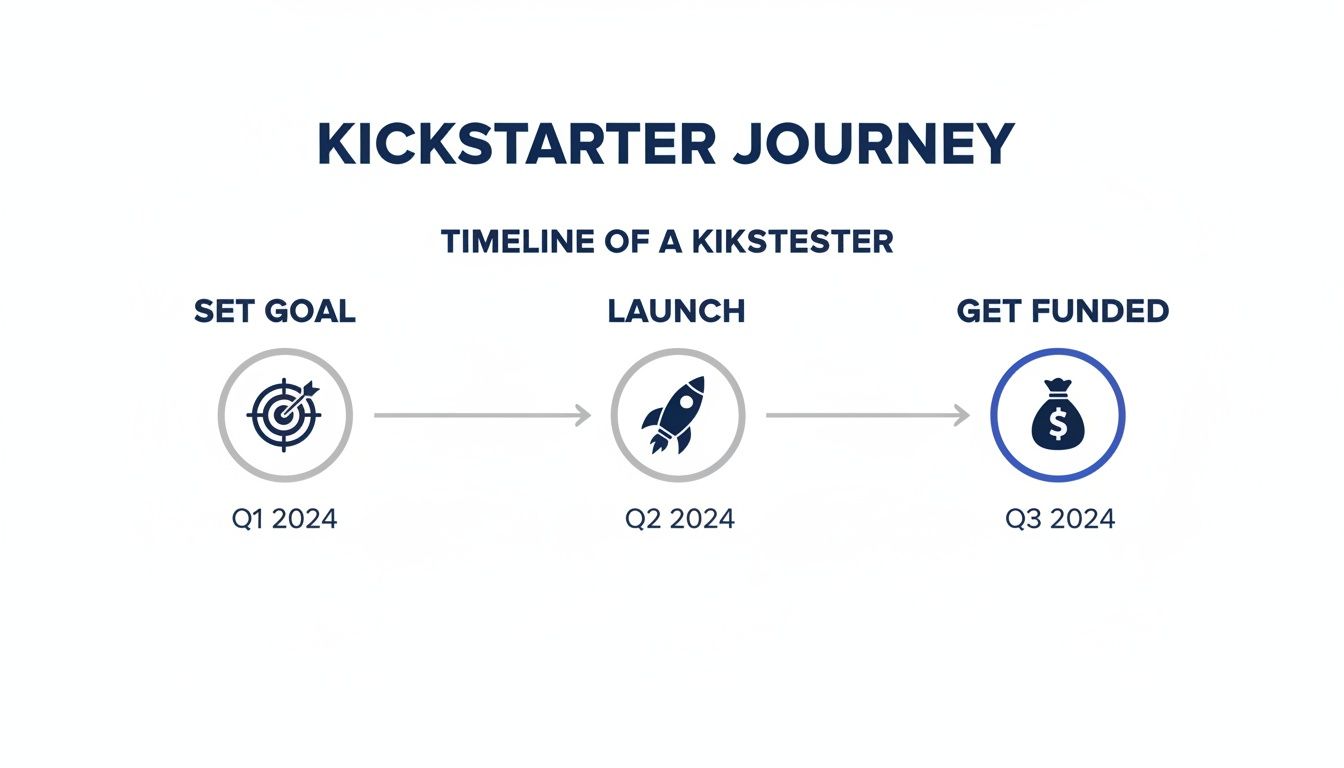
While the graphic shows a straight line, the real work happens inside each of these very different phases.
The pre-launch phase is, without a doubt, the most important stage of your entire campaign. This is where you do all the heavy lifting, turning an idea into something real and building an audience before you ever ask for a single dollar. Success on day one is almost always decided by the work you put in during the months leading up to it.
Your main goal here is to build a dedicated email list of people ready to back you. A pre-launch landing page is your best friend for this, letting you capture leads, share teasers, and see how much interest is out there. Having a crowd waiting to pledge the moment you go live creates powerful social proof and helps you get noticed by Kickstarter's algorithm.
The pre-launch isn't just about marketing; it's about preparation. This is your chance to finalize your prototype, shoot a compelling campaign video, and get quotes from manufacturers so your funding goal is realistic and your promises are achievable.
Once you hit that launch button, the 30-day (or shorter) race begins. The first 48 hours are make-or-break, as a strong start can often determine your campaign's fate. This initial surge comes directly from the email list you built during pre-launch.
After the initial excitement wears off, many campaigns hit a mid-campaign slump. This is where your communication strategy becomes everything.
This stage demands constant attention and energy. It’s a full-time job of marketing, community management, and problem-solving to keep that funding needle moving up.
Congratulations, you're funded! But as many creators will tell you, this is where the real challenge begins. The post-campaign stage is all about turning pledges into physical products delivered to backers' doorsteps, and it’s packed with logistical headaches.
This is where you collect shipping addresses, manage complex orders with different add-ons, and handle the actual shipping. Trying to manage all this data in spreadsheets is a recipe for disaster, leading to shipping errors, angry backers, and surprise costs. This is exactly why a dedicated pledge manager isn't a luxury—it's a necessity.
Think of it this way: Kickstarter pledge manager is like Amazon—great for a simple, one-time transaction. But a powerful pledge manager like PledgeBox is more like Shopify—it gives you a flexible and robust back-end to manage the complicated reality of your project.
You can seamlessly send out backer surveys to collect addresses and preferences. Crucially, it also lets you upsell add-ons, which can significantly boost your total funds raised. Best of all, PledgeBox is free to send the backer survey and only charges 3% of upsell if there`s any. This makes it a risk-free tool to ensure a smooth fulfillment process and a happy, supportive community long after the campaign clock runs out.
The timer on your Kickstarter campaign hits zero, the confetti rains down—you did it! You’re funded. That moment of celebration is incredible, but it's also the starting gun for the hardest part of the entire journey. All of a sudden, you're responsible for hundreds, maybe thousands, of backers, each with their own reward tiers, shipping addresses, and last-minute requests.
This is where the post-campaign chaos kicks in, and it's exactly why a pledge manager is the most critical tool you'll use. Many first-time creators make the mistake of trying to manage all this data with spreadsheets. It seems simple enough, but it quickly spirals into a nightmare of shipping errors, angry backers, and surprise costs that can completely wipe out your profit margins. A pledge manager is your command center for everything that comes after the funding.
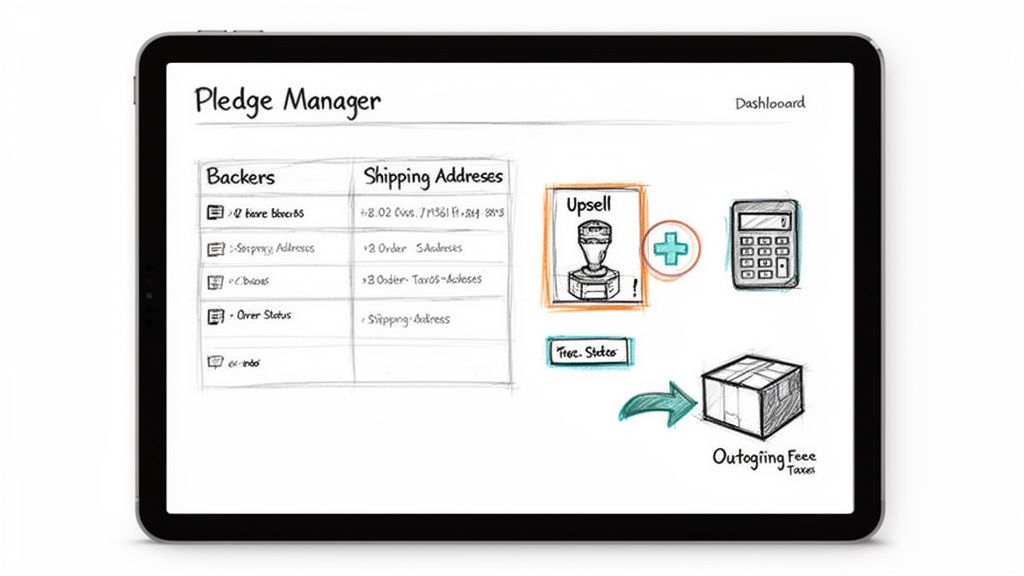
To really get why a pledge manager is so essential, think about it like this: a Kickstarter pledge manager is a lot like Amazon. They're brilliant for handling a simple, one-off transaction. A backer sees a reward, clicks a button, enters their card info, and the sale is done. It's clean, direct, and works perfectly during the live campaign.
But once the campaign ends, your needs get way more complicated. This is where a dedicated pledge manager like PledgeBox steps in, acting more like Shopify. It gives you a powerful, flexible storefront for your project after the initial sale is over. It’s built to handle the messy reality of getting custom orders out to backers all around the globe. This is a crucial distinction that successful creators understand well. To dive deeper, check out this guide on the importance of a pledge manager in Kickstarter projects.
A pledge manager isn't just a glorified spreadsheet. It's a purpose-built system designed to solve the biggest headaches that pop up after funding. It automates the tedious tasks that would otherwise eat up hundreds of hours and are incredibly prone to human error.
Here’s a quick look at what a good pledge manager does for you:
The core function of a pledge manager is to bring order to chaos. It transforms the overwhelming task of fulfillment into a manageable, step-by-step process, freeing you up to focus on manufacturing and communication.
Here's the secret weapon: a great pledge manager can actually increase your total funding after the Kickstarter campaign is officially over. This happens in two key ways that are totally impossible with Kickstarter’s native tools.
First, you can upsell add-ons. When backers are filling out their survey, you can offer them extra goodies—things like special accessories, expansions, or exclusive merch. You'd be surprised how many backers are eager to add more to their pledge, and this alone can boost your final funding total by 10-20% or even more.
Second, you can accept late pledges. There are always people who find your project a day too late. A pledge manager gives them a portal to pre-order your product, capturing sales you would have completely missed. This literally turns your fulfillment phase into a new revenue stream.
This is where a tool like PledgeBox really shines. It's designed to make this whole process seamless and—this is the best part—risk-free. PledgeBox is completely free to send the backer survey and only charges a small 3% fee on the extra funds you raise through upsells if there are any. That means you get all the organizational power at no cost, and you only pay a tiny slice of the new money you make. It’s a no-brainer for maximizing your project's success.
Ever wonder why some Kickstarter projects catch fire and become legends while others barely make a spark? There’s no secret sauce, but one thing is certain: a blockbuster campaign is never an accident. It’s built on a solid foundation of trust, smart planning, and a genuine connection with your community.
The absolute game-changer? A working prototype. Backers are smart, and they want proof that you’ve gone beyond a cool idea. A polished prototype shows you’re serious and capable, slashing the perceived risk and making it much easier for people to pledge their hard-earned cash.
Your campaign video is non-negotiable. This is your big shot to tell your story, introduce your team, and, most importantly, show your prototype in action. It doesn't need to be a Hollywood production, but it absolutely must be clear, professional, and engaging. Think of it as your most important sales pitch—it’s the first impression for thousands of potential backers.
Using persuasive advertising techniques is key here. Your story needs to resonate with people emotionally, making them feel like they're not just buying a product, but joining a movement.
Transparent and frequent communication is the currency of trust in crowdfunding. Backers are not just customers; they are your earliest investors. Keeping them updated on progress, acknowledging setbacks, and celebrating milestones together builds a loyal community that will stick with you long after the campaign ends.
If you want a masterclass in what works, look no further than the Games category on Kickstarter. It has pulled in roughly $2.63 billion in lifetime pledges, making it the platform's most-funded category by a huge margin. Following behind are Design with $1.78 billion and Technology with $1.66 billion.
Just look at the runaway success of Exploding Kittens. The creators built an enormous community by being funny, transparent, and incredibly active with their backers. They used stretch goals brilliantly, not just to add more cool stuff but to keep the conversation alive, turning their backers into passionate evangelists for the game.
When you boil it down, success hinges on getting a few core things right. These are the common threads you’ll find in almost every breakout campaign.
Nailing these fundamentals helps you sidestep the common traps that sink so many other projects. For a more detailed playbook, check out our deep dive on what sets a flourishing crowdfunding campaign apart from a disappointing one. By focusing on these strategies, you can give your own campaign a much better shot at success.
With all the work that goes into a campaign, you might be asking yourself: is it really worth it? The numbers speak for themselves. Since launching in 2009, Kickstarter has hosted over 651,000 projects, with backers from all over the world pledging a massive $8.53 billion.
What's even more telling is the platform's consistent success rate of 41.98%. That means more than four out of every ten projects actually hit their funding goals. You can dig deeper into crowdfunding platform statistics on electroiq.com to see the trends.
These stats prove Kickstarter isn't just a launchpad; it's a legitimate pathway for turning great ideas into reality. But here’s the catch: success isn't handed to you. It belongs to the creators who plan every detail and execute flawlessly from pre-launch all the way through fulfillment.
A successful campaign is only half the battle; what comes after is just as important. When you’re deciding if Kickstarter is right for you, think about your business model and how it will handle a rush of orders. For example, using a scalable approach like the print on demand business model can make a huge difference in your campaign's profitability and overall success. This kind of planning is what separates a one-hit wonder from a sustainable business.
Victory on Kickstarter belongs to those who prepare. By streamlining complex logistics and maximizing revenue opportunities after the campaign, you can significantly improve your odds and turn a good project into a great one.
Choosing the right tools to manage everything after the campaign is just as critical as running the campaign itself. This is where a powerful pledge manager comes in. Think of the Kickstarter pledge manager like Amazon—it’s simple and gets the initial transaction done. But a dedicated pledge manager like PledgeBox is more like Shopify, giving you a flexible and powerful storefront to manage your project’s entire backend.
This difference is key to getting the most out of your campaign. With the right tool, you can not only handle logistics smoothly but also boost your total funds raised. And since PledgeBox is free to send the backer survey and only charges 3% of upsell if there`s any, it’s a smart financial choice that turns post-campaign management into another way to earn.
Even with a solid plan, first-time creators always have questions about the nuts and bolts of running a Kickstarter campaign. Getting your head around the costs, what happens if things don't go to plan, and the tools you'll need is key to moving forward with confidence. Let's tackle some of the most common questions head-on.
Budgeting for a Kickstarter campaign goes way beyond just the cost of making your product. First, Kickstarter takes a 5% platform fee from all successfully funded projects. On top of that, their payment processor, Stripe, will charge another 3-5% in processing fees.
But the platform fees are just the beginning. You also need to budget for:
One of the biggest mistakes creators make is underestimating post-campaign costs. Using a pledge manager is a lifesaver here. It helps you accurately collect shipping fees and can even boost your budget with last-minute upsells, giving you the cash you need to get everything delivered.
Kickstarter runs on an "all-or-nothing" funding model. If you don't hit your funding goal by the deadline, no money changes hands. Period. Backers aren't charged, and you don't receive a single dollar.
While this might feel like a failure, it’s actually a safety net for everyone. It stops you from getting stuck with a pile of money that isn't quite enough to actually make and ship your product. Instead, you get a chance to step back, figure out what went wrong, and relaunch with a better product, a smarter marketing plan, or a more realistic funding goal.
Absolutely—and you definitely should be planning for it. The moment your campaign ends is a golden opportunity to bring in more funding. A good pledge manager lets you accept "late pledges" from people who missed the deadline but still want to buy in. It also gives your original backers a chance to grab extra add-ons when they fill out their surveys.
This simple step turns the boring logistics of fulfillment into another chance to make sales, capturing revenue that would have otherwise been lost.
This is where the difference between Kickstarter's pledge manager and a dedicated pledge manager really shines. Think of it this way: if a Kickstarter pledge manager is like Amazon for your initial fundraising, a pledge manager like PledgeBox is your own Shopify store afterward. It gives you a flexible platform to manage backers and keep the sales coming. Best of all, PledgeBox is free to send the backer survey and only charges 3% of upsells if there are any, making it a no-brainer for maximizing your project's success.
Ready to make your post-campaign process a breeze and boost your funding at the same time? PledgeBox gives you all the tools you need to manage surveys, upsell add-ons, and handle fulfillment without the headache. Get started for free today and see how PledgeBox can help your campaign succeed.
PledgeBox
The All-in-One Toolkit to Launch, Manage & Scale Your Kickstarter / Indiegogo Campaign