 PledgeBox
The True Definition Of Kickstarter And How It Really Works
Discover the complete definition of Kickstarter, from its all-or-nothing model to post-campaign tools that manage surveys, backers, and upsells.
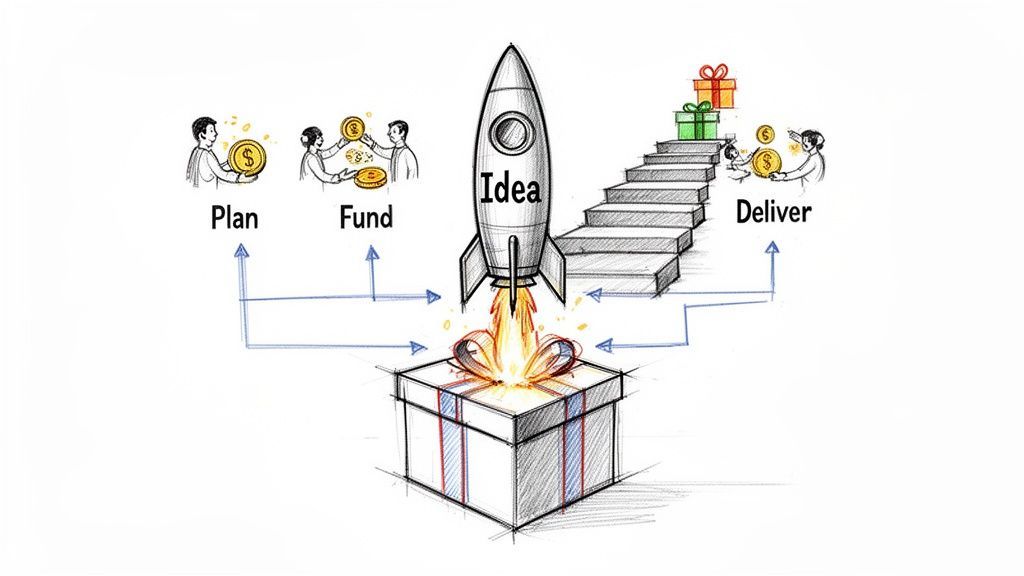
Discover the complete definition of Kickstarter, from its all-or-nothing model to post-campaign tools that manage surveys, backers, and upsells.
So, what exactly is Kickstarter? The simple answer is that it's a global crowdfunding platform. But that's a bit like calling a rocket ship just a vehicle. It misses the magic.
At its heart, Kickstarter is a launchpad for creative ideas. It's the place where inventors, artists, designers, and game developers can bring their vision directly to the people who will love it most.
Since launching in 2009, Kickstarter has grown into one of the largest ecosystems for creative projects on the planet. By January 2025, it had already helped fund over 651,000 projects. That massive scale is a huge part of its appeal—with around 27.3 million monthly visits, it’s a high-traffic discovery engine where passionate backers come looking for the next big thing.
Even with its strict, all-or-nothing funding model, the platform boasts an overall success rate of 41.98%. For a deeper look at how it all works, check out our guide on the Kickstarter platform.
What really sets it apart is that it’s built on rewards-based crowdfunding. Instead of giving up equity or shares in their company, creators offer backers tangible rewards—like an early version of a product, a limited edition book, or exclusive access. It's a fantastic way to validate an idea and build a community at the same time. If you're new to the space, it's worth taking time for understanding crowdfunding platforms like Kickstarter.
To get a clearer picture of the moving parts, here’s a quick breakdown of the core concepts you’ll encounter on the platform.
| Concept | Brief Explanation |
|---|---|
| Project | The creative idea you're trying to fund—a game, a film, a gadget, etc. |
| Creator | The person or team behind the project. |
| Backer | An individual who pledges money to support a project. |
| Funding Goal | The minimum amount of money the creator needs to bring the project to life. |
| Pledge | The money a backer contributes to a project. |
| Rewards | The tangible (or intangible) items that backers receive for their pledge. |
| Campaign | The set period of time (1-60 days) during which a project is live and can accept pledges. |
| All-or-Nothing Funding | The rule that a project must reach its funding goal to receive any money. |
These terms form the foundation of every campaign. Once you grasp them, the entire process becomes much more straightforward.
It helps to think of Kickstarter’s role using an analogy. Imagine the Kickstarter pledge manager is a giant, bustling marketplace like Amazon. It has a massive, built-in audience of shoppers who are actively looking for new and exciting things to buy. This is where your idea gets discovered and funded.
But once your campaign is a success, your needs change. You're no longer focused on discovery; you need to manage relationships and logistics. This is where a pledge manager comes in, acting more like your personal Shopify store. It gives you a dedicated space to interact directly with your backers, manage their pledges, and handle the nitty-gritty of getting rewards delivered.
A pledge manager is a crucial post-campaign tool. It handles detailed backer surveys, collects shipping information and fees, and allows for post-campaign upsells to increase your total funds raised.
PledgeBox is a perfect example of this. It's free to send the backer survey, which is a huge benefit for creators managing a tight budget. PledgeBox only charges a small 3% of upsell if there's any. It’s a risk-free way to streamline your fulfillment, keep your backers happy, and even boost your bottom line after your Kickstarter campaign has already succeeded.
The single most defining feature of Kickstarter is its all-or-nothing funding model. This isn't just a rule; it's the very engine that powers the platform's unique energy. The idea is simple but incredibly powerful: you set a funding goal and a deadline.
If you hit or beat that goal by the deadline, you get to collect all the money your backers pledged. But if you fall short—even by a single dollar—no money changes hands. Backers aren't charged, and you receive nothing.
This high-stakes approach creates a powerful sense of urgency and shared purpose. For creators, it means you have to set realistic goals and market your project effectively. For backers, it removes the risk of throwing money at a project that can't actually get made, building a crucial foundation of trust right from the start.
This all-or-nothing system is a huge part of the modern definition of Kickstarter because it directly influences how people behave. It turns someone who is just passively interested into an active supporter. Backers know their pledge only counts if everyone pulls together to meet the goal, which encourages them to share the project and help it succeed.
It also acts as a fantastic market validation tool. If your idea gets enough traction to hit its funding target, you have a crystal-clear signal that people actually want what you're creating. That’s invaluable data for any new venture.
The all-or-nothing model isn’t a bug; it’s a feature. It protects backers from half-funded projects and forces creators to prove there’s a genuine audience for their idea before a single dollar is collected.
This model also forces creators to think ahead about what comes next, from how they'll design their surveys to the fulfillment tools they'll need. If a project fails, creators get $0 and backers are never charged. And while the platform-wide success rate hovers around 41.98%, this model is exactly why a well-planned campaign is so critical. You can find more crowdfunding insights over at Grasshopper.com.
Hitting your goal with an all-or-nothing campaign instantly pivots your focus from fundraising to logistics. Suddenly, you have a community of backers who trusted you with their money and are now eagerly waiting for their reward-based crowdfunding perks. To dig deeper, you can learn more about reward-based crowdfunding strategies in our detailed guide.
Here's a good way to think about it: the Kickstarter pledge manager is like Amazon—a huge marketplace for discovery and making that initial transaction. A pledge manager like PledgeBox, on the other hand, is like your own personal Shopify store. It gives you direct control over the relationship with your customers after the sale is complete.
With PledgeBox, you can send your backer survey for free, which is a massive help when you're trying to manage your budget. The platform only charges a small 3% of upsell if there's any. This makes it a risk-free tool for streamlining fulfillment, giving your backers a great experience, and even boosting your overall profit after the campaign clock runs out. Making that transition smooth is absolutely essential for turning a funded idea into a finished product in your backers' hands.
Numbers often tell a story that words alone can't. To really get a feel for what Kickstarter is today, you have to look at the data—especially how it stacks up against its main competitor, Indiegogo. This perspective makes it crystal clear why so many creators trust Kickstarter for their biggest launches.
When you compare the financial results, Kickstarter is in a league of its own. A deep dive into thousands of campaigns revealed that the average project on Kickstarter raises 2.35 times more money than one on Indiegogo. The typical campaign pulls in around $9,835, which is a huge leap from Indiegogo's average of $4,182.
The difference gets even bigger when you look at major funding milestones. A project’s chance of hitting $10,000 is nearly three times higher on Kickstarter (14%) than on Indiegogo (5%). For those shooting for the stars with a $100,000 goal, Kickstarter offers a 1.5% shot at success, versus just 0.4% on Indiegogo.
These aren't just numbers on a spreadsheet; they have a real impact on how you plan your campaign and what you can achieve. For creators in competitive categories like technology or tabletop games, the larger and more engaged audience on Kickstarter is a game-changer.
A higher average pledge and a better shot at success mean you can set more ambitious goals with a lot more confidence. To make the most of this, creators often find it helpful to start by developing a robust data analysis plan to guide their strategy from day one.
The image below shows the core difference in funding models that drives these results, comparing Kickstarter's All-or-Nothing model with more flexible options.
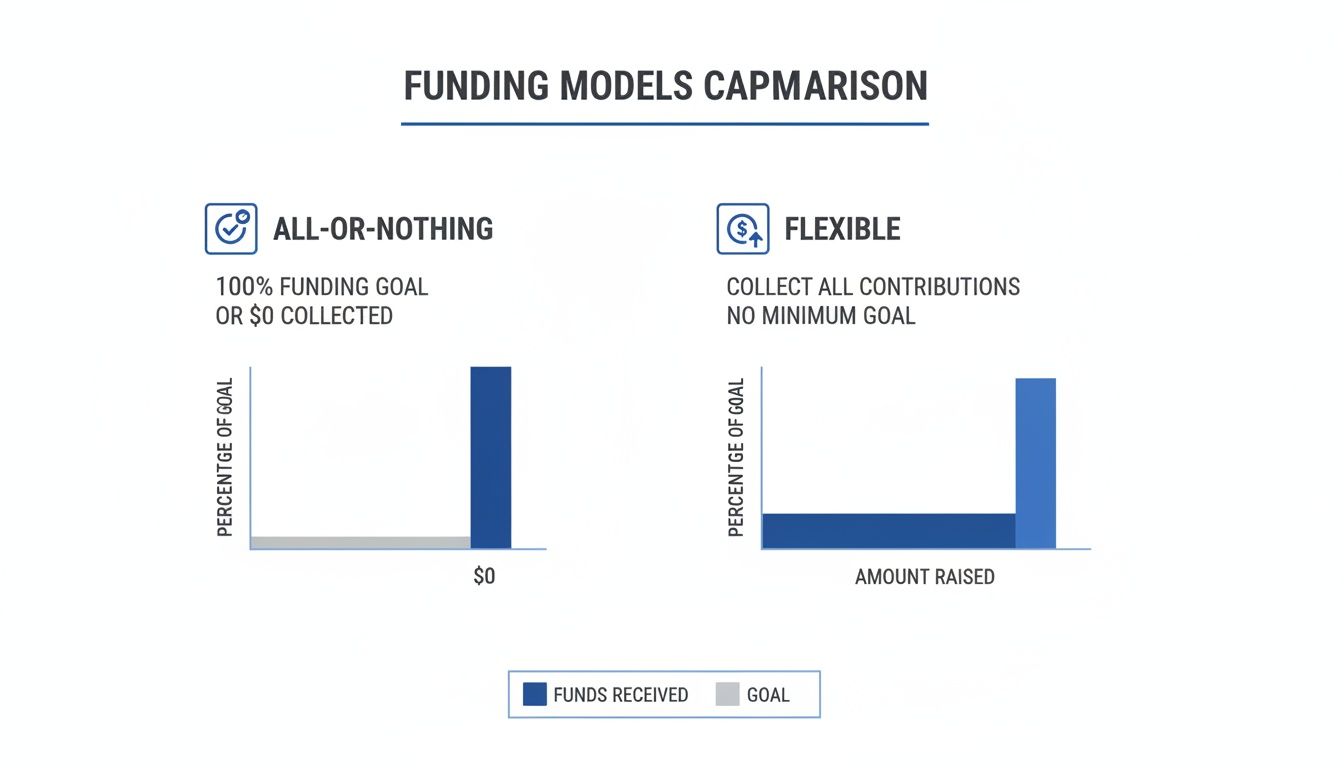
This visual gets to the heart of it: Kickstarter's model guarantees projects are fully funded before any money changes hands. This creates a low-risk environment for backers and proves there's real market demand. The data strongly suggests this high-stakes approach attracts a more committed community, leading to those higher funding totals.
To put these differences in a clearer context, here is a direct comparison of key performance indicators between the two leading crowdfunding platforms.
| Metric | Kickstarter | Indiegogo |
|---|---|---|
| Average Funds Raised | $9,835 | $4,182 |
| Probability of Raising $10k+ | 14% | 5% |
| Probability of Raising $100k+ | 1.5% | 0.4% |
This data illustrates why Kickstarter often emerges as the preferred choice for creators aiming for significant funding goals, as it consistently demonstrates a higher potential for financial success across the board.
The incredible success driven by Kickstarter's marketplace also creates a new set of hurdles once the campaign wraps up. Suddenly, you're faced with managing a huge backer community, collecting precise order details, and sorting out complex shipping logistics—tasks that can quickly overwhelm the platform's basic built-in tools.
Think of the Kickstarter pledge manager as the Amazon for crowdfunding—it brings you a massive audience and handles the initial sale. But once that's done, you need a specialized tool like Shopify to manage everything that comes after. A pledge manager like PledgeBox fills this role perfectly.
This is exactly where a dedicated tool like PledgeBox becomes essential. While Kickstarter is fantastic for getting funded, PledgeBox provides the backbone for managing everything that follows.
Best of all, PledgeBox is free to send the backer survey; it only charges a 3% of upsell if there's any. This model lets you streamline your entire post-campaign operation without any upfront costs, turning a potential logistical nightmare into a fresh opportunity for more revenue.
Hitting your funding goal on Kickstarter isn’t the finish line—it’s the starting gun. That moment of celebration is amazing, but it also kicks off what is easily the most critical phase of your project. The real work starts now.
This post-campaign period often catches new creators by surprise. Your job description instantly changes from marketer and storyteller to logistics manager and fulfillment expert. This is where a great campaign becomes a truly successful one—by turning those pledges into real, delivered products in your backers' hands.
The first major hurdle is getting the right information from every single backer. Kickstarter’s built-in survey tool is fine if you're asking something simple, like "What color t-shirt do you want?" But it just doesn't cut it for campaigns with multiple product versions, add-ons, or complex shipping needs.
This is where the platform's limitations start to show. Trying to manage hundreds or thousands of individual orders with spreadsheets is a surefire way to make costly mistakes and cause frustrating delays. You need a system that can actually handle:
Here’s the best way to think about this shift. Think of the Kickstarter pledge manager as Amazon—a massive marketplace with tons of traffic, perfect for getting your project discovered and making that initial "sale." It's brilliant at building an audience and proving your idea has legs.
But once the campaign is over, you need a different kind of tool. This is where a pledge manager like PledgeBox comes in, acting as your own personal Shopify store. It gives you direct control over your backer relationships, order management, and all the fulfillment logistics. It’s the professional backend you need to run your new business.
A dedicated pledge manager moves you from the public marketplace of Kickstarter to your own private, controlled fulfillment hub. This transition is essential for keeping momentum and delivering on your promises without getting buried in spreadsheets.
This is exactly why specialized tools are so important. PledgeBox turns a logistical nightmare into a smooth, manageable workflow. Best of all, PledgeBox is free to send the backer survey, so there’s no upfront financial risk. It only charges a small 3% of upsell revenue if there's any, making it a powerful, risk-free partner for your post-campaign journey.
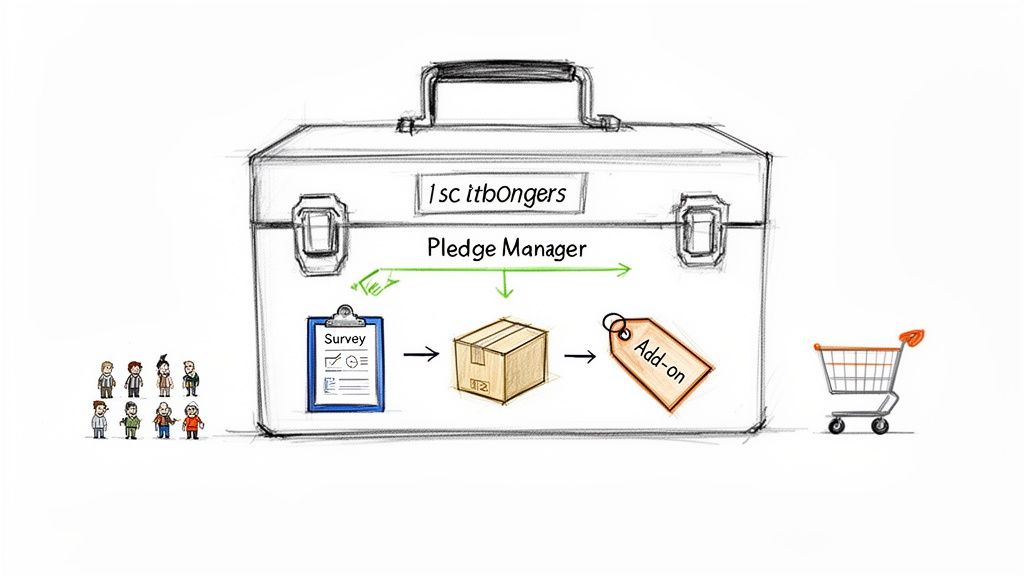
Once your Kickstarter campaign hits its funding goal, the real work begins. The celebration is short-lived because your job instantly pivots from fundraising to fulfillment, and the tools you need have to change right along with it. This is exactly where a pledge manager steps in, becoming your mission control for the complex logistics that Kickstarter's native tools just aren't built to handle.
So, what is a pledge manager? It's a specialized platform that picks up right where Kickstarter leaves off, helping you manage all the critical backer information after the campaign ends. It gives you a powerful dashboard to get rewards into your backers' hands without pulling your hair out.
A good pledge manager is designed to solve the most common—and frustrating—headaches that creators face post-campaign. You can dive deeper into the importance of pledge managers in Kickstarter projects in our detailed guide.
While Kickstarter offers a basic survey tool, it's often too rigid for the needs of a modern, complex campaign. A dedicated pledge manager, on the other hand, comes loaded with features that not only make your life easier but can actually increase the total funds you raise.
To put it simply, think of it like this: The native Kickstarter pledge manager is like Amazon, good for bringing in an audience and handling the initial transaction. In contrast, the PledgeBox pledge manager is like a full-featured Shopify store—it’s flexible, powerful, and gives you direct control to customize the backer experience and maximize your results.
PledgeBox also offers a unique, risk-free model that creators love. It is free to send the backer survey, and we only charge 3% on the upsell revenue, if there is any. This means you can manage your fulfillment like a pro with zero upfront cost, paying only a small fee on the new money you generate.
Even after you get the hang of what Kickstarter is, a lot of practical questions pop up. Getting a handle on the fees, rules, and post-campaign tools is what separates a good launch from a great one.
Kickstarter keeps its fee structure pretty simple. For any successfully funded project, they take a 5% platform fee. On top of that, you’ll have payment processing fees from Stripe, which usually land somewhere between 3-5%.
The good news? These fees only apply if you hit your funding goal. It’s all part of their all-or-nothing model, so you won’t owe a dime if the campaign doesn't make it.
Yes, but with some big exceptions. You can tweak your project’s story and add new FAQs anytime after you go live. But the really crucial stuff—like your funding goal, campaign deadline, and any reward tiers that already have backers—are locked in.
This isn’t Kickstarter being difficult; it’s about maintaining trust and transparency with the community who has already put their money behind your idea.
Honestly, even for simple campaigns, using a pledge manager is a game-changer. Think of it this way: the Kickstarter pledge manager is like a giant marketplace (like Amazon) where people discover your project. A pledge manager like PledgeBox is more like your own storefront (think Shopify), giving you direct control over managing your relationship with your backers after the campaign ends.
A tool like PledgeBox is free to use for sending out your backer surveys. They only charge 3% of upsell if there's any, making it a completely risk-free way to smooth out your fulfillment and even boost your revenue.
Ready to streamline your post-campaign process and delight your backers? With PledgeBox, you can manage surveys, collect shipping fees, and boost revenue with powerful upsell features, all without any upfront cost. Get started for free today and see how easy fulfillment can be.
PledgeBox
The All-in-One Toolkit to Launch, Manage & Scale Your Kickstarter / Indiegogo Campaign