 PledgeBox
How to Build a Dungeon for Your TTRPG
Learn how to build a dungeon that captivates your players. Our guide covers storytelling, map design, monster encounters, and puzzles for your TTRPG.
Learn how to build a dungeon that captivates your players. Our guide covers storytelling, map design, monster encounters, and puzzles for your TTRPG.
If you want to build a dungeon that truly sticks with your players, you have to start with one simple question: Why does it even exist?
A great dungeon isn't just a string of rooms filled with monsters. It’s a place with a story, a clear purpose, a history, and a theme that ties it all together. Getting this foundation right is easily the single most important step of the whole design process.
Before you even think about sketching a single corridor, you need to nail down the core concept. This is your narrative anchor. It's the big idea that will guide every decision you make, from the dungeon's layout and its inhabitants to the loot they find at the very end.
Without a strong 'why,' your dungeon will feel like a random mishmash of encounters instead of a believable, immersive place. It’s the difference between a generic cave and the forgotten tomb of a betrayed king, now haunted by his vengeful spirit.
This stage is all about turning a cool idea into a working framework for an adventure. You're not just brainstorming what the dungeon is now, but what it was and why it's still around. Think of it like building a prototype; you’re creating the blueprint that makes sure the final product is both fun and makes sense. For anyone trying to bring a new game to life, this process is key. You can find out more about turning an idea into a solid plan by checking out our guide to crafting your crowdfunding prototype.
The theme is your dungeon's personality—its overall vibe and atmosphere. It’s the feeling players get as they creep through its halls. Is it an abandoned dwarven mine, a shimmering cavern of living crystals, or a wizard's tower flash-frozen in the middle of a magical catastrophe?
A solid theme makes your creative choices so much easier. For instance:
Every place has a history. Was this dungeon built by someone, or did it form naturally? Who lived here before the current occupants, and what drove them out? Figuring out these details adds incredible depth, which players can discover through clues you leave behind. A mess hall left in a state of sudden chaos tells a very different story than an altar prepared for a dark ritual.
A dungeon's history isn't just flavor text; it’s the wellspring of its puzzles, secrets, and soul. The story of what happened here before is what makes players care about what happens next.
Finally, you need to establish its current purpose. Why are the players here now? Are they hunting for a legendary artifact, rescuing a captured ally, or trying to stop an ancient evil from reawakening? This purpose becomes the adventure's driving force and makes sure your dungeon plays a meaningful role in your bigger story.
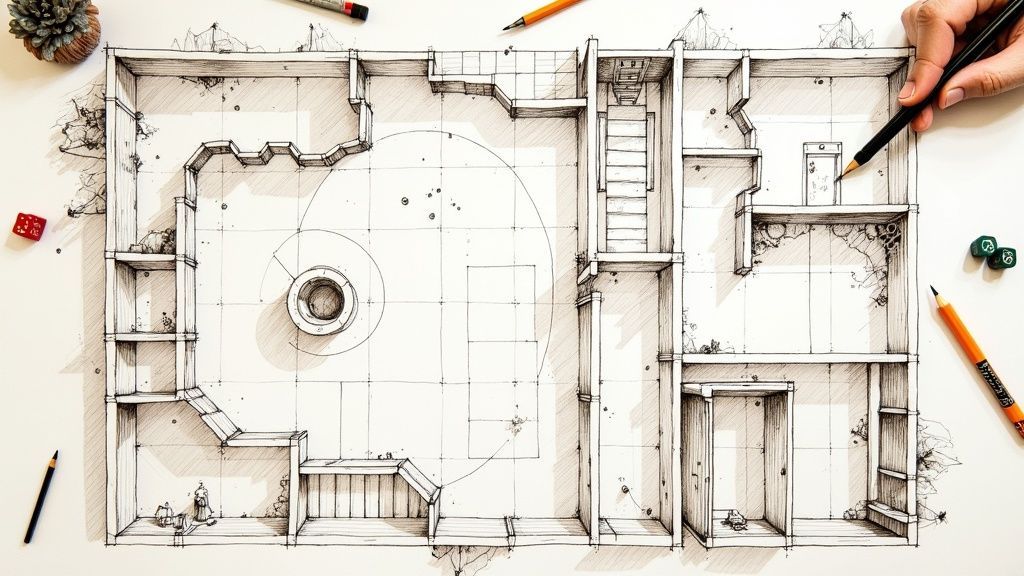
Once your core concept is locked in, it’s time to start sketching. A dungeon's layout is so much more than a bunch of connected rooms—it's the very architecture of your players' experience. It dictates the pacing, guides the story, and makes the difference between an exciting delve and a tedious slog.
This is where you start translating your ideas into a physical space your players can navigate. Should you lead them down a straightforward, linear path to build tension? Or would a sprawling network of corridors better capture that classic feeling of open-ended exploration? Each choice shapes the adventure in a different way.
This visual breaks down how your theme and purpose naturally flow into your layout decisions.
The big takeaway here is that a strong concept almost designs the dungeon for you. When the layout feels logical and purposeful, it pulls your players deeper into the world.
The flow of your dungeon has a huge impact on how it plays. Different styles are better for certain kinds of stories, so let’s look at the strengths of the most common approaches.
Pro tip: The best layouts often mix and match these styles. A mostly linear dungeon might have a small looping section that lets clever players flank a tough group of enemies. It makes the world feel alive and rewards smart thinking.
A flat, one-level dungeon can get old fast. Introducing verticality—things like staircases, deep pits, rickety rope bridges, or flooded lower levels—instantly adds a sense of scale and danger. It makes the space feel more three-dimensional and realistic, especially for underground locations. There's a reason the real-world underground construction market was valued at USD 23.12 billion in 2023—people are fascinated by what lies beneath. You can find out more in these underground bunker construction market reports.
And of course, a dungeon just isn't a dungeon without secrets. Hidden passages, illusory walls, and cleverly disguised traps are what make exploration truly rewarding. A great secret door shouldn't just hide some extra gold; it should offer a tactical advantage in a future fight or reveal a critical piece of the dungeon's forgotten history. These kinds of discoveries make your players feel brilliant and turn your dungeon from a simple backdrop into an interactive puzzle waiting to be solved.

A dungeon's layout gives it a body, but its inhabitants give it a soul. Filling your creation isn't about just dropping monsters into empty rooms. It's about building a believable, breathing ecosystem where every creature, trap, and piece of treasure has a reason to be there. This is how you turn a static map into a living, dangerous world.
Each encounter needs to reinforce your dungeon's core theme. The goblins in that derelict mine aren't just there for a fight—they’re scavengers who’ve jury-rigged old mining equipment into crude defenses. That one detail makes the world feel infinitely more real.
When it comes to populating your dungeon, think of it like stocking a unique storefront for your players. For creators who use crowdfunding, this stage is a lot like setting up a post-campaign pledge manager. Kickstarter is like Amazon, a massive one-time marketplace, but a pledge manager like PledgeBox is like Shopify, giving you your own custom shop to offer add-ons and manage your audience directly. It’s also good to know that PledgeBox is free to send the backer survey and only charges 3% of the upsell revenue if there's any.
The best encounters feel like they belong. Don't just flip open a monster manual and pick something that looks cool. Think about what would logically live in this specific environment you've created.
Coming up with creative names is essential for making your monsters and NPCs memorable. If you're stuck, an external tool like an AI Dungeons & Dragons name generator can be a huge help.
A truly memorable encounter is more than just a fight; it's a story beat. It should reveal something new about the dungeon, its history, or the forces at play within it.
Traps should never feel like random "gotcha" moments. They are logical defenses placed by the dungeon's inhabitants. Goblins would use simple pit traps and tripwires. A paranoid wizard, on the other hand, would protect their laboratory with complex magical runes. A good trap challenges the players' ingenuity, not just their hit points.
The same logic applies to treasure. A monster's hoard should reflect its intelligence and habits. A mindless ooze might have a few valuable coins accidentally absorbed into its body, while a cunning dragon would guard its wealth in the most secure part of its lair. Rewards should always feel earned.
To build a well-rounded experience, it's helpful to think of encounters in three core categories. Each one serves a different purpose, testing a different aspect of the party's skills and keeping the pacing fresh.
By carefully considering why each element is there, you create a dungeon that feels coherent, challenging, and alive. You ensure your players aren't just exploring a map—they're delving into a story.
Sure, combat and traps are the bread and butter of any good dungeon crawl. But what truly makes a dungeon stick in your players' minds are the moments that test their wits and pull at their heartstrings. This is your chance to elevate a simple monster-bashing session into a living, breathing story.
By weaving in clever puzzles and subtle environmental details, you encourage your players to slow down, look around, and actually engage with the world you've built. It’s what separates a forgettable map from a legendary location.
Think about it—building a dungeon is a massive undertaking, even a magical one. In the real world, the global construction industry employs over 100 million people. As of October 2024, the U.S. alone had around 8.3 million people in construction jobs, which gives you an idea of the sheer scale of building anything. You can find more cool facts about trends in the construction sector that might just inspire your next dwarven hold.
A good puzzle should never feel like a random roadblock dropped in the players' path. Instead, it should feel like an organic part of the dungeon's logic—maybe it's an ancient security system, a ritualistic lock, or a natural phenomenon the party has to navigate.
The best puzzles reward observation and teamwork, and even better, they can be solved in more than one way. This allows different characters to shine.
Here are a few ideas to get you started:
The point of a puzzle isn't to stump your players into submission. It's to make them feel like geniuses when they figure it out. Always have a backup clue or two in your pocket just in case they get truly stuck.
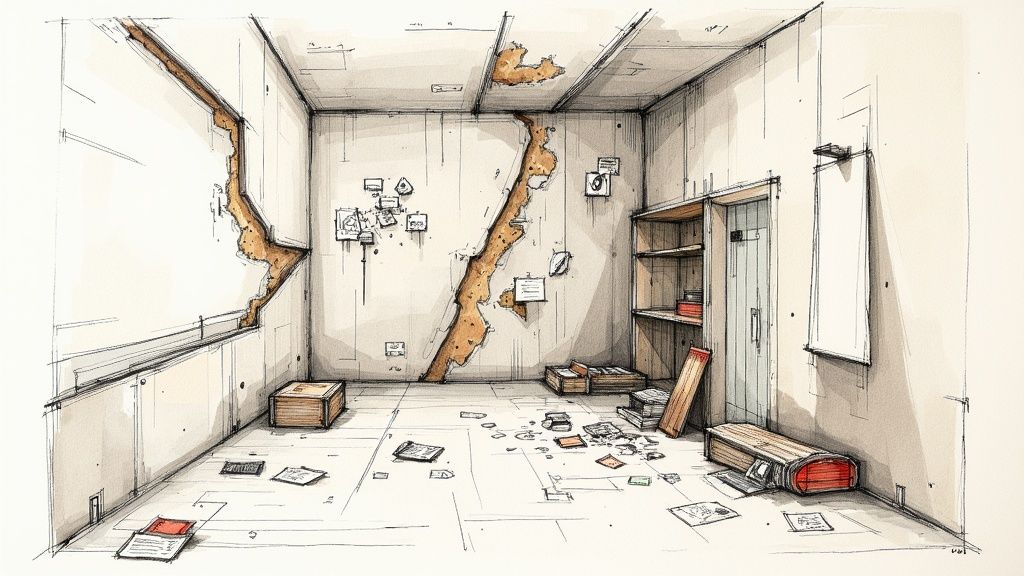
This is the art of showing, not telling. Environmental storytelling lets you feed your players lore and history without a single dreaded monologue from an NPC. It’s all in the details.
A mess hall with plates of moldy, half-eaten food tells a story of a sudden catastrophe. A series of faded tapestries depicting a forgotten king hints at the dungeon’s original noble purpose. These little clues make the space feel real and lived-in.
This is also your secret weapon for making the adventure personal. Imagine the party finding a crumbling statue that looks just like one of the player character's ancestors. Or a series of journal entries written by a mentor they thought was long gone.
By weaving your players' backstories and the main plot hooks directly into the scenery, exploration becomes more than just looking for loot. It becomes a personal journey, creating a rich, immersive world they won't soon forget.
Let's be honest: no dungeon design, no matter how clever you think it is, ever survives first contact with the players. This final stretch—playtesting and refining—is where your architectural blueprint transforms into a genuinely fun experience. It's the critical step that separates a frustrating slog from a legendary adventure.
You can spend weeks perfecting a layout, but until real people are interacting with it, it's all just theory. This is your quality assurance phase, the final shakedown to catch problems before they ruin game night.
Before you even think about gathering your players, do a dry run inside your own head. "Walk through" the dungeon from their perspective, not your own as the all-knowing creator. This is your chance to be your own harshest critic.
Ask yourself some tough questions at every turn:
Running through this checklist helps you spot the most glaring issues before they ever hit the table. At the end of the day, it's all about crafting a user-friendly gameplay experience.
The goal of playtesting isn't to prove your design is perfect; it's to find its flaws so you can fix them. A resilient dungeon is one that has been pressure-tested.
Getting direct feedback from other humans is absolutely invaluable. You can run the dungeon as a one-shot with a fresh group or even just ask a friend to look over your notes. The trick here is to listen without getting defensive.
If your players get hopelessly stuck on a puzzle you thought was a piece of cake, that’s not on them—it means your clues weren't clear enough. Their confusion is your opportunity to improve.
After a test run, structured feedback is your best friend. You’ll want to know what was fun, what was frustrating, and what just plain didn't make sense. For a deeper dive, our guide on designing an effective survey for playtest feedback has some great pointers.
Ultimately, learning to build a great dungeon is a process of trial and error. You have to embrace the unexpected. Because when your players inevitably do something you never, ever anticipated, don't panic—adapt. Those moments of improvisation are what turn a well-designed map into a living, breathing world.
When you're first getting your hands dirty building a dungeon, it’s natural for a bunch of questions to pop up. Even seasoned Game Masters hit creative walls or just need a gut check to know they're on the right path. Let's tackle some of the most common ones.
The honest answer? It depends entirely on your goal and how much time you have at the table. There’s no magic number, so it’s much more useful to think in terms of game sessions.
My advice? It's always better to build a small, memorable dungeon packed with meaningful choices than a massive, sprawling one that feels empty and becomes a slog. Start with a scope that feels exciting, not intimidating.
Forget what you've heard about complex combat math. Real balancing is about managing the pacing of your session and the resources of your players. Not every single fight should be a knock-down, drag-out battle that leaves the party gasping for air.
The key is variety.
Throw in some easier fights to let your players feel like heroes and flex their cool abilities. Then, follow up with a medium-difficulty puzzle or combat that makes them burn a few spell slots or daily powers. You save the truly gut-wrenching, epic boss encounters for those big, climatic moments. That way, they feel earned.
And don't forget the environment is your best friend. A handful of weak goblins on a narrow, crumbling bridge over a chasm is suddenly a much more interesting—and dangerous—problem to solve.
The secret to a dungeon that your players will talk about for years is a strong, cohesive theme. You have to push past generic labels like "a fire cave" and get specific.
Think about it: "a volcanic cave system being used as a demonic forge by blood-obsessed cultists." Doesn't that immediately spark a dozen more interesting ideas than just "fire cave"?
Once you have that core concept, make sure every single element reinforces it.
That kind of thematic consistency is what makes a location feel like a real, living place. It's an absolutely essential skill, especially for creators planning to publish their worlds as TTRPG books or board games. If you're thinking about taking that next step with a project, our guide to crowdfunding for games has some great insights.
Bringing a creative project from a cool idea to a finished product in your backers' hands takes serious organization. PledgeBox gives you the tools to manage your backers, send out surveys, and even boost your funding with post-campaign upsells. Find out how PledgeBox can help you streamline your next project.
PledgeBox
The All-in-One Toolkit to Launch, Manage & Scale Your Kickstarter / Indiegogo Campaign